
Your Seattle office’s air quality directly affects how well your team thinks and works. When commercial air quality drops, employees struggle with focus, experience headaches, and their productivity suffers.
We at Bumble Bee Cleaning Services know that poor ventilation and high CO2 levels are silent productivity killers. This guide shows you how to spot air quality problems and fix them fast.
How Poor Air Quality Silently Damages Your Team’s Performance
Your Seattle office’s air quality directly controls whether employees can concentrate or not. Research from Harvard T.H. Chan School of Public Health shows that cognitive function deteriorates measurably as CO2 rises from typical outdoor levels to common office concentrations. When CO2 levels climb above 640 ppm, employees experience slower processing speed, worse decision-making, and reduced creative thinking. The problem worsens in poorly ventilated spaces because stale air accumulates pollutants faster. Most Seattle offices operate around 0.6 air changes per hour, which sounds adequate until you consider that inadequate ventilation allows CO2 to spike during occupied hours.
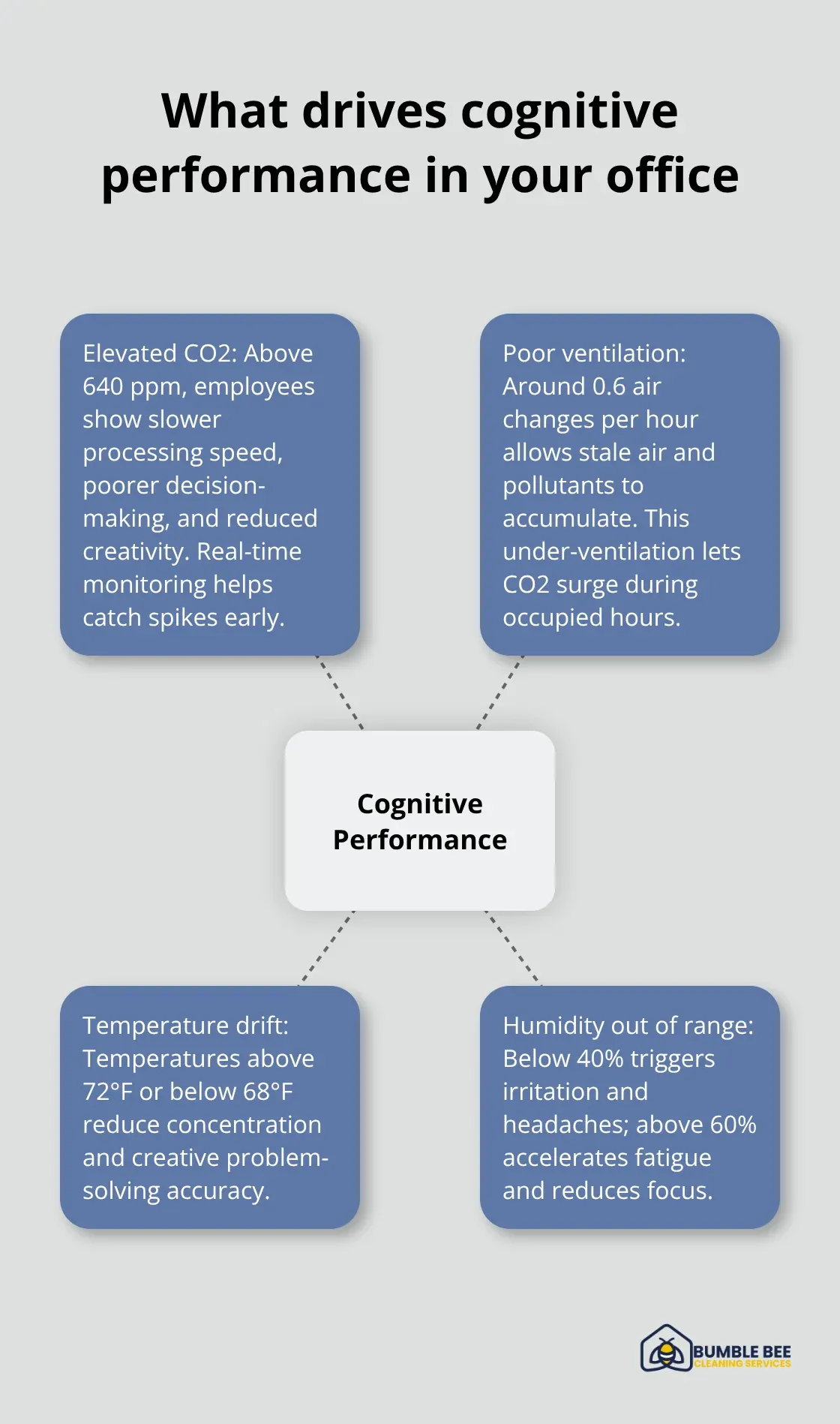
A study from Building and Environment in 2024 tracked office workers and found that thermal conditions significantly impact cognitive performance too. Temperatures above 72°F or below 68°F caused measurable declines in concentration tasks and creative problem-solving. Humidity levels outside the 40-60% range also degrade focus-too dry and employees develop headaches and irritability, too humid and mental fatigue sets in faster.
The CO2 Problem in Open Office Layouts
CO2 acts as a marker for ventilation failure, but it also independently impairs cognition at elevated levels. When your office hits 1000 ppm CO2, employees show slower reaction times on complex tasks. The Harvard research specifically measured this using cognitive tests and found consistent performance drops. Seattle’s rainy climate means offices stay sealed for months, trapping CO2 without adequate outdoor air exchange. Real-time CO2 monitors at workstations reveal the problem immediately-most Seattle offices show CO2 spiking to 900-1200 ppm by mid-afternoon in conference rooms and open areas. You cannot fix what you cannot measure, so baseline monitoring becomes your first actionable step.
Temperature and Humidity as Concentration Killers
Indoor thermal conditions matter more than most managers realize. The Harvard study using two real-time IAQ monitors in home workspaces found that temperatures just five degrees off the optimal range reduced Stroop test performance and creative problem-solving accuracy. Relative humidity below 30% increases static electricity and respiratory irritation, while humidity above 60% promotes mold growth and dust mite populations. ASHRAE standards recommend maintaining offices at 68–72°F with 40-60% relative humidity. Your HVAC system’s ability to hold these ranges determines whether employees leave work exhausted or energized. Fluctuating temperatures disrupt concentration more than steady suboptimal conditions-employees spend mental energy adapting instead of working.
Why Cleaning Products Worsen Office Air Quality
Commercial cleaning releases volatile organic compounds (VOCs), fine particles, and reactive byproducts that linger indoors and degrade air quality. VOCs from standard cleaners evaporate readily at room temperature, contributing to a “clean” scent while harming the air your team breathes. These chemicals react with indoor ozone to form formaldehyde and ultrafine particles, increasing exposure risk. Cleaning activities also stir up dust and generate fine particles that penetrate deep into the lungs. Synthetic fragrances and phthalates in many cleaning products link to endocrine disruption with chronic exposure. Employees exposed to these emissions experience coughing, throat irritation, wheezing, and shortness of breath-all of which tank concentration. Switching to low-emission, fragrance-free, or green-certified products reduces emissions while maintaining cleaning effectiveness. Scheduling cleaning for unoccupied times (evenings or weekends) and allowing ventilation time before reoccupancy minimizes occupant exposure. Your choice of cleaning products and timing directly impacts whether your office air supports or sabotages employee focus.
How to Spot Air Quality Problems in Your Seattle Office
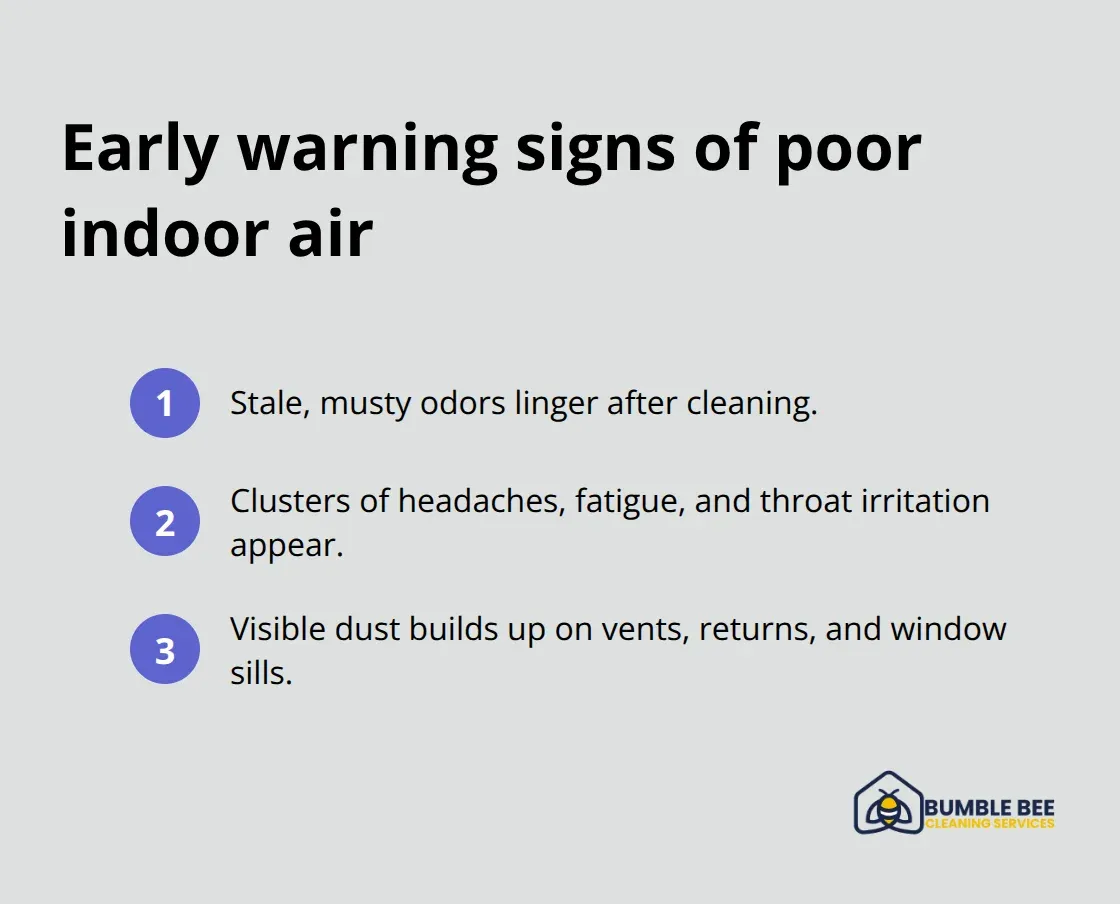
Your team won’t alert you to bad air until it already affects their work. Warning signs appear gradually-stale odors develop first, employee complaints follow, and visible dust accumulates before anyone connects the dots to air quality.
Stale Air and Inadequate Ventilation
Stuffy, stale air signals inadequate ventilation and CO2 buildup. If your office smells musty or flat despite recent cleaning, your HVAC system likely fails to bring in sufficient outdoor air. Seattle’s wet climate compounds this problem because sealed buildings prevent moisture from escaping, creating conditions where stale air lingers and odors concentrate. A simple test reveals the problem: open windows in different zones and notice whether the air feels fresher within minutes. If it does, your mechanical ventilation underperforms.
Install CO2 monitors in your main work areas and conference rooms-most Seattle offices show readings between 800–1200 ppm during occupied hours. CO2 readings above 1000 ppm indicate conditions that affect cognitive performance. Readings above 1000 ppm mean your employees experience measurable concentration loss while sitting at their desks.
Employee Health Complaints Point to Ventilation Failure
Employee health complaints arrive next and often get misdiagnosed as seasonal illness. Headaches, fatigue, and throat irritation cluster among staff members in the same zone when air quality fails. The U.S. EPA links poor indoor air quality directly to allergies, headaches, fatigue, and chronic respiratory conditions. If multiple employees report headaches after lunch or fatigue by mid-afternoon, poor ventilation and CO2 accumulation drive those symptoms.
These complaints signal that your HVAC system cannot maintain the 68–72°F temperature range and 40–60% humidity that support concentration. Employees working in these conditions spend mental energy adapting instead of focusing on tasks.
Visible Dust Reveals Filtration and Circulation Problems
Visible dust and allergen buildup on surfaces, air vents, and window sills indicates your filtration system captures inadequate particles. Check your HVAC filters monthly-if they clog faster than expected or show visible dust accumulation, upgrade to MERV 13+ filters that trap finer particles including bacteria and viruses. Dust on horizontal surfaces near air returns shows dead zones where stagnant air collects pollutants instead of circulating them out.
Professional ductwork inspection reveals whether accumulated dust inside your ducts recirculates contaminated air throughout the building. When visible dust appears on registers or when air quality complaints emerge, professional deep cleaning of ductwork paired with baseline IAQ monitoring confirms improvements after cleaning. These findings point directly to your next action: fixing the systems and practices that created the problem in the first place.
Solutions to Improve Office Air Quality
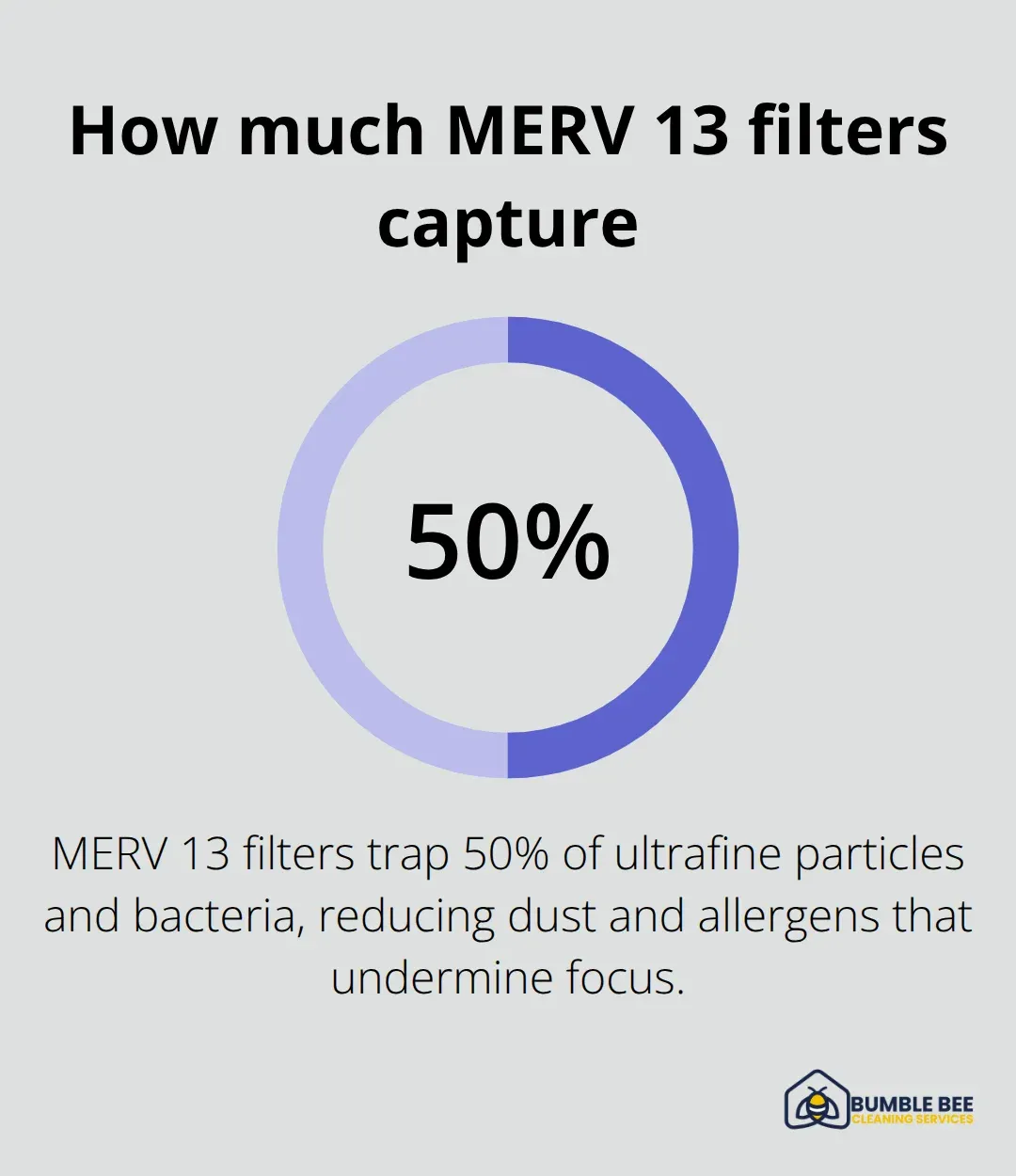
Start with your HVAC system because it controls whether your office air stays clean or becomes a concentration killer. Check your current filter rating immediately-most Seattle offices run MERV 8 or MERV 11 filters, which capture only 20-35% of particles down to 3 microns. Upgrade to MERV 13 filters that trap 50% of ultrafine particles and bacteria, directly reducing the dust and allergens that tank employee focus.
ASHRAE standards specify minimum ventilation rates for acceptable indoor air quality. During Seattle’s wildfire season or heavy smoke days, filters clog faster, so inspect them every two weeks. A clogged filter forces your HVAC system to work harder, consuming more energy while delivering worse air quality. Replace filters on a strict schedule, not just when they look dirty-performance degrades long before visible discoloration appears. Your HVAC professional should perform airflow tests to verify adequate outdoor air intake, because many Seattle offices maintain mechanical systems that underdeliver fresh air during peak occupancy. Real-time CO2 monitoring after filter upgrades shows whether your ventilation improvements actually work. Most offices see CO2 drop from 1000+ ppm to 700-800 ppm when they upgrade filters and balance airflow properly.
Upgrade Your HVAC Filters and Test Ventilation Performance
Your HVAC filters determine how much contamination your system removes from circulating air. MERV 13+ filters capture bacteria and viruses that lower-rated filters miss entirely. Test your current system’s performance with CO2 monitors placed in conference rooms and open work areas during peak occupancy hours. This measurement reveals whether your ventilation system delivers adequate fresh air or allows pollutants to accumulate. After upgrading filters and balancing airflow, retest CO2 levels to confirm improvements. Most Seattle offices see measurable drops within days of filter replacement.
Schedule Deep Cleaning During Unoccupied Hours
Professional ductwork cleaning removes accumulated dust that recirculates contaminated air throughout your building, but timing matters enormously. Schedule deep cleaning during unoccupied hours-evenings or weekends-because the cleaning process itself stirs up fine particles that degrade air quality during the work. Pair ductwork cleaning with baseline IAQ monitoring so you measure improvements in CO2, PM2.5, and humidity after the work completes. This data proves ROI to management and identifies whether additional upgrades are needed. After professional ductwork cleaning, your employees typically report fresher air within 24-48 hours.
Switch to Low-VOC Cleaning Products Immediately
Standard commercial cleaners release volatile organic compounds that react with indoor ozone to form formaldehyde and ultrafine particles. These byproducts penetrate deep into lungs and impair cognitive function more than the original cleaning chemicals. Switch your daily cleaning products to low-VOC, fragrance-free, or Green Seal certified options immediately. Your cleaning crew should follow label instructions exactly, avoiding overuse of disinfectants in low-risk areas, and wearing proper PPE during application. This change reduces harmful emissions while maintaining effective sanitation.
Add Supplemental Air Purification to High-Risk Zones
Supplemental air purification using HEPA filters and activated carbon units in high-occupancy zones or poorly ventilated conference rooms captures residual VOCs and particles that central ventilation misses. These devices provide measurable concentration improvements within days. Install them in spaces where employees spend extended time in meetings or collaborative work. Monitor their performance with real-time IAQ sensors to confirm they reduce PM2.5 and VOC levels effectively.
Final Thoughts
Your Seattle office’s commercial air quality directly determines whether employees concentrate or struggle through their workday. The connection between air quality and cognitive performance is measurable and undeniable-when you upgrade filters, balance ventilation, and eliminate harmful cleaning chemicals, your team experiences immediate improvements in focus and energy levels. Employees report fewer headaches, less fatigue, and better mental clarity within days of these changes.
The financial case for investing in air quality improvements is straightforward. Better ventilation and filtration reduce sick days, boost productivity, and lower HVAC energy consumption through proper system maintenance. Your employees spend eight hours daily in your office breathing the air your systems deliver, so neglecting that air quality costs you far more in lost productivity than upgrading filters and scheduling professional cleaning ever will.
We at Bumble Bee Cleaning Services specialize in deep cleaning and recurring commercial cleaning that supports your air quality goals. Contact us to schedule a professional assessment of your Seattle office’s cleaning needs and air quality challenges.
For more information about our cleaning services in Seattle and Atlanta, or to request a cleaning quote, call or text us at 425-786-1360 or email us at info@qbclean.com
