
Seattle property managers juggle staffing, budgets, and compliance requirements that never stop growing. When cleaning operations consume your team’s attention, your core property management work suffers.
We at Bumble Bee Cleaning Services know that turnkey janitorial solutions free you from these distractions. This post covers how outsourcing cleaning operations cuts costs, meets regulatory standards, and keeps your properties consistently clean.
What Happens When You Stop Managing Cleaning Yourself
Time Your Team Reclaims
Outsourcing janitorial operations immediately frees your team from tasks that drain hours without adding property value. Seattle property managers report spending 8–12 hours weekly on cleaning coordination, scheduling staff, handling complaints about dirty restrooms or dusty hallways, and managing supply inventories. That time vanishes when you stop managing cleanliness yourself and hand off daily maintenance to a dedicated janitorial partner.
Your facilities team shifts focus to repairs, tenant relations, and strategic property improvements instead of scrubbing floors or restocking paper towels.
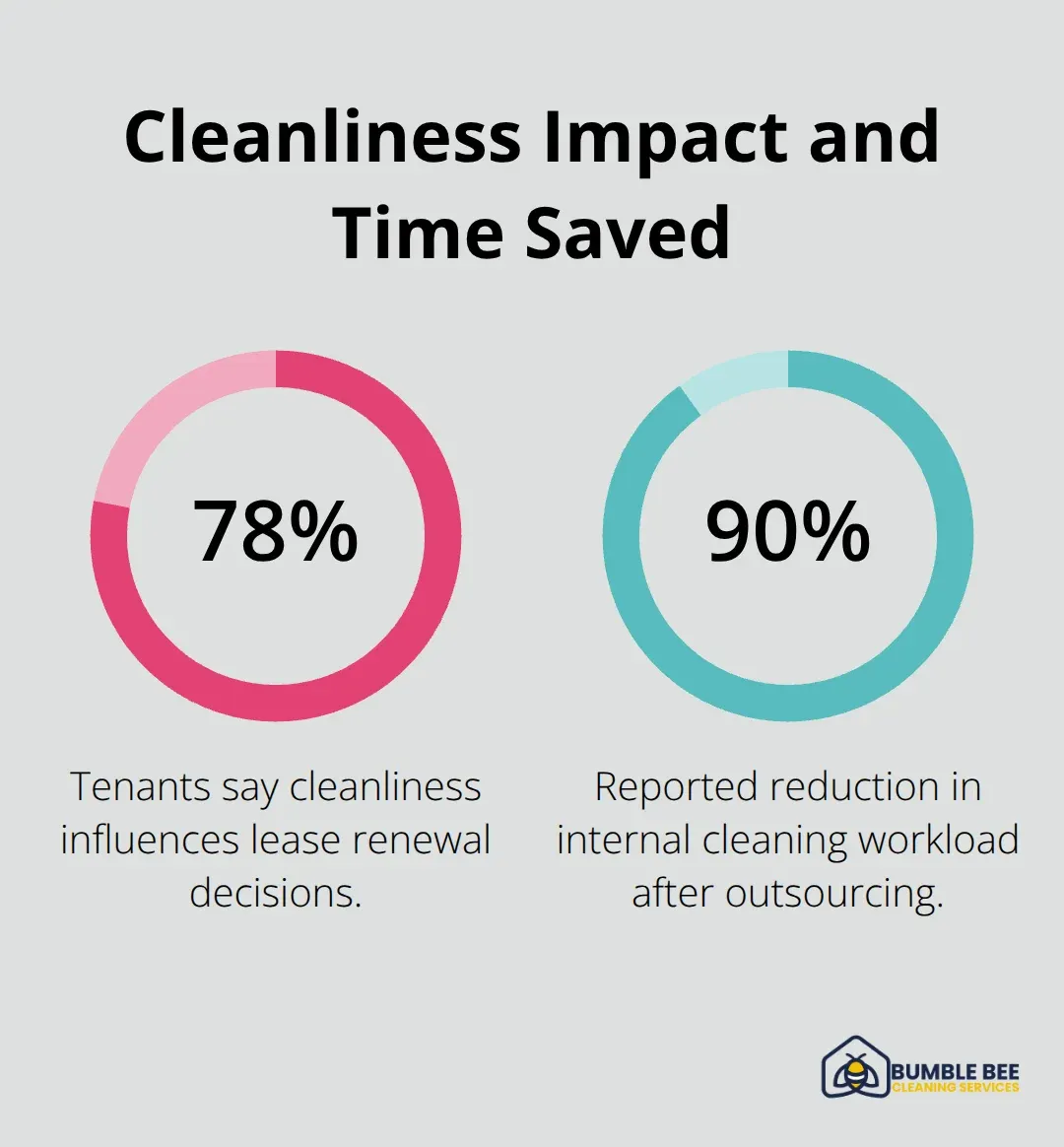
One property manager told us that moving to professional janitorial services cut their internal cleaning workload by 90 percent, allowing them to address maintenance requests faster and improve tenant satisfaction measurably.
Consistent Standards That Tenants Notice
Consistent cleanliness standards across all building areas become automatic rather than dependent on staff availability or mood. A survey found that 78 percent of tenants say cleanliness directly influences whether they renew their lease. When every hallway, restroom, and common area meets the same high standard every single day, tenants notice and stay longer.
Professional janitorial teams follow documented procedures, use the right equipment for each surface, and show up on schedule regardless of holidays or staffing gaps. Your property maintains that polished appearance that protects market value and justifies rent rates without your team constantly chasing cleanliness issues.
Why Facilities Staff Retention Improves
Buildings that outsource cleaning stop burning through facilities workers. In-house cleaning roles carry high turnover because the work is physically demanding, the pay is modest, and workers feel undervalued when property managers pile on extra tasks beyond their job description. Facilities staff who stay focus on preventive maintenance, equipment care, and building systems that require skill and judgment.
These roles feel more professional and offer clearer career paths than general cleaning. When your facilities team shrinks to two or three skilled technicians instead of five or six mixed-skill workers, you reduce hiring costs, training time, and the constant churn of onboarding replacements. Lower turnover also means institutional knowledge stays in place-your remaining staff understand your building systems, know tenant preferences, and build relationships that improve service quality.
Professional janitorial services handle the high-turnover, commodity-level work while your permanent team tackles what actually requires building expertise. This shift in focus sets the stage for understanding the regulatory landscape that governs how Seattle properties must maintain their facilities.
What Standards Your Seattle Property Must Actually Meet
Washington State Regulations and Health Department Requirements
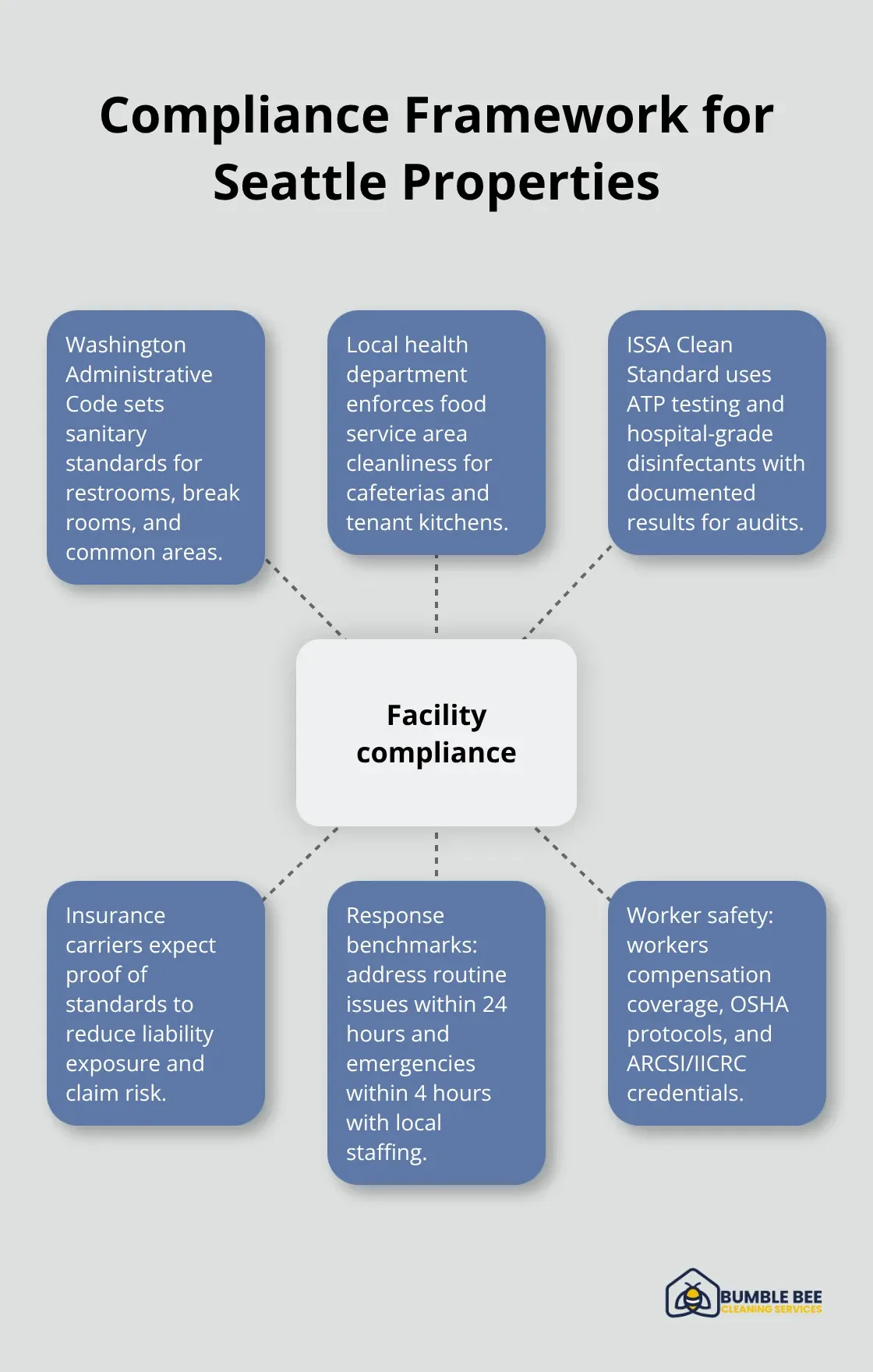
Seattle property managers operate under overlapping regulations that demand consistent compliance. Washington State requires facilities to maintain sanitary conditions under the Washington Administrative Code, which sets baseline standards for restrooms, break rooms, and common areas in commercial buildings. The health department enforces food service area cleanliness if your property includes cafeterias or tenant kitchens. These regulations form the foundation of your legal obligations, and violations trigger fines, tenant complaints, and potential lease disputes that consume management time and damage your reputation.
ISSA Standards and ATP Testing for Measurable Cleanliness
ISSA, the industry’s leading standards body, publishes the Institutional & Commercial Clean Standard, which uses ATP testing to measure cleanliness objectively on high-touch surfaces like door handles, light switches, and restroom fixtures. Properties that follow ISSA benchmarks demonstrate they meet measurable hygiene thresholds rather than relying on subjective visual inspections alone. Your janitorial partner must use hospital-grade disinfectants on verified high-risk points and document results consistently. This approach protects you legally because it creates an audit trail showing you maintained reasonable sanitation practices.
Insurance Requirements and Liability Protection
Insurance carriers increasingly require proof of these standards because liability claims spike when properties cannot demonstrate they maintained reasonable sanitation practices. A single slip-and-fall lawsuit or tenant illness traced to unsanitary conditions can cost Seattle property managers tens of thousands in legal fees and settlements, making compliance documentation your protection, not just a regulatory checkbox. Your janitorial partner should maintain a documented cleaning log showing what was cleaned, when, and by whom. This record satisfies insurance companies and protects you legally if disputes arise.
Response Time Benchmarks and Local Staffing
Industry standards expect janitorial teams to address spills, restroom issues, or odor complaints within 24 hours during business days and within 4 hours for emergency situations like flooding or pest sightings. Seattle’s competitive rental market punishes slow responses: tenants who report a dirty restroom and see no action within a day file complaints, leave negative reviews, and choose competitors on renewal. Meeting these response windows requires staff positioned locally, not outsourced to distant call centers. Your janitorial partner should have teams stationed in Seattle neighborhoods to reach your properties quickly when problems occur.
Worker Safety Certifications and Contractor Credentials
Worker safety means your cleaning contractor must carry proper workers compensation insurance and follow OSHA guidelines for chemical handling and equipment use. Verify your partner holds current certifications from recognized bodies like ARCSI or IICRC before signing any contract. These credentials confirm they’ve invested in training and stay current with evolving safety protocols rather than cutting corners to undercut pricing. Understanding these compliance layers reveals why cost alone should never drive your janitorial decision-the real expense comes from choosing a partner who cannot meet these standards consistently.
What Professional Janitorial Services Actually Cost
Flat-Rate Pricing Eliminates Budget Surprises
Property managers who assume outsourcing janitorial work will drain budgets often discover the opposite when they understand how professional cleaning partners structure pricing. Flat-rate pricing removes the budget surprises that plague in-house cleaning operations. Your monthly bill stays identical whether your property faces a slow month or unexpected tenant turnover, allowing you to forecast cleaning expenses with precision instead of watching costs spike unpredictably. This stability matters enormously for Seattle property managers managing multiple buildings: you know exactly what janitorial services will cost for the entire year, and your accounting team stops fielding surprise invoices from overtime, emergency staffing, or supply shortages.
Hidden Costs of In-House Cleaning Operations
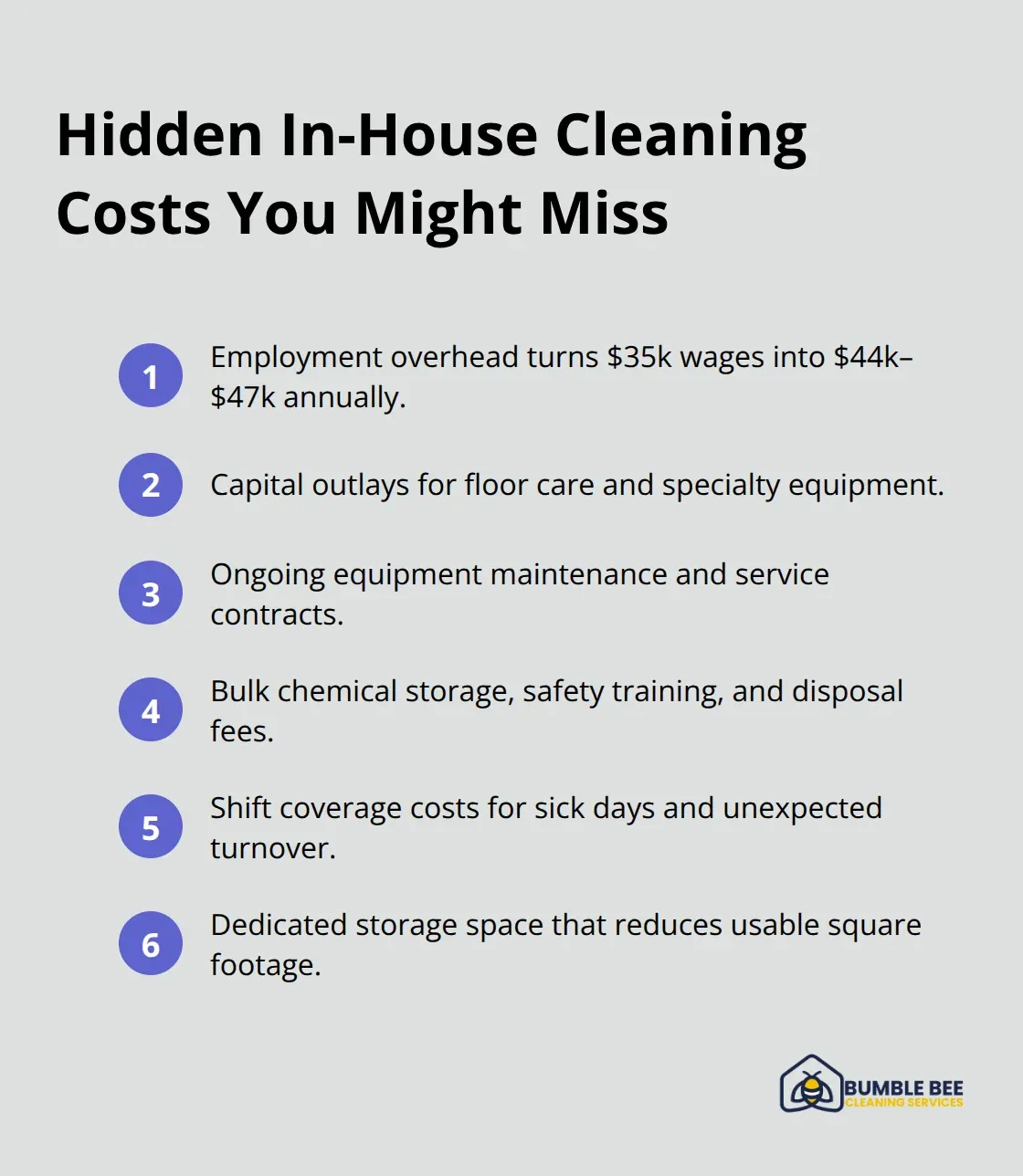
In-house cleaning operations hide enormous costs that most property managers never calculate accurately. When you employ two or three full-time facilities staff dedicated primarily to cleaning, you pay their salaries year-round even during slow periods, plus payroll taxes, workers compensation insurance, and benefits that typically add 25 to 35 percent to base wages. A single facilities worker earning $35,000 annually costs your property roughly $44,000 to $47,000 when you include all employment overhead. Specialized equipment like floor buffers, carpet extractors, and pressure washers requires capital investment, maintenance contracts, and storage space. You purchase cleaning chemicals in bulk, which means storage hazards, chemical safety training for staff, and disposal costs for expired products. When a facilities worker calls in sick or leaves unexpectedly, you scramble to cover shifts or pay premium rates for temporary staffing.
Professional janitorial partners spread these costs across multiple properties, purchase supplies at wholesale rates, and maintain equipment centrally, passing those savings directly to you through lower per-property pricing. A property manager with four buildings might spend $180,000 to $200,000 annually on in-house cleaning staff and supplies, while outsourcing to a professional partner costs $120,000 to $150,000 for identical service levels. The difference funds tenant retention improvements, maintenance projects, or your bottom line.
Risk Transfer and Insurance Savings
Liability and workers compensation costs shift dramatically when you partner with a professional janitorial provider. Your property remains liable for injuries sustained by employees cleaning your buildings, and workers compensation insurance for facilities staff carries significant expense depending on injury risk and your claims history. A single serious injury claim can raise your insurance premiums for years. When you outsource to a credentialed partner, they carry their own workers compensation coverage and assume liability for their employees’ safety and actions. Your insurance carrier recognizes this risk transfer and typically reduces your commercial general liability premiums by 3 to 8 percent annually. For a property with $500,000 in annual insurance costs, that reduction equals $15,000 to $40,000 in savings.
Chemical Safety and Liability Reduction
Professional cleaners use hospital-grade disinfectants, follow OSHA protocols, and document their work systematically, reducing slip-and-fall claims and tenant illness complaints that trigger lawsuits. Eco-friendly products that professional cleaners use eliminate chemical exposure liability that can arise when in-house staff handle hazardous materials improperly. These risk reductions compound over time, making professional janitorial services not an expense but a genuine financial safeguard that protects your property’s long-term profitability and reputation.
Final Thoughts
Comprehensive janitorial services eliminate the operational friction that drains Seattle property managers’ time and budgets. When you stop managing cleaning yourself, your team reclaims hours weekly to focus on tenant relations, maintenance priorities, and strategic improvements that actually grow property value. Tenants stay longer in consistently clean buildings, compliance becomes automatic rather than reactive, and your liability exposure shrinks measurably.
The financial case for outsourcing is straightforward: in-house cleaning operations hide enormous costs across salaries, benefits, equipment, insurance, and emergency staffing that professional partners eliminate through economies of scale. Flat-rate pricing lets you forecast expenses accurately instead of watching costs spike unpredictably. Risk transfer to a credentialed janitorial partner reduces your workers compensation and liability insurance premiums while documented cleaning procedures protect you legally if disputes arise.
Turnkey janitorial solutions from experienced providers handle the compliance complexity that Washington State regulations and ISSA standards demand. Your partner maintains ATP testing records, uses hospital-grade disinfectants on high-touch surfaces, and responds to issues within industry-standard timeframes. Contact Bumble Bee Cleaning Services today to discuss how comprehensive janitorial solutions can streamline your property management operations.
For more information about our cleaning services in Seattle and Atlanta, or to request a cleaning quote, call or text us at 425-786-1360 or email us at info@qbclean.com
