
You’ve just finished construction on your Seattle home or office, but the smell won’t leave. That persistent odor comes from new materials, adhesives, and dust settling into every corner of your space.
We at Bumble Bee Cleaning Services know that odor elimination after construction requires more than opening windows. Seattle’s damp climate actually traps these smells longer than in drier regions, making professional intervention necessary.
What Creates These Lingering Smells
Paint fumes are the most obvious culprit, but they’re only part of the problem. Construction adhesives, sealants, and new flooring materials release volatile organic compounds (VOCs) that persist far longer than most people expect. Even low-VOC paints continue off-gassing for several days, while spray foam insulation can release odors for weeks or months after installation. The adhesives used for flooring, drywall joint compounds, and silicone sealants are particularly stubborn offenders. When multiple materials off-gas simultaneously in a confined space, the combined chemical smell becomes overwhelming. Seattle’s wet climate makes this worse because moisture slows down the off-gassing process, extending the timeline considerably.
Fine Dust Traps Smells Longer Than You Think
Construction dust isn’t just an aesthetic problem-it actively absorbs and holds odors from paints, adhesives, and new materials. Fine particles from drywall, insulation, and sanding settle on every surface, including inside air vents and within carpet fibers where they remain nearly invisible. These particles spread odors throughout your space and make the smell linger even after visible surfaces appear clean. A standard household vacuum won’t capture this fine dust; you need HEPA-filtered equipment that captures 99.97% of particles as small as 0.3 microns. This is why opening windows alone fails to eliminate the problem-the dust remains trapped indoors, continuously releasing trapped odors into your breathing space.
Hidden Moisture Breeds Mold That Masks Real Problems
Seattle’s humidity creates a secondary odor problem that construction sites rarely address properly. New drywall, concrete, and wooden framing retain moisture during and after construction. If adequate ventilation and drying time don’t manage this moisture, mold and mildew develop in hidden areas like inside walls, under flooring, and within HVAC ducts. Concrete typically requires a minimum of seven days curing before it stops off-gassing moisture. When mold grows alongside chemical off-gassing, the combined smell becomes much harder to identify and eliminate. Homeowners often assume the construction smell is normal when they’re actually dealing with mold growth that poses health risks to occupants with asthma or allergies.
Why Professional Intervention Matters
The combination of VOCs, trapped dust, and hidden moisture creates a problem that surface-level cleaning cannot solve. You need specialized equipment and techniques to address all three sources simultaneously. Professional post-construction cleaning services use HEPA-filtered vacuums, targeted deodorizing methods, and moisture assessment to eliminate odors at their source rather than mask them. This multi-step approach (deep extraction, air purification, and moisture remediation) tackles the root causes that DIY methods miss. Understanding what causes these smells is the first step; removing them requires the right strategy and equipment.
How Long Odors Persist After Construction
Different Materials Release Odors on Different Timelines
Paint and adhesives off-gas on different schedules depending on product type and environmental conditions. Standard paint releases odors for 2–3 days after application, while low-VOC paint extends this to several days due to slower evaporation rates. Construction adhesives used for flooring and drywall present a far more stubborn problem, off-gassing for 1–2 weeks under normal conditions. Spray foam insulation ranks as the worst offender, persisting for weeks or even months because the chemical reaction that creates the foam continues long after installation. Silicone sealants release odors for 24–72 hours depending on humidity and temperature. Concrete curing adds another layer of complexity-concrete requires a minimum of seven days to stop actively off-gassing moisture, and this timeline extends significantly in damp climates where moisture slows the curing process considerably.
Multiple Materials Create Compounded Odor Problems
The combined effect of multiple materials off-gassing simultaneously means your space won’t smell normal until every material finishes releasing its chemicals. In ideal conditions, this typically takes 2–4 weeks. When paint, adhesives, sealants, and new flooring all release volatile organic compounds at the same time, the chemical smell becomes overwhelming and masks individual odor sources. This compounding effect explains why construction odors feel so persistent-you’re not dealing with one problem but several happening in parallel. Waiting passively for materials to finish off-gassing leaves you trapped in a smelly space with no control over the timeline.
Seattle’s Climate Extends Odor Persistence
Seattle’s wet conditions and frequent rain trap moisture indoors, which slows off-gassing and creates conditions where mold develops alongside chemical odors. Winter conditions prove particularly problematic because temperature inversions and low ventilation rates keep chemical-laden air trapped inside homes and offices. Stagnant air concentrates odors rather than dispersing them, making spaces smell worse for longer periods. Homes with poor ventilation or sealed windows experience odor persistence that extends far beyond the typical timeline. Spaces with active HVAC systems and cross-ventilation can reduce odor levels by dispersing chemical-laden air more effectively than sealed environments.
Active Intervention Cuts Odor Duration in Half
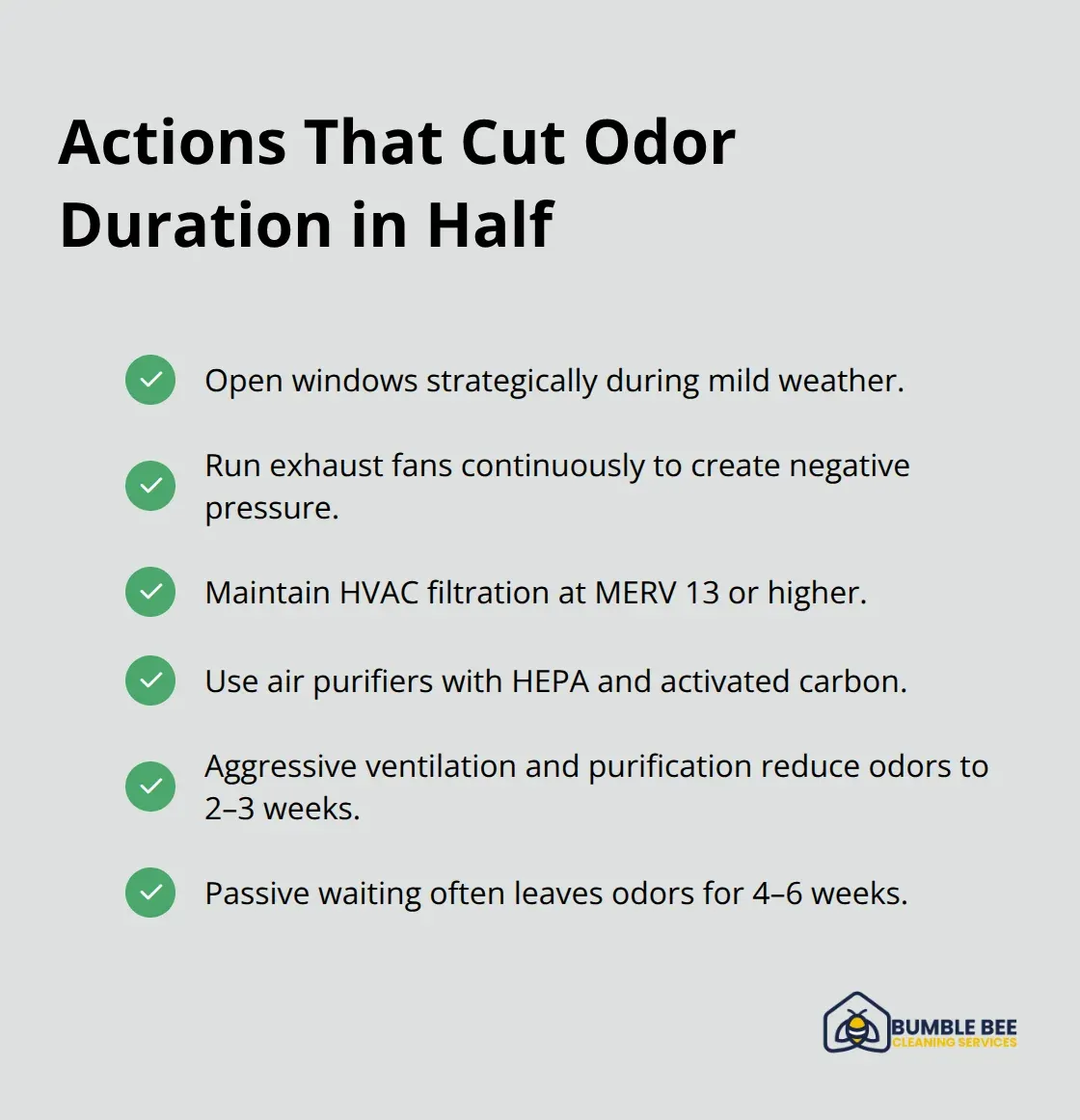
Your approach to ventilation directly determines how long you’ll tolerate construction odors. Opening windows strategically during mild weather, running exhaust fans continuously, and maintaining HVAC filtration at MERV 13 or higher substantially shortens the odor timeline compared to passive waiting. Without active intervention, Seattle homeowners should expect construction odors to linger for 4–6 weeks. Those who implement aggressive ventilation and air purification strategies can reduce this to 2–3 weeks. The difference between these timelines comes down to whether you actively manage air quality or simply hope the smell disappears on its own.
Effective odor removal requires a deliberate strategy that addresses ventilation, filtration, and moisture control simultaneously-which brings us to the specific methods that actually work in Seattle spaces.
How to Actually Eliminate Construction Odors
Professional post-construction cleaning tackles odor removal in ways that homeowners cannot replicate alone. HEPA-filtered vacuums capture 99.97% of particles down to 0.3 microns, which removes the dust particles that trap and release odors long after visible surfaces appear clean. This equipment extracts odor-causing particles from carpets, upholstery, and air vents where standard household vacuums fail completely. Enzyme-based cleaners break down organic odor sources at their molecular level rather than masking smells with fragrance. Air purifiers with both HEPA and activated carbon filters work simultaneously-HEPA captures fine particles while activated carbon absorbs volatile organic compounds directly from the air. Activated carbon binds to chemical molecules rather than simply circulating air around them. For Seattle spaces, professionals assess moisture levels in walls and concrete to identify hidden mold growth before it becomes a health hazard. This multi-step approach addresses all three odor sources at once: trapped dust, lingering chemicals, and moisture-related mold.
Why DIY Methods Fall Short
Surface cleaning and air fresheners accomplish almost nothing because they ignore the root causes entirely. Standard household vacuums recirculate fine dust rather than capturing it, which spreads odors throughout your space instead of eliminating them. Air fresheners and scented candles mask smells temporarily while leaving chemical residue that can mix with construction odors and create artificial, heavy-smelling air. Wiping down visible surfaces removes dust you can see but leaves particles embedded in carpet fibers, upholstery, and inside HVAC ducts where they continue releasing trapped odors. Without proper equipment and targeted techniques, your efforts waste time and money while the underlying problem persists.
Cross-Ventilation Reduces Odors Faster Than Waiting
Seattle homeowners assume that rain and clouds prevent effective window ventilation, but this belief leads to sealed homes that trap construction odors indefinitely. Cross-ventilation-opening windows on opposite sides of your space-creates airflow that disperses chemical-laden air far more effectively than passive waiting. Run exhaust fans continuously during and after construction to create negative air pressure that pulls odors out rather than allowing them to settle. Maintain HVAC filters at MERV 13 or higher and replace them every 30 days during the post-construction period because standard filters allow fine dust to recirculate. Avoid sealing windows completely; even partial ventilation during mild weather accelerates odor dispersal compared to completely sealed environments.
Low-Cost Treatments That Work on Hard Surfaces and Soft Materials
Baking soda sprinkled on carpets and left for several hours before vacuuming absorbs odors without chemical residue. A solution of one part white vinegar to three parts water neutralizes alkaline odors on hard surfaces and leaves no artificial scent behind. These practical interventions cost almost nothing and significantly shorten the timeline before your space becomes livable again. Fabrics retain odors the longest, so target curtains, rugs, and upholstery with these treatments first. Hard surfaces like countertops and floors respond quickly to vinegar solutions, while carpets require the baking soda treatment followed by thorough vacuuming to remove absorbed particles.
Professional Equipment Combines Multiple Strategies
Professional cleaners combine ventilation strategies with specialized equipment to achieve results that individual homeowners cannot accomplish independently. HEPA-filtered extraction removes particles that standard vacuums miss, while activated carbon filtration captures chemical compounds that ventilation alone cannot disperse. Moisture assessment identifies hidden mold growth in walls and concrete before it becomes a health hazard. This combination of equipment, techniques, and moisture evaluation addresses all three odor sources simultaneously rather than treating them separately.
Final Thoughts
Construction odors in Seattle spaces demand professional intervention because the combination of VOCs, trapped dust, and moisture creates problems that passive waiting cannot solve. Standard household methods fail because they address only visible surfaces while leaving particles embedded in carpets, upholstery, and HVAC ducts where they continue releasing trapped odors indefinitely. We at Bumble Bee Cleaning Services understand that odor elimination requires specialized equipment and targeted strategies tailored to Seattle’s damp climate.
Preparing your space after construction means implementing a multi-step approach from day one. Start with continuous ventilation through cross-ventilation and exhaust fans rather than sealing your home completely, and upgrade HVAC filters to MERV 13 or higher while replacing them every 30 days during the post-construction period. Simultaneously, address soft surfaces with baking soda treatments and hard surfaces with vinegar solutions to absorb odors at their source rather than masking them with fragrance.
Professional post-construction cleaning combines HEPA-filtered extraction, activated carbon air purification, and moisture assessment in a single comprehensive service that tackles all three odor sources at once. Contact Bumble Bee Cleaning Services to schedule your post-construction cleaning and transform your Seattle space from smelly to fresh within days rather than weeks.
For more information about our cleaning services in Seattle and Atlanta, or to request a cleaning quote, call or text us at 425-786-1360 or email us at info@qbclean.com
