
Construction work leaves behind more than just a finished room. Dust and debris settle into your home’s air, creating invisible hazards that standard cleaning misses.
At Bumble Bee Cleaning Services, we know that air purification after construction is essential for your family’s health. This guide shows you what to watch for and how to reclaim clean air in your Seattle home.
What Makes Post-Construction Dust So Dangerous
Fine Particles That Standard Cleaning Misses
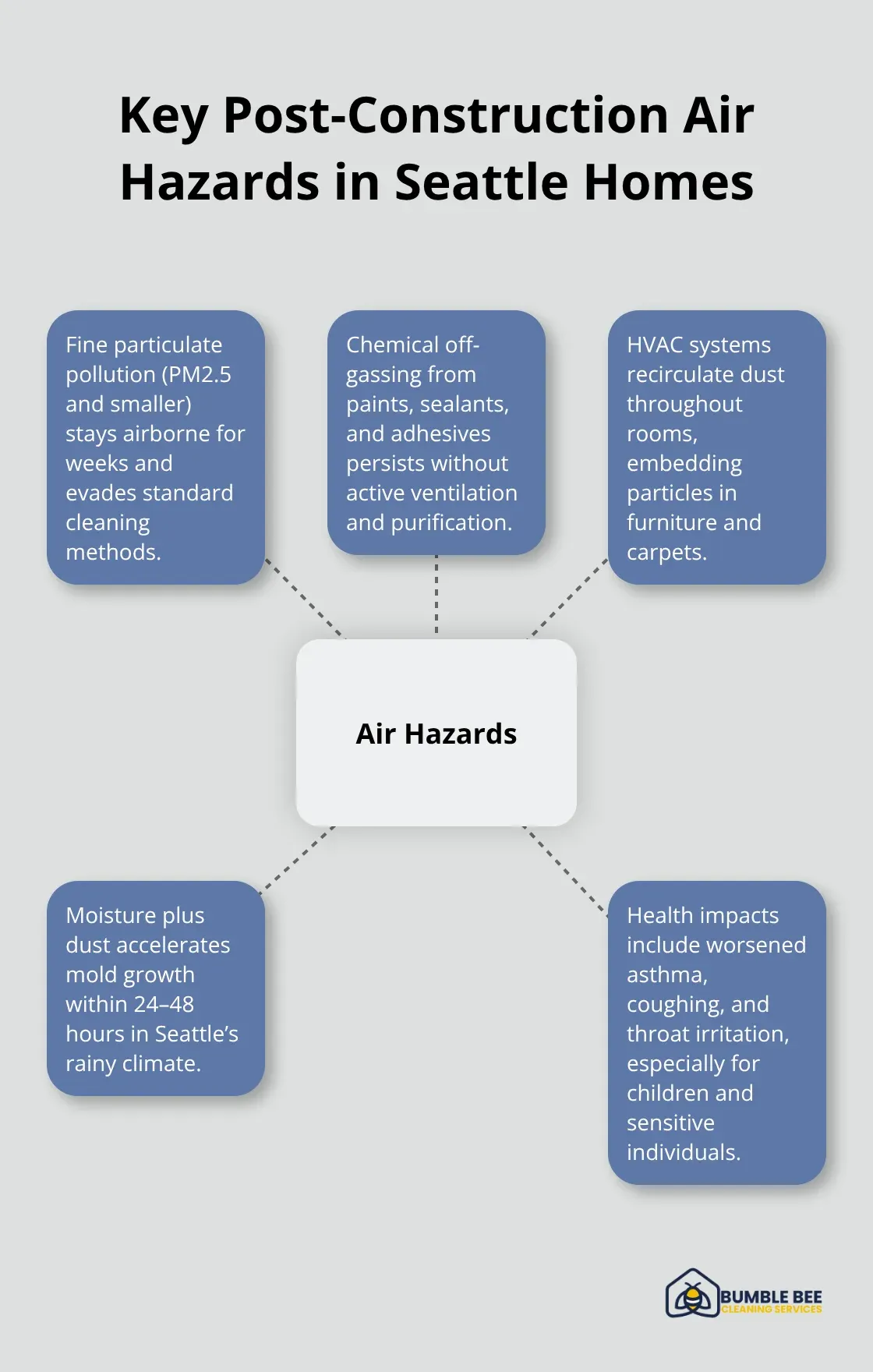
Construction work releases fine particles that remain suspended in your home’s air long after visible debris disappears. The EPA identifies PM2.5-particles smaller than 2.5 microns-as a major health concern, and PM2.5 particles from construction generate these hazardous particles constantly through drilling, cutting, and demolition. When your Seattle home undergoes renovation, this dust doesn’t simply settle; it circulates through your HVAC system, embeds in furniture and carpets, and stays airborne for weeks. Standard vacuuming and surface wiping miss these microscopic particles entirely. A HEPA vacuum captures 99.97 percent of particles as small as 0.3 microns, which is why regular household vacuums fail to address the actual problem.
Chemical Off-Gassing From Materials
Construction also releases volatile organic compounds from paints, sealants, and adhesives-chemicals that off-gas continuously and create persistent odors even after the work ends. The EPA notes that VOC-containing materials reduce indoor air quality significantly, and Seattle’s rainy climate traps these chemicals indoors longer than drier regions experience. These compounds linger in your living spaces for weeks without proper ventilation and air purification.
Health Risks Your Family Faces
Your family’s respiratory health depends on addressing this invisible contamination. Construction dust irritates airways and worsens asthma symptoms, particularly in children and anyone with pre-existing respiratory conditions. Moisture from Seattle’s frequent rain combined with construction dust creates conditions where mold develops within 24 to 48 hours if not properly managed. Standard cleaning services focus on visible surfaces but ignore the air itself-the actual medium where harmful particles circulate. Without targeted air purification, your newly renovated space remains contaminated for months, forcing your family to breathe polluted air inside their own home. The next section explores specific warning signs that indicate your Seattle home needs professional air purification after construction work.
How to Spot Air Quality Problems After Construction
Visible Dust Signals Airborne Contamination
When construction ends, most Seattle homeowners focus on the visible transformation-new floors, fresh paint, updated fixtures. What they miss is the invisible contamination still circulating through their home. Dust doesn’t announce itself; it settles slowly over days and weeks, accumulating on surfaces you thought were clean. If you notice a fine white or gray film reappearing on shelves, window sills, or furniture just days after your contractor leaves, that’s a clear signal that airborne particles remain suspended in your home’s air. The IICRC S410 standard for infection prevention emphasizes that visual cleanliness doesn’t equal hygienically clean outcomes-a newly renovated home can look spotless while harboring dangerous particulates. This dust comes from drilling, cutting, and sanding activities that create particles fine enough to bypass standard cleaning entirely.
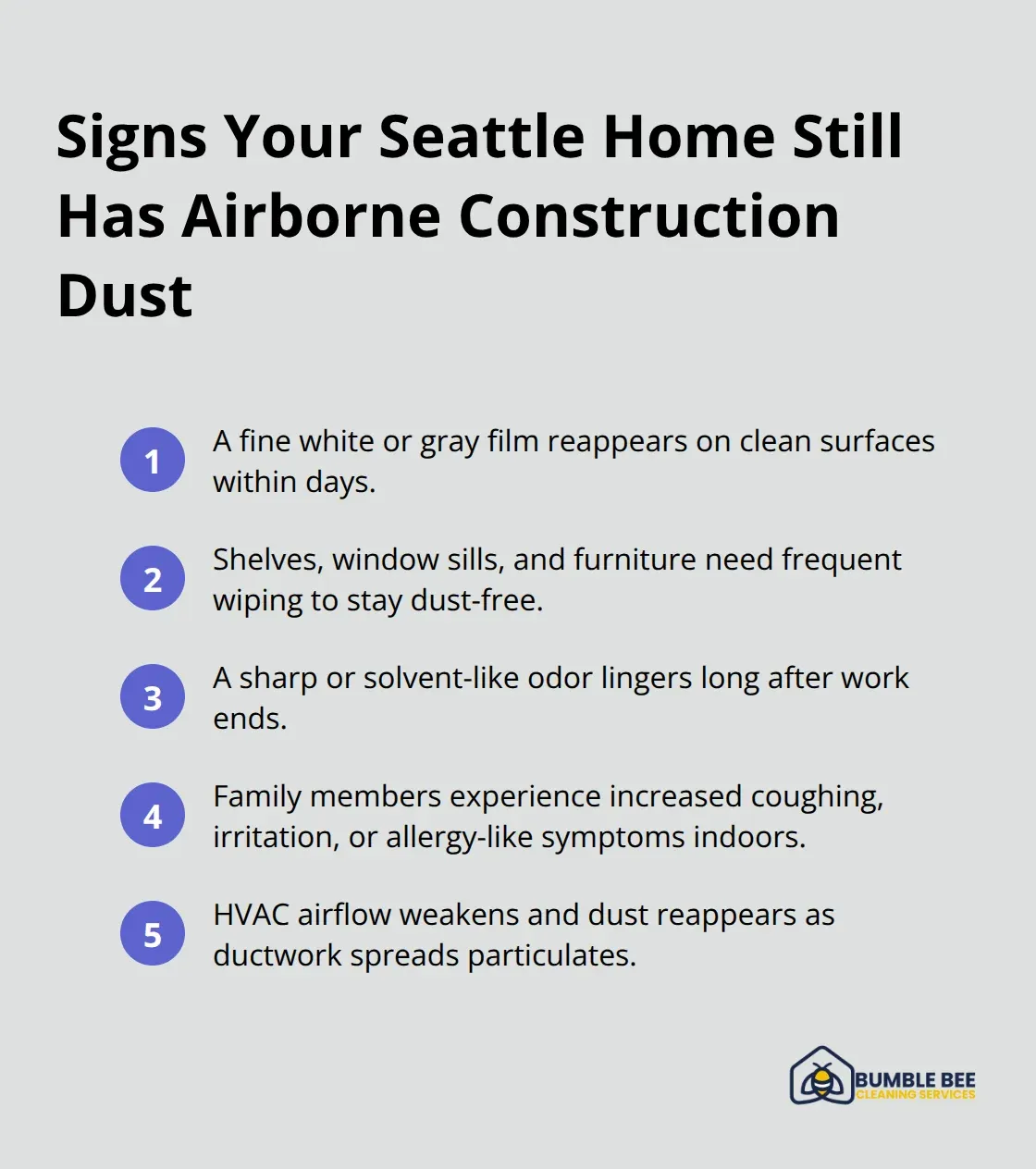
When surfaces require daily wiping to stay dust-free weeks after construction ends, air purification isn’t optional; it’s necessary. The EPA identifies PM2.5 particles as a major health concern, and construction work generates these hazardous particles constantly. Your HVAC system circulates this dust throughout your home, embedding particles in furniture and carpets where they remain for weeks. Dust accumulation in ductwork reduces airflow efficiency while spreading contaminated air throughout your property.
Chemical Odors Reveal Ongoing Off-Gassing
Construction materials release volatile organic compounds that create that distinctive sharp or solvent-like smell lingering long after workers leave. These odors persist because ventilation alone won’t remove them quickly-they continue off-gassing from paints, adhesives, and sealants for weeks without active air purification. Seattle’s rainy climate traps these chemicals indoors longer than drier regions experience, extending the problem significantly.
Your nose detects what your lungs will soon process. If your home smells like a construction site weeks after work completion, chemical contamination is actively affecting your indoor air quality.
Respiratory Symptoms Point to Real Air Quality Decline
Your family’s respiratory response provides the most urgent warning sign. Increased coughing, throat irritation, or worsening allergy symptoms indoors indicate your air quality has degraded significantly. Children and adults with asthma experience the most noticeable reactions, as construction dust directly irritates airways. If household members who don’t typically suffer allergies suddenly experience symptoms confined to your home, the problem isn’t external-it’s the post-construction environment itself.
Construction dust irritates airways and worsens asthma symptoms, particularly in children and anyone with pre-existing respiratory conditions. Moisture from Seattle’s frequent rain combined with construction dust creates conditions where mold develops within 24 to 48 hours if not properly managed. Persistent respiratory symptoms warrant professional services to address the contamination source directly. These warning signs demand action beyond standard deep cleaning because they indicate particulates and chemicals actively affecting your family’s health every time you breathe. Understanding these problems is the first step-the next section explores the air purification solutions that actually work.
What Actually Works for Post-Construction Air
HEPA Filtration Captures Microscopic Particles
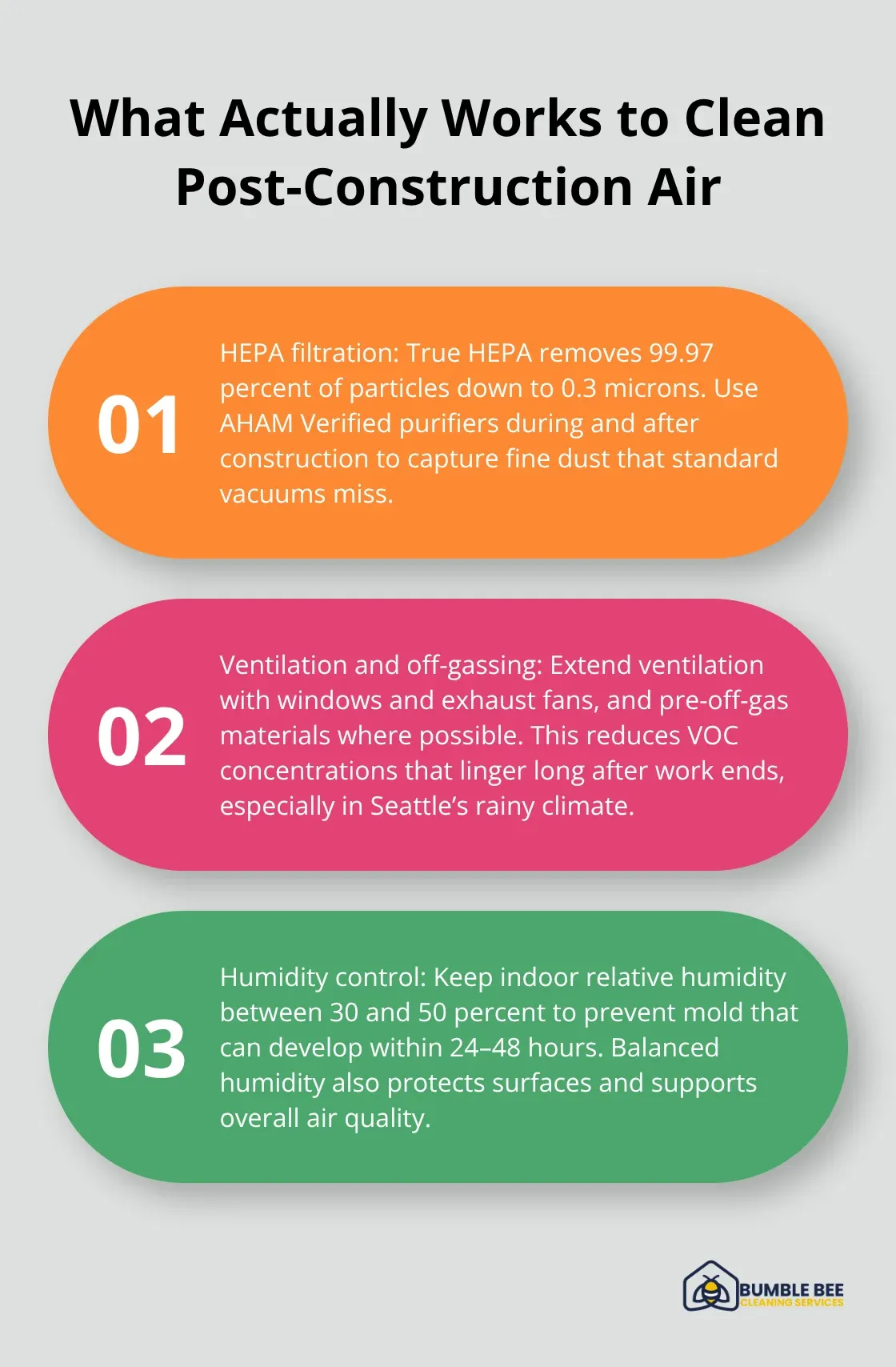
HEPA filtration removes 99.97 percent of particles as small as 0.3 microns, making it the only technology proven to capture the fine dust that standard vacuums miss entirely. Professional air purifiers equipped with true HEPA filters work continuously during and after construction, pulling contaminated air through multiple filtration stages before recirculating it back into your space. The AHAM Verified seal on air purifiers guarantees performance standards, so look for this certification when selecting equipment for your Seattle home. Portable HEPA units placed in central living areas during construction catch airborne particles before they settle into furniture and carpets, while whole-home systems integrated with your HVAC provide comprehensive protection.
Ventilation and Chemical Off-Gassing Management
Chemical off-gassing from paints and adhesives requires extended ventilation beyond what HEPA filters alone accomplish. Opening windows, running exhaust fans, and allowing materials to off-gas outside before installation reduces VOC concentration significantly. The EPA recommends maintaining maximum ventilation after construction completion to minimize residual odors and emissions. Seattle’s rainy climate makes this challenging, but sealed windows combined with indoor air purification outperform opening doors to damp outdoor air during wet seasons.
Humidity Control Prevents Mold Development
Humidity control prevents the mold development that occurs within 24 to 48 hours when moisture combines with construction dust. Maintain indoor humidity between 30 and 50 percent to protect both air quality and your home’s structural integrity. This balance matters especially in Seattle, where frequent rain introduces excess moisture into renovation spaces.
Professional Cleaning and Air Purification Work Together
Professional post-construction cleaning paired with air purification delivers results that homeowners cannot achieve independently. We at Bumble Bee Cleaning Services combine HEPA vacuuming with industrial-grade air scrubbers and proper ventilation protocols to eliminate both visible debris and microscopic particles in a single comprehensive service. The IICRC S410 standard for infection prevention in the built environment establishes that visual cleanliness does not equal hygienically clean outcomes-professional teams trained in these standards use measurable protocols rather than guesswork. Standard cleaning services often overlook HVAC ductwork contamination, which circulates particles throughout your entire home weeks after surface cleaning ends.
Scheduling air purification during the deep cleaning phase, not weeks afterward, prevents particles from embedding deeper into fabrics and materials. For Seattle homes, this integrated approach addresses construction dust, chemical off-gassing, and moisture concerns simultaneously rather than treating them as separate problems requiring multiple service calls.
Final Thoughts
Post-construction air purification demands immediate action while your home transitions from a work site to a living space. Waiting allows particles to embed deeper into fabrics, chemicals to linger longer in your air, and mold to establish itself in hidden spaces where standard cleaning cannot reach. Your family’s respiratory health depends on treating air purification as part of the construction process itself, not an afterthought weeks later.
Professional cleaning and air purification work together because they address different contamination problems simultaneously. Surface cleaning removes visible debris, but HEPA filtration and ventilation management eliminate the microscopic particles and chemical off-gassing that standard cleaning misses entirely. We at Bumble Bee Cleaning Services combine these approaches in our post-construction cleaning service, using industrial-grade equipment and IICRC-certified protocols to deliver measurable results rather than visual assumptions. Seattle homes face unique challenges that generic cleaning approaches don’t address-your region’s frequent rain introduces moisture that accelerates mold development, while cooler temperatures trap chemical off-gassing indoors longer than warmer climates experience. Contact Bumble Bee Cleaning Services to schedule your post-construction cleaning and air purification service today.
For more information about our cleaning services in Seattle and Atlanta, or to request a cleaning quote, call or text us at 425-786-1360 or email us at info@qbclean.com
