
Renovations transform your Seattle home, but they also leave behind construction dust, chemical fumes, and particles that linger in your air for weeks. Most homeowners don’t realize how contaminated their indoor air becomes during this process, and standard cleaning alone won’t fix it.
We at Bumble Bee Cleaning Services know that air purification after renovation isn’t optional-it’s necessary for your family’s health. This guide walks you through what you need to know about restoring clean air to your newly renovated space.
What Happens to Your Air During and After Renovation
Construction dust poses a serious air quality threat that extends far beyond the renovation site. During renovation, particles smaller than 10 micrometers penetrate deep into your lungs, according to EPA research on particle pollution. These fine particles, called PM2.5, act as the primary cause of reduced visibility and haze in parts of the United States. Your newly renovated Seattle home traps these particles indoors where they concentrate far beyond outdoor levels. Standard vacuuming and surface cleaning remove only visible dust; the microscopic particles that pose the greatest health risk remain suspended in your air for weeks after construction ends.
The Off-Gassing Problem Nobody Talks About
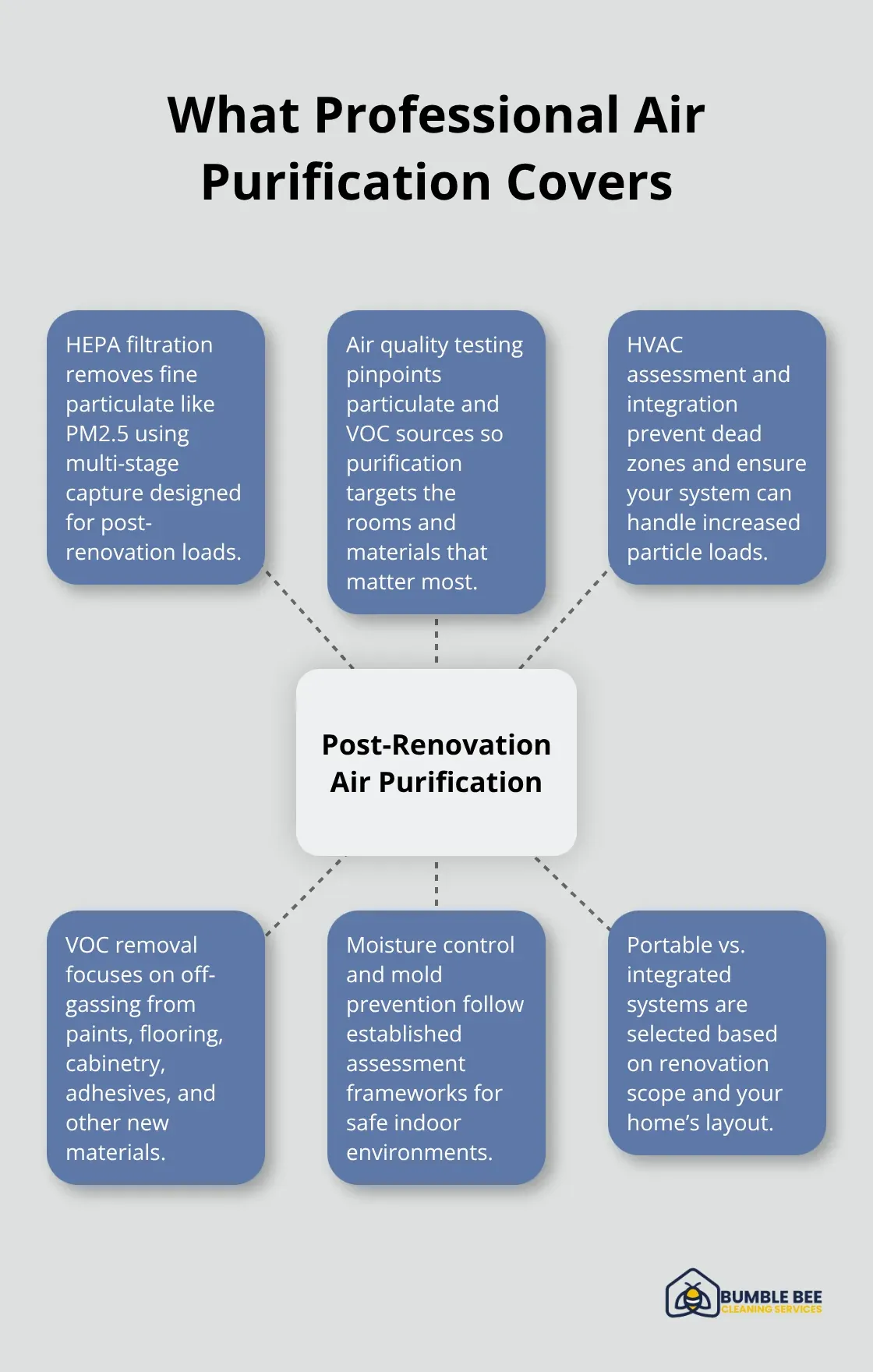
New materials release volatile organic compounds, or VOCs, into your home’s air. Fresh paint, new flooring, insulation, cabinetry, and adhesives all off-gas at different rates depending on temperature and humidity. Your Seattle home’s climate-with its moderate temperatures and variable moisture-can extend off-gassing periods significantly. The EPA provides guidance on managing these chemical releases, but most homeowners lack the tools to monitor or control them effectively. Professional air quality testing identifies which materials serve as the primary VOC sources, allowing targeted purification rather than guessing which rooms need the most attention.
Health Risks That Extend Beyond Renovation Week
Exposure to particle pollution links to premature death in people with heart or lung disease, according to EPA research. Particle pollution also causes irregular heartbeat, aggravates asthma, decreases lung function, and increases respiratory symptoms like coughing and difficulty breathing. Children, older adults, and individuals with existing respiratory conditions face the greatest risk. Even healthy family members experience irritation of airways during the weeks following renovation. The longer contaminated air circulates through your home, the greater the cumulative health impact on everyone living there.
Why Standard Cleaning Falls Short
Surface cleaning addresses visible dust but misses the airborne particles that matter most for your family’s health. Particles suspended in your air (especially those smaller than 2.5 micrometers) require specialized equipment to remove effectively. Professional air purification systems target these microscopic contaminants that standard household methods cannot reach. Understanding this gap between visible cleanliness and actual air quality is the first step toward protecting your home after renovation.
What Professional Air Purification Actually Does
HEPA Filtration: The Industry Standard
HEPA filtration stands as the industry standard for post-renovation air cleaning, and for good reason. True HEPA filters capture 99.97% of particles 0.3 micrometers and larger, which means they trap the PM2.5 particles that penetrate deep into your lungs. The International Institute of Inspection, Cleaning and Restoration Certification (IICRC) recommends professional assessment of HVAC systems following renovation events under their S590 Standard, because your existing system likely cannot handle the particle load without upgrades. Most residential HVAC systems use standard filters rated MERV 8 or MERV 11, which remove only 20-45% of fine particles.
Professional-grade HEPA systems operate as portable units that work independently or integrate with your HVAC, creating multi-stage filtration that captures dust, VOCs, and chemical off-gassing simultaneously. The right system depends on your renovation’s scope and your Seattle home’s layout.
Testing Reveals What You Cannot See
Professional air quality testing identifies exactly what contaminates your air rather than guessing which rooms need priority attention. Post-renovation assessment measures both particulate matter levels and volatile organic compound concentrations, pinpointing which materials or areas drive contamination. The IICRC S530 Indoor Environment Assessment for Suspected Mold Contaminated Structures and S410 Cleaning of the Built Environment for Infection Prevention and Control provide frameworks for comprehensive post-renovation evaluation.
Testing results guide purification strategy, determining whether you need aggressive VOC removal, moisture control to prevent mold growth, or extended particulate filtration. Most professional services recommend baseline testing immediately after construction ends, then follow-up testing one to two weeks later to confirm air quality recovery.
HVAC Integration Requires Professional Expertise
Integration with your HVAC system requires professional evaluation because improper installation reduces efficiency and leaves dead zones where particles accumulate. Sealed rooms, basements, and upper floors often trap contaminated air that standard ventilation misses, making targeted purification essential in homes with complex layouts or multiple renovation zones. Professional assessment determines whether portable HEPA units, HVAC upgrades, or combination approaches work best for your specific situation.
The right purification strategy addresses your home’s unique ventilation challenges and renovation scope. Understanding these technical requirements helps you recognize why professional solutions outperform DIY approaches when your family’s air quality is at stake.
When Professional Air Purification Becomes Non-Negotiable
Most Seattle homeowners wait too long to call for professional air purification, hoping that opening windows and running fans will solve the problem. This approach fails because particulate contamination doesn’t simply disperse into the atmosphere-it settles into fabrics, HVAC ducts, and continues circulating through your home for weeks after renovation ends. The EPA identifies that particle pollution from construction remains elevated indoors for 3 to 8 weeks without active purification, meaning your family breathes contaminated air far longer than you realize.
Signs Your Home Needs Professional Air Purification
You need professional intervention when visible dust persists beyond the first week after construction. Respiratory symptoms like persistent coughing or throat irritation signal that airborne particles have reached your family’s lungs. Strong chemical odors that don’t fade within 48 hours indicate active off-gassing from new materials.
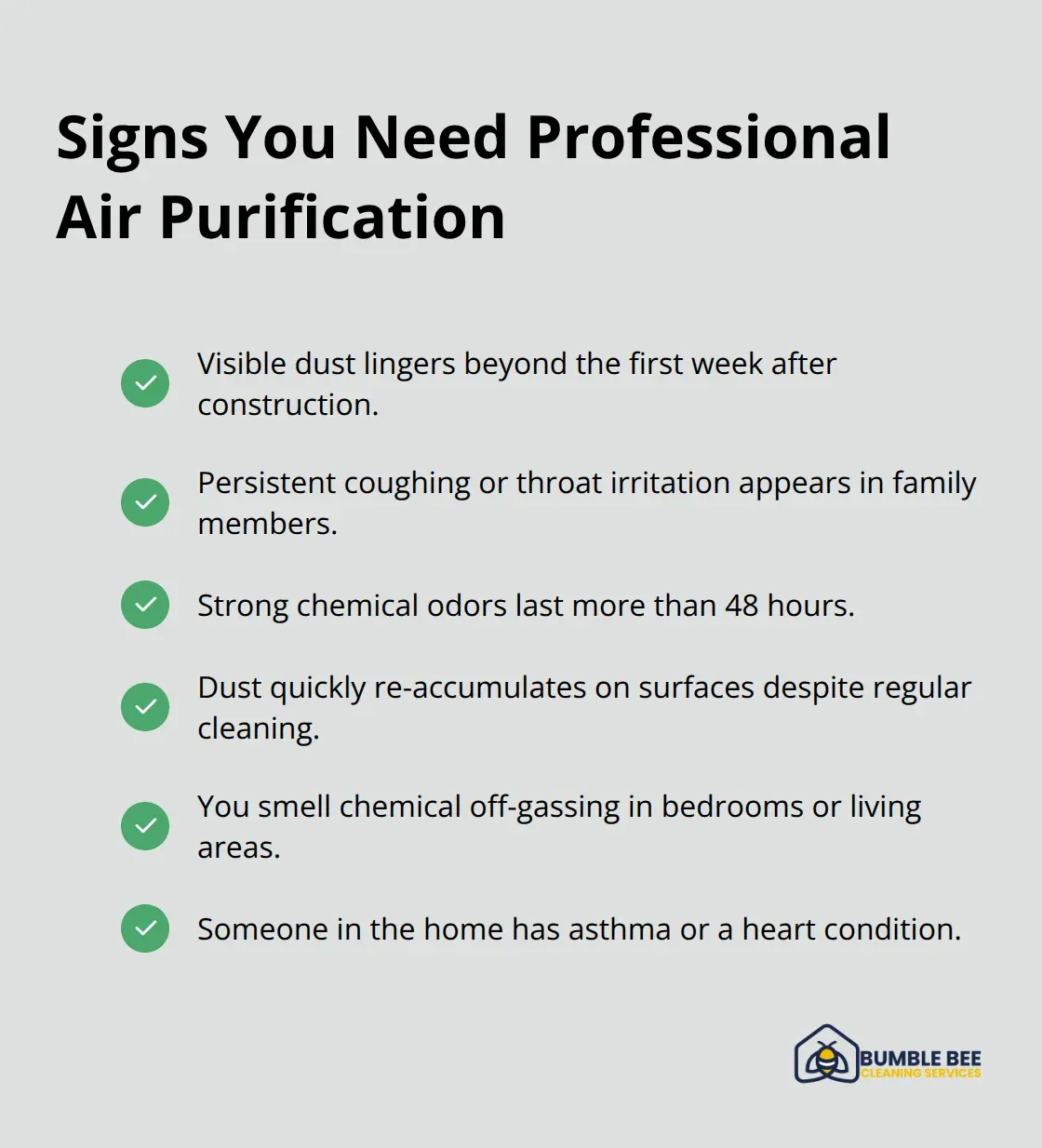
If you notice dust accumulation on surfaces despite regular cleaning, smell chemical off-gassing in bedrooms or living areas, or have family members with asthma or heart conditions, professional testing and purification should happen within the first two weeks after construction completion. The IICRC S590 Standard for Professional Assessment of HVAC Systems Following Water, Fire, or Mold Damage Event applies equally to post-renovation scenarios, emphasizing that your existing HVAC system requires professional evaluation to determine whether it can handle the contamination load.
How Fast Professional Purification Works
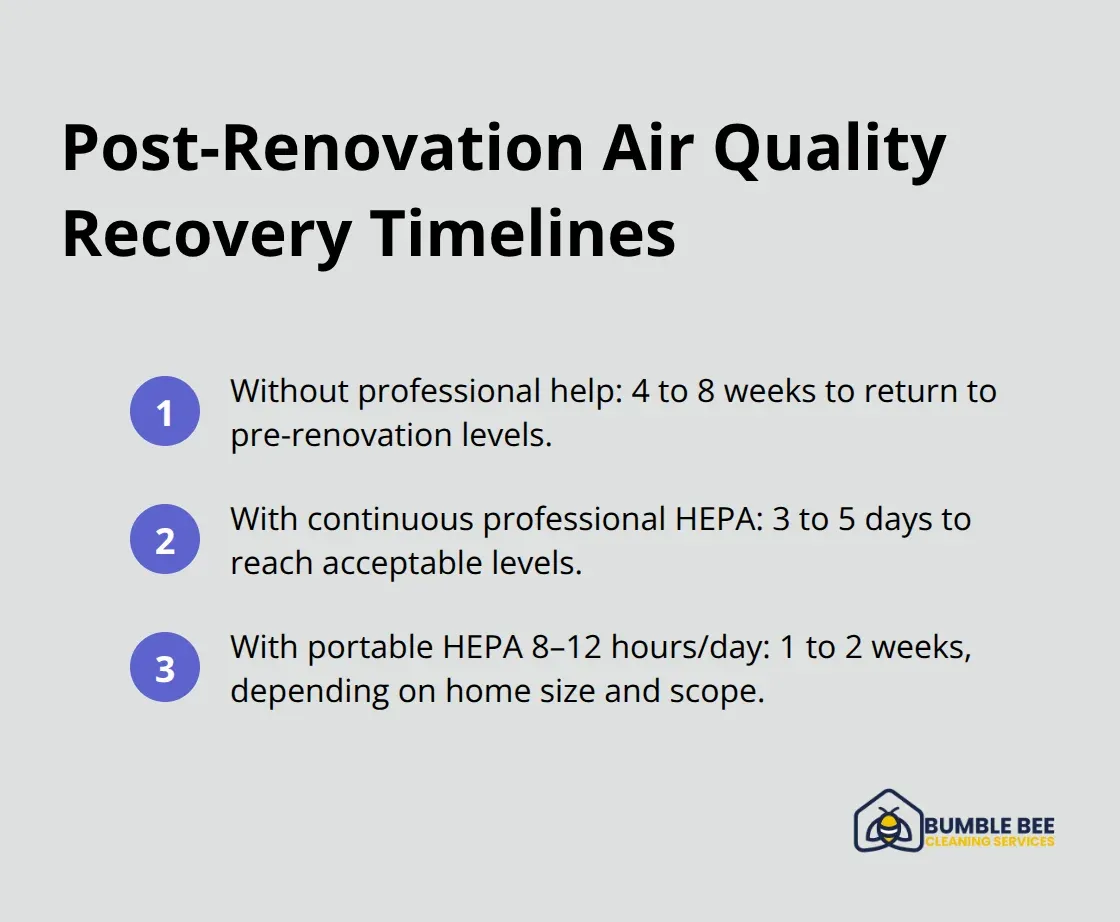
Without professional intervention, Seattle homes typically require 4 to 8 weeks for air quality to return to pre-renovation levels-assuming you keep windows open constantly and maintain active ventilation. Professional HEPA filtration accelerates this timeline dramatically, reducing contamination to acceptable levels within 3 to 5 days of continuous operation. Portable HEPA units running 8 to 12 hours daily can achieve similar results within 1 to 2 weeks, depending on your home’s square footage and the renovation’s scope.
Testing and Verification Matter
Baseline air quality testing immediately after construction ends provides your starting point. Professional purification deployment within 48 hours prevents contamination from settling deeper into your home’s materials and systems. Verification testing 5 to 7 days later confirms that recovery has actually occurred rather than relying on how your home feels or smells.
Long-Term Monitoring Prevents Hidden Problems
VOC off-gassing continues at reduced levels for months-particularly from new cabinetry, flooring adhesives, and paint finishes. Schedule follow-up testing at 4 weeks and 8 weeks post-renovation to verify that off-gassing rates have declined sufficiently for occupied living. Homes with multiple renovation zones or complex HVAC layouts benefit from extended monitoring because air stratification creates pockets where contamination lingers longer than in main living areas. Professional assessment identifies which rooms recover fastest and which require extended purification attention, preventing the false sense of security that comes from surface-level improvements.
Final Thoughts
Your Seattle home’s air quality after renovation depends on recognizing contamination signs and acting quickly. Persistent dust beyond the first week, respiratory symptoms in family members, and chemical odors lasting more than 48 hours all signal that professional intervention is necessary. These indicators reflect what actually happens in your air, not just what you see on surfaces.
Professional air purification outperforms DIY approaches because it targets the microscopic particles and VOCs that standard cleaning cannot reach. HEPA filtration captures 99.97% of fine particles, while professional assessment identifies exactly which materials and areas drive contamination. Your existing HVAC system likely cannot handle post-renovation particle loads without upgrades, making professional evaluation essential for effective recovery. Testing confirms that purification actually works rather than relying on how your home feels.
The timeline matters significantly-without professional intervention, your family breathes contaminated air for 4 to 8 weeks. Professional air purification reduces this to 3 to 5 days with continuous operation, protecting your family’s respiratory health during the weeks when contamination poses the greatest risk. We at Bumble Bee Cleaning Services combine professional-grade equipment with comprehensive assessment to restore your home’s air quality after construction, and our team understands Seattle’s climate challenges and renovation complexities that affect how long contamination lingers.
For more information about our cleaning services in Seattle and Atlanta, or to request a cleaning quote, call or text us at 425-786-1360 or email us at info@qbclean.com
