
Your office equipment care directly impacts your bottom line. Dust and debris silently damage servers, computers, and networking systems-shortening their lifespan and triggering expensive repairs.
We at Bumble Bee Cleaning Services know that most Seattle businesses overlook this critical maintenance gap. Professional deep cleaning isn’t a luxury; it’s a business necessity that prevents downtime and protects your technology investment.
Why Dust Destroys Your Tech Investment
Seattle’s indoor environment creates perfect conditions for tech damage. The Pacific Northwest’s moisture and urban dust combine to coat servers, computers, and networking equipment with debris that degrades performance faster than most business owners realize. Dust buildup can block fans, causing the CPU or GPU to overheat and significantly hindering cooling efficiency. In server rooms and network closets, this heat accumulation becomes catastrophic. Your IT infrastructure depends on consistent airflow, and dust clogs ventilation pathways within hours of accumulation in high-traffic Seattle offices.
How Heat Buildup Damages Equipment
Heat accumulation inside equipment triggers cascading failures that compound over time. Processors throttle performance when internal temperatures rise, slowing your entire system. Capacitors and power supplies fail prematurely when exposed to sustained heat stress, and replacement costs escalate quickly. Your servers and networking devices operate within narrow temperature ranges, and dust disrupts this balance entirely. Most businesses wait until equipment fails before addressing cleanliness, at which point replacement costs exceed $5,000 to $15,000 per server or advanced networking device.
Where Dust Hides in Your Office
Dust settles unevenly across your workspace, concentrating in specific high-risk zones. Server racks and network closets accumulate the heaviest deposits because air circulation systems push debris toward these concentrated areas. Keyboard mechanisms trap particles that corrode electrical contacts, making equipment unresponsive within months of neglect. Ventilation intakes in computers and monitors pull in dust continuously, creating internal blockages that force system shutdowns and data loss. Conference room equipment like projectors and video conferencing systems fail silently until they malfunction during critical client presentations. Break room appliances, printers, and multifunction devices experience the same degradation pattern. Seattle offices with open floor plans face additional challenges because dust travels freely across larger spaces, settling on every surface including equipment. The Eastside tech campuses in Redmond and Kirkland experience particular vulnerability because their newer, more densely packed facilities concentrate equipment in smaller zones where dust accumulation accelerates.
The Real Cost of Skipping Deep Cleaning
Neglected tech maintenance compounds financially in ways that spreadsheets often miss. Equipment lifespan drops from five years to two or three years when dust accumulates unchecked. Unplanned server failures can cost tens of thousands of dollars per outage in emergency repairs, data recovery, and lost productivity during downtime. Your employees cannot work when systems fail, and that idle time multiplies across your entire team. A 50-person Seattle tech company loses approximately $2,500 per hour when critical systems go offline, according to industry downtime studies. Most businesses discover this cost only after experiencing their first major failure. Professional deep cleaning prevents this scenario entirely, maintaining equipment at peak efficiency and protecting your technology assets from preventable damage. The investment in regular deep cleaning costs a fraction of emergency repairs.
Understanding these risks reveals why professional deep cleaning standards matter for your tech infrastructure. Industry guidelines from organizations like ISSA and ARCSI establish specific protocols that protect your equipment while removing harmful debris.
Deep Cleaning Protects Your Technology Investment
Equipment Lifespan Collapses Without Maintenance
Equipment lifespan deteriorates measurably when dust accumulates inside systems. A server that should operate for five years often fails within two to three years when dust buildup remains unchecked. This acceleration happens because dust blocks thermal pathways, forcing processors to throttle performance and capacitors to degrade under sustained heat stress. Your networking equipment, storage drives, and power supplies all experience the same compressed timeline. Replacing a single server costs between $5,000 and $15,000, and that expense multiplies across your entire tech infrastructure. Seattle businesses operating with 20 to 50 servers face replacement costs exceeding $100,000 when equipment fails prematurely from neglect. Deep cleaning costs a fraction of this amount, yet most companies only address cleanliness after experiencing their first catastrophic failure.
Performance Degradation Starts Early
System performance degradation begins long before equipment fails completely. Dust accumulation reduces cooling efficiency, which triggers automatic performance throttling that slows your entire operation. Employees experience system lag, application crashes, and file transfer delays that compound throughout the workday.
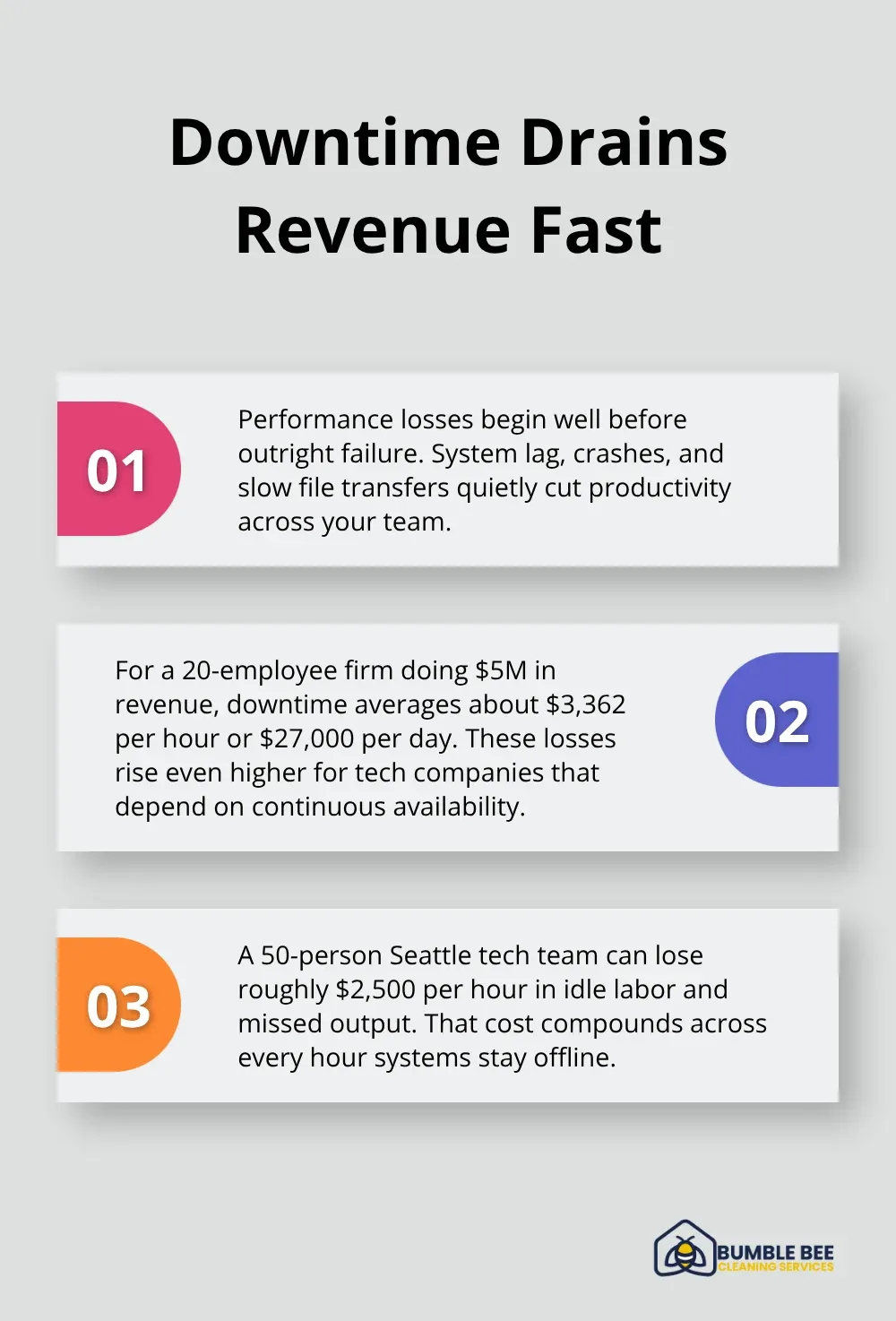
For a company with 20 employees doing $5 million in annual revenue, downtime can cost $3,362 per hour or $27,000 per day, with tech companies experiencing even higher losses because their operations depend entirely on system availability. Your 50-person Seattle tech team loses significant revenue when critical systems malfunction, multiplied across every team member unable to work.
Real Consequences Across Your Operations
These aren’t theoretical costs. When your development servers go offline during a critical project deadline, your team cannot deploy code, test applications, or meet client deliverables. Conference room equipment fails during investor presentations or client demos, damaging your professional reputation and potentially costing business. Break room printers jam repeatedly, wasting employee time on troubleshooting instead of productive work. Each failure compounds the damage to your operations and your bottom line.
Professional deep cleaning prevents these scenarios entirely, maintaining equipment at peak operational efficiency and protecting your technology assets. Regular maintenance keeps systems cool, responsive, and reliable throughout their intended lifespan. Industry standards from organizations like ISSA and ARCSI establish specific protocols that protect your equipment while removing harmful debris-protocols that separate professional deep cleaning from standard janitorial services.
Professional Standards Protect Your Equipment
ISSA and ARCSI Guidelines Establish Safe Cleaning Protocols
Industry organizations like ISSA and ARCSI have established specific cleaning protocols that directly address equipment protection in tech environments. ISSA’s Cleaning Industry Management Standard provides detailed guidelines for removing dust and debris from sensitive electronics without causing damage, while ARCSI certification ensures cleaners understand the unique requirements of technology-heavy workspaces. These standards exist because standard janitorial cleaning damages equipment. Compressed air canisters force moisture into circuit boards and create static discharge that kills components. ISSA guidelines specifically prohibit this approach, instead recommending microfiber cloths and vacuum systems with HEPA filtration that capture particles without forcing them deeper into equipment.
Why Certified Cleaners Outperform Uncertified Teams
The difference between certified and uncertified cleaners becomes obvious when equipment starts failing after a cleaning visit. Your IT team needs cleaners who understand that server fans require gentle, directional cleaning rather than aggressive blowing, and that keyboard mechanisms need specialized extraction techniques to remove trapped particles without damaging electrical contacts. ARCSI-certified professionals know these distinctions; general cleaners do not. Bumble Bee Cleaning Services holds ARCSI certification, ensuring our team follows professional cleaning best practices when cleaning your servers, networking equipment, and critical infrastructure.
DIY Cleaning Causes More Damage Than Prevention
DIY cleaning consistently causes more damage than it prevents in technology environments. When your internal staff or untrained contractors attempt to clean servers and networking equipment, they lack the equipment and knowledge to do it safely. Most businesses use household vacuum cleaners that generate static electricity capable of destroying sensitive circuitry, or they use compressed air that introduces moisture into sealed components.
Moisture Control Requires Professional Coordination
Server rooms require temperature and humidity control that gets disrupted when untrained people open equipment enclosures. Professional deep cleaning services coordinate with your facility managers to maintain environmental controls throughout the process, preventing the temperature fluctuations and humidity spikes that damage equipment. The cost of professional cleaning for your server room runs between $500 and $1,500 depending on equipment density, while a single failed server costs $5,000 to $15,000 to replace.
Final Thoughts
Your office equipment care directly impacts whether your Seattle business operates smoothly or faces expensive downtime. Dust accumulation inside servers, computers, and networking systems compresses equipment lifespan from five years to two or three years, costing your company tens of thousands in premature replacements and emergency repairs. A single server replacement costs $5,000 to $15,000, while an hour of system downtime costs your 50-person tech team approximately $2,500 in lost productivity.
Professional deep cleaning prevents both scenarios by maintaining your equipment at peak efficiency throughout its intended lifespan. Industry standards from ISSA and ARCSI exist specifically because standard janitorial cleaning damages sensitive electronics-certified cleaners understand the difference between safe microfiber techniques and destructive compressed air methods. They coordinate with your facility managers to maintain environmental controls, preventing the temperature fluctuations that trigger component failure.
DIY cleaning consistently causes more damage than prevention, as your internal staff lacks the specialized equipment and knowledge required to clean servers and networking infrastructure safely. Moisture introduced during cleaning, static discharge from household vacuums, and aggressive techniques that force debris deeper into equipment all create expensive problems that far exceed the cost of professional service. Contact Bumble Bee Cleaning Services today to schedule your first deep cleaning and protect your technology investment from preventable damage.
For more information about our cleaning services in Seattle and Atlanta, or to request a cleaning quote, call or text us at 425-786-1360 or email us at info@qbclean.com
