
Construction projects leave behind stubborn odors that won’t fade on their own. These smells come from materials, dust buildup, and trapped moisture-all of which can drive customers away and hurt your bottom line.
At Bumble Bee Cleaning Services, we’ve seen how lingering construction odors damage Seattle businesses. Odor neutralization through professional post-construction cleaning is the fastest way to reclaim your space and restore customer confidence.
What Makes Construction Odors Stick Around
Volatile Organic Compounds Release Over Weeks
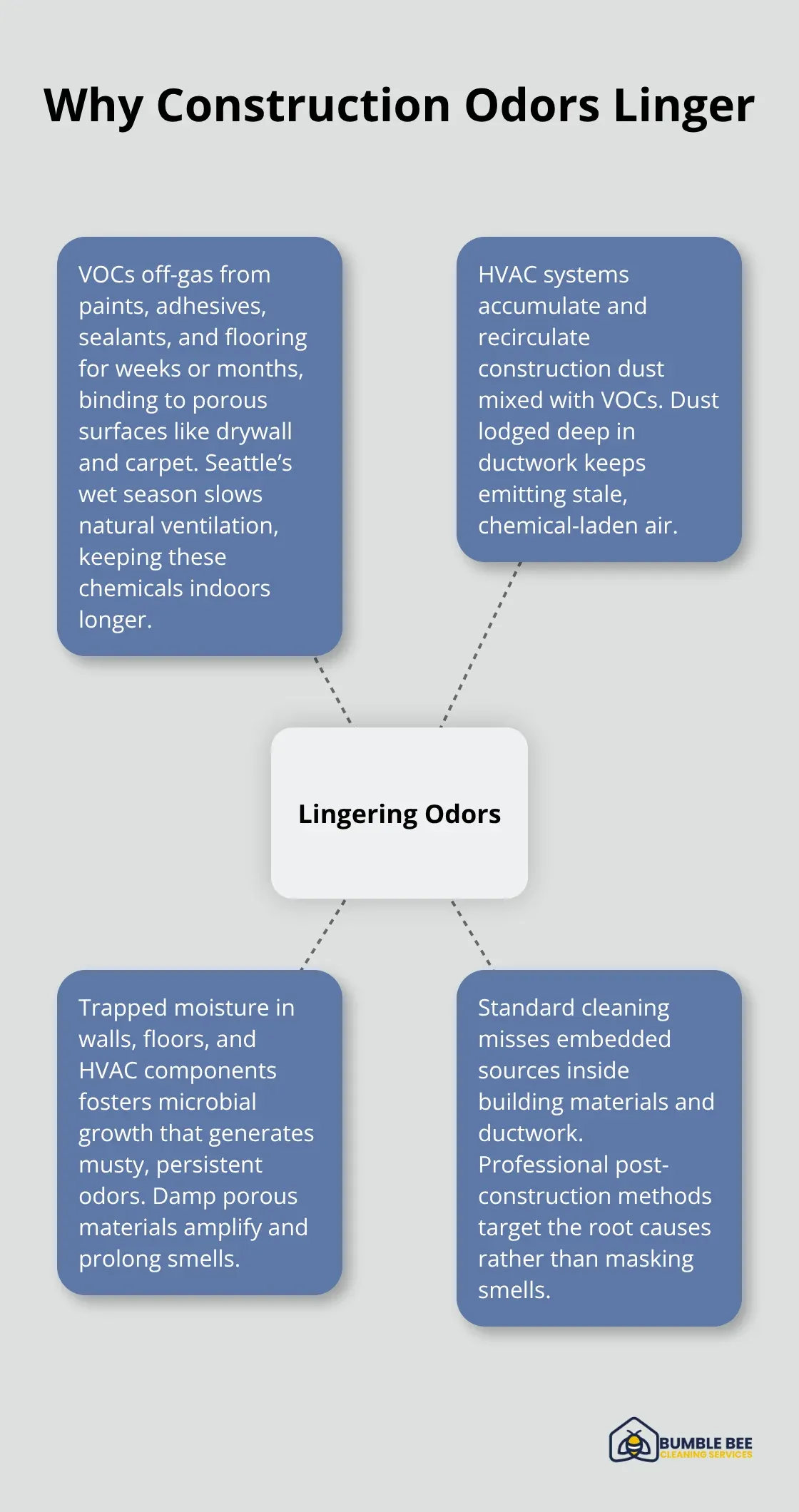
Construction materials release volatile organic compounds that don’t disappear when workers leave the site. Paint, adhesives, sealants, and new flooring emit VOCs that linger in the air and settle into porous surfaces like drywall, carpet, and insulation. These compounds stick around because they bond to materials and continue off-gassing for weeks or months after installation. Seattle’s wet season traps moisture in walls and building cavities, slowing the natural ventilation process that would normally clear these chemicals out.
HVAC Systems Recirculate Construction Dust
Construction dust accumulates in HVAC systems and air ducts, where it mixes with VOCs and gets recirculated throughout your entire building every time the system runs. This dust settles on surfaces and inside ductwork, creating a continuous source of stale, chemical-laden air that customers and employees notice immediately upon entering your space. The problem compounds because standard vacuuming doesn’t reach deep into ductwork where particles lodge and persist.
Moisture Traps Odors in Building Materials
Moisture is the hidden culprit that makes construction odors nearly impossible to eliminate without professional intervention. After drywall installation, concrete pours, and plumbing work, water gets trapped inside walls, under flooring, and in HVAC components. Seattle’s heavy rainfall and snowmelt intensify this problem-water intrusion from storms or poor drainage routes moisture into foundation cracks and wall cavities where it sits for months. When porous materials like drywall, insulation, and subflooring stay damp, they develop microbial growth that produces musty, persistent odors far worse than the original VOC smell.
Why Standard Cleaning Falls Short
Standard cleaning alone won’t solve construction odor problems because the source embeds itself in your building’s structure and mechanical systems. Professional post-construction cleaning removes dust from HVAC systems, applies enzymatic treatments to porous surfaces, and uses targeted ventilation strategies to flush out trapped VOCs and moisture. Acting quickly after construction ends prevents these odors from becoming permanent fixtures in your business environment-and sets the stage for understanding how these lingering smells affect your customers and staff.
The Real Cost of Construction Odors to Your Business
First Impressions Collapse in Seconds
Construction odors damage your business faster than you might expect. When customers walk into a space that smells like paint, adhesives, or musty drywall, their first impression turns negative within seconds. That initial reaction shapes how they perceive your entire operation, regardless of how clean your floors are or how professional your staff appears. Smell ranks second only to sight in shaping purchasing decisions. If your Seattle business reopens after construction with lingering odors, you face an uphill battle to convince customers the space is truly ready.
Employee Health and Productivity Suffer Immediately
Employees notice the problem just as quickly as customers do. VOCs and construction dust trigger headaches, respiratory irritation, and fatigue-symptoms that reduce focus and slow productivity. Workers in poorly ventilated spaces after construction report higher absenteeism and lower output. Fine particulate matter from construction work penetrates deep into your lungs and causes immediate irritation plus chronic health problems, and when your team spends 8+ hours breathing contaminated air daily, their performance suffers measurably.
Revenue Loss Hits Your Bottom Line
Beyond customer perception and employee health lies the financial reality: businesses lose revenue because people avoid spaces that smell bad. A commercial property manager in Seattle shared that a retail tenant experienced a 30% drop in foot traffic during the first three weeks after renovation until professional odor remediation was completed. That’s not theoretical-it’s revenue walking out the door. The cost of professional post-construction cleaning pales compared to lost sales, customer complaints, and staff turnover caused by odor problems.
The number 100% seems to be not appropriate for this chart. Please use a different chart type.
Professional Remediation Protects Your Investment
Addressing construction odors immediately positions your business to reclaim customer confidence and protect your team’s health from day one. Professional post-construction cleaning removes dust from HVAC systems, applies enzymatic treatments to porous surfaces, and uses targeted ventilation strategies to flush out trapped VOCs and moisture. The speed of your response determines whether odors become temporary inconveniences or permanent business liabilities. Understanding what removal strategies actually work-and which ones fall short-separates businesses that recover quickly from those that struggle for months.
How to Eliminate Construction Odors Fast
HEPA Filtration Removes Dust at the Source
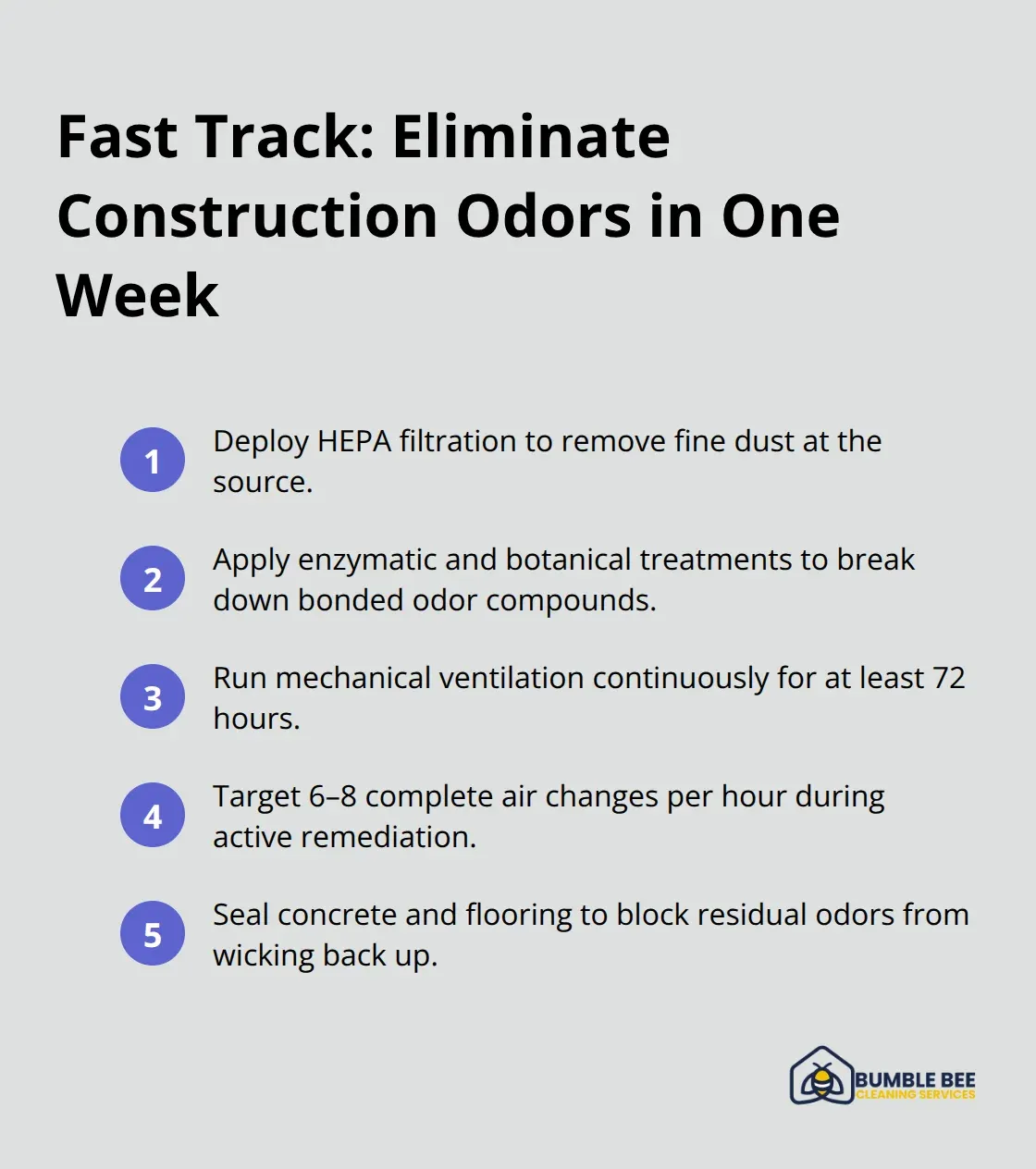
Professional post-construction cleaning removes the source of odors rather than masking them with fragrance. HEPA filtration captures 99.97% of airborne particles as small as 0.3 microns, eliminating dust trapped in HVAC systems and on surfaces where VOCs cling. Standard vacuums leave behind fine particles that continue releasing chemical odors for weeks. After HVAC cleaning, enzymatic treatments break down odor-causing compounds bonded to drywall, carpet, and concrete.
Enzymatic and Botanical Treatments Target Moisture Odors
For moisture-related smells from trapped water in walls or subflooring, targeted drying protocols followed by botanical-grade disinfectants work to eliminate odor-producing microbes. EPA-registered plant-derived solutions like thymol kill 99.9% of the bacteria and fungi responsible for musty smells. The timeline matters significantly: odor remediation within 48 to 72 hours of construction completion prevents moisture from settling permanently into building materials. Waiting longer allows VOCs to bond deeper into porous surfaces and microbial growth to establish in damp wall cavities, making removal exponentially harder.
High-Capacity Ventilation Flushes VOCs and Moisture
Ventilation strategy matters as much as cleaning. After construction, mechanical ventilation must run continuously at high capacity for 72 hours minimum to flush VOCs and moisture out of the building. Many Seattle businesses make the mistake of opening windows for a few hours and assuming the problem is solved; outdoor air circulation alone cannot remove VOCs embedded in materials or moisture trapped inside wall cavities. Air exchange rates need to reach 6 to 8 complete room air changes per hour during active remediation, far exceeding normal operating ventilation.
Sealing Prevents Residual Odors from Returning
Once professional cleaning and intensive ventilation complete the initial flush, seal concrete and flooring with odor-blocking products to prevent residual smells from rising back through porous substrates. This combination of HEPA-filtered dust removal, enzymatic treatments, high-capacity ventilation, and sealing delivers measurable results within one week rather than months of waiting for air to naturally clear the space. The sealed surfaces act as a barrier that stops odor molecules from migrating upward through concrete or subflooring (a common problem in Seattle’s damp climate where moisture continuously tries to rise from below).
Final Thoughts
Construction odors don’t fade without professional intervention, and waiting costs your Seattle business money, customers, and employee health. Odor neutralization removes the root causes-trapped VOCs, dust in HVAC systems, and moisture in building materials-rather than masking the problem with fragrance. Acting within 48 to 72 hours after construction ends prevents odors from embedding permanently into your walls, flooring, and mechanical systems.
Your customers return without hesitation, your employees work in a healthy environment free from respiratory irritation, and your reputation stays intact when you address construction odors immediately. Sealed concrete and treated surfaces prevent residual smells from creeping back months later when Seattle’s wet season brings moisture rising through your foundation. You avoid the compounding costs of lost revenue, staff turnover, and repeat remediation attempts that plague businesses that delay action.
We at Bumble Bee Cleaning Services use HEPA filtration, enzymatic treatments, and high-capacity ventilation to eliminate odors completely rather than temporarily (our team holds ARCSI and IICRC certification for every post-construction project). Contact us today to schedule your post-construction cleaning and reclaim your space within days, not months. Your business deserves a fresh start after construction-and your customers and team deserve to breathe clean air from day one.
For more information about our cleaning services in Seattle and Atlanta, or to request a cleaning quote, call or text us at 425-786-1360 or email us at info@qbclean.com
