
Seattle business owners often assume their cleaning routines are compliant. The reality is that many fall short of OSHA, Washington State Health Department, and industry standards.
We at Bumble Bee Cleaning Services have seen firsthand how commercial compliance gaps create liability and health risks. This guide walks you through the standards that matter and how to audit your business against them.
Which Compliance Standards Actually Apply to Your Seattle Business
OSHA, Washington State, and Industry Standards Work Together
OSHA sets the baseline for workplace safety, requiring employers to maintain clean environments that prevent hazards. Floors must stay free from spills and debris, restrooms must receive proper sanitization, and high-touch surfaces need regular disinfection to reduce pathogen transmission. Washington State Health Department guidelines build on OSHA requirements with sector-specific rules. Healthcare facilities must follow infection-control protocols aligned with CDC standards, while food service areas require HACCP compliance. Educational institutions must prioritize high-touch surface sanitization in classrooms and common areas. The key difference is that Washington State rules often exceed federal minimums, making local compliance harder than just meeting OSHA alone.
ISSA and ARCSI set industry standards that go further still. ISSA’s Cleaning Industry Management Standard provides a framework for quality assurance and documentation, while ARCSI emphasizes professional practices and accountability. These standards matter because they create benchmarks that insurers, regulators, and clients now expect. A facility meeting ISSA standards typically demonstrates lower infection rates and fewer liability claims than those relying only on basic OSHA compliance.
Your Seattle Business Must Align With All Three Levels
Your Seattle business must align with all three levels simultaneously. OSHA compliance alone leaves gaps in documentation and disinfection protocols that Washington State inspectors will catch. Skipping ISSA or ARCSI standards means missing the operational rigor that protects against costly re-cleaning, health claims, and reputational damage.
Documentation and Product Verification Create the Real Compliance Burden
The real compliance burden falls on documentation and product verification. OSHA requires records of cleaning tasks and chemical safety data sheets. Washington State expects proof of proper disinfectant use, especially in healthcare and food handling environments. ISSA standards demand detailed cleaning logs tied to specific protocols. Many Seattle businesses fail not because they skip cleaning, but because they cannot produce timestamped records showing what was cleaned, when, and with which approved products.
EPA-Approved Disinfectants Matter More Than Frequency
Using EPA-approved disinfectants matters more than frequency alone. A surface cleaned twice daily with unapproved products creates liability, while a properly disinfected surface cleaned once daily with EPA-registered sanitizers meets standards. Washington State VOC limits also restrict certain chemical types, so generic off-shelf products often violate state rules.
Identify Your Compliance Gaps Before an Inspector Does
The compliance reality in Seattle is strict, overlapping, and heavily documentation-focused. Most businesses discover their gaps only after an inspection or health incident exposes them. Identifying these gaps now-before regulators or clients demand proof-protects your operation and prevents costly corrections later.
Where Seattle Businesses Fail on Compliance
Disinfection Protocols That Miss EPA Standards
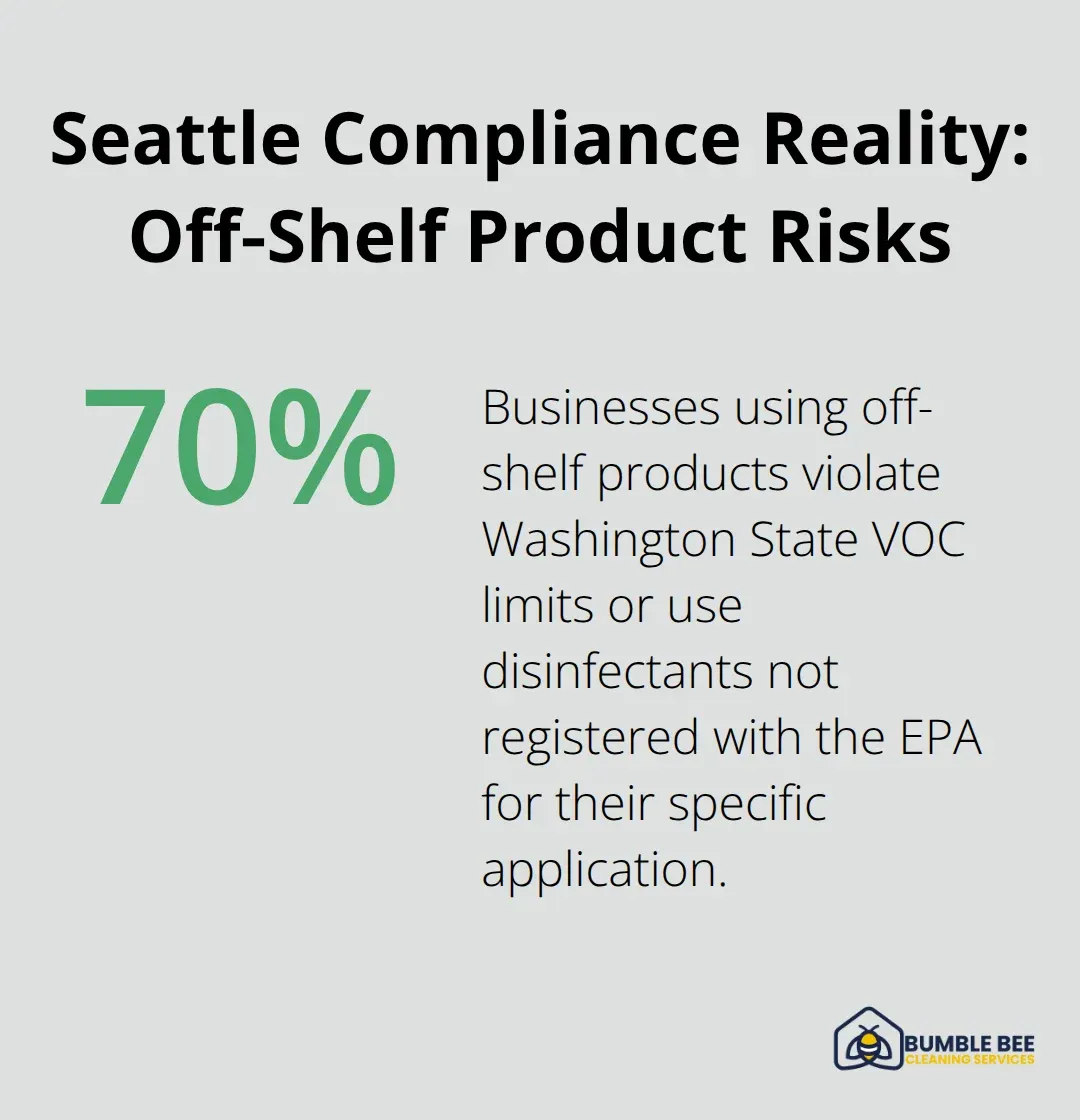
Most Seattle businesses fail compliance audits not because they skip cleaning entirely, but because they misunderstand what regulators actually demand. OSHA inspectors and Washington State health officials focus on three specific failures: disinfection protocols that don’t meet EPA standards, documentation systems that can’t prove compliance happened, and product choices that violate state regulations. These aren’t theoretical problems. Roughly 70 percent of businesses using off-shelf cleaning products unknowingly violate Washington State VOC limits or use disinfectants not registered with the EPA for their specific application.
A surface wiped with a general-purpose cleaner fails to meet healthcare or food-handling standards, even if it looks clean.
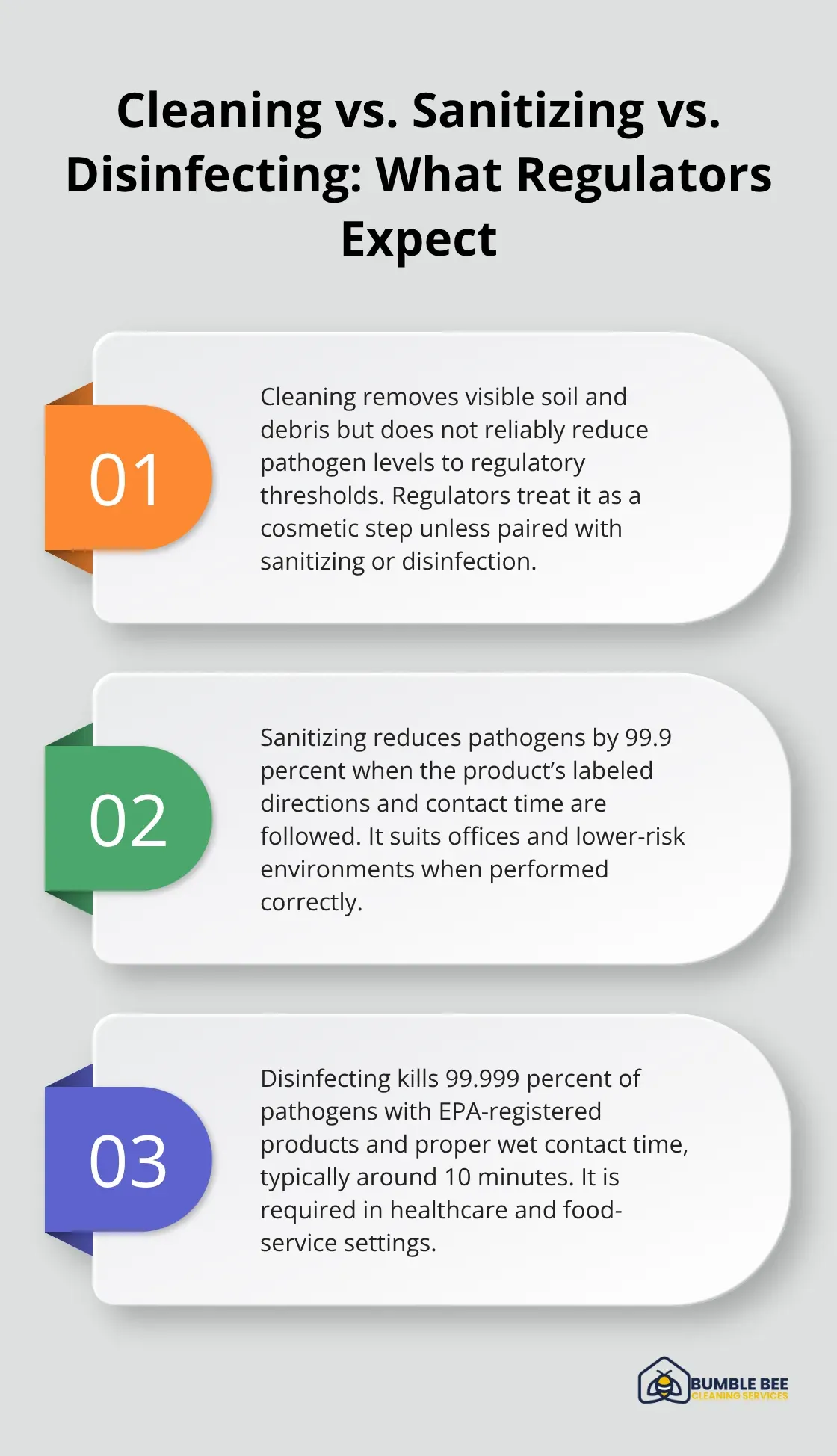
Washington State requires contact time documentation, meaning the disinfectant must sit on the surface for a specific duration (typically 10 minutes for most EPA-registered products) to actually kill pathogens. Many businesses spray and wipe immediately, achieving zero disinfection despite the effort. The difference between cleaning, sanitizing, and disinfecting matters legally. Cleaning removes dirt; sanitizing reduces pathogens by 99.9 percent under specific conditions; disinfecting kills 99.999 percent of pathogens. Healthcare facilities and food-service areas require disinfection. Offices with high employee density need at minimum sanitization.
Using the wrong product category for your business type creates liability and fails inspections.
Record-Keeping Systems That Collapse Under Scrutiny
The second major gap involves record-keeping systems that fail under scrutiny. ISSA standards demand detailed logs showing which areas received cleaning, when, what product was used, and who performed the work. Digital systems with timestamped entries beat paper logs because they cannot be backdated and provide audit trails regulators now expect. Without timestamped records linking each cleaned surface to the exact disinfectant used and contact time required, you cannot prove compliance to an inspector.
Seattle businesses lose contracts because they maintain cleaning schedules but cannot produce proof that high-touch surfaces like door handles, light switches, and conference room tables received the required disinfection frequency. An inspector will ask for documentation, and a verbal assurance that cleaning happened carries zero weight. Digital tracking systems eliminate this vulnerability entirely.
Product Selection Based on Price Rather Than Compliance
A third compliance failure stems from product selection. Many Seattle businesses purchase cleaning supplies based on price rather than regulatory alignment. Products labeled green or eco-friendly sometimes lack EPA registration for disinfection claims, meaning they clean but don’t sanitize. Washington State also enforces stricter VOC limits than federal standards, making many common commercial disinfectants illegal in this state.
These three gaps-inadequate disinfection protocols, missing documentation, and non-compliant products-create the foundation for regulatory failure. Addressing all three simultaneously requires a systematic approach to auditing your current practices and identifying where your operation falls short.
Audit Your Seattle Business for Compliance Right Now
Walk Through Your Facility and Test for Actual Disinfection
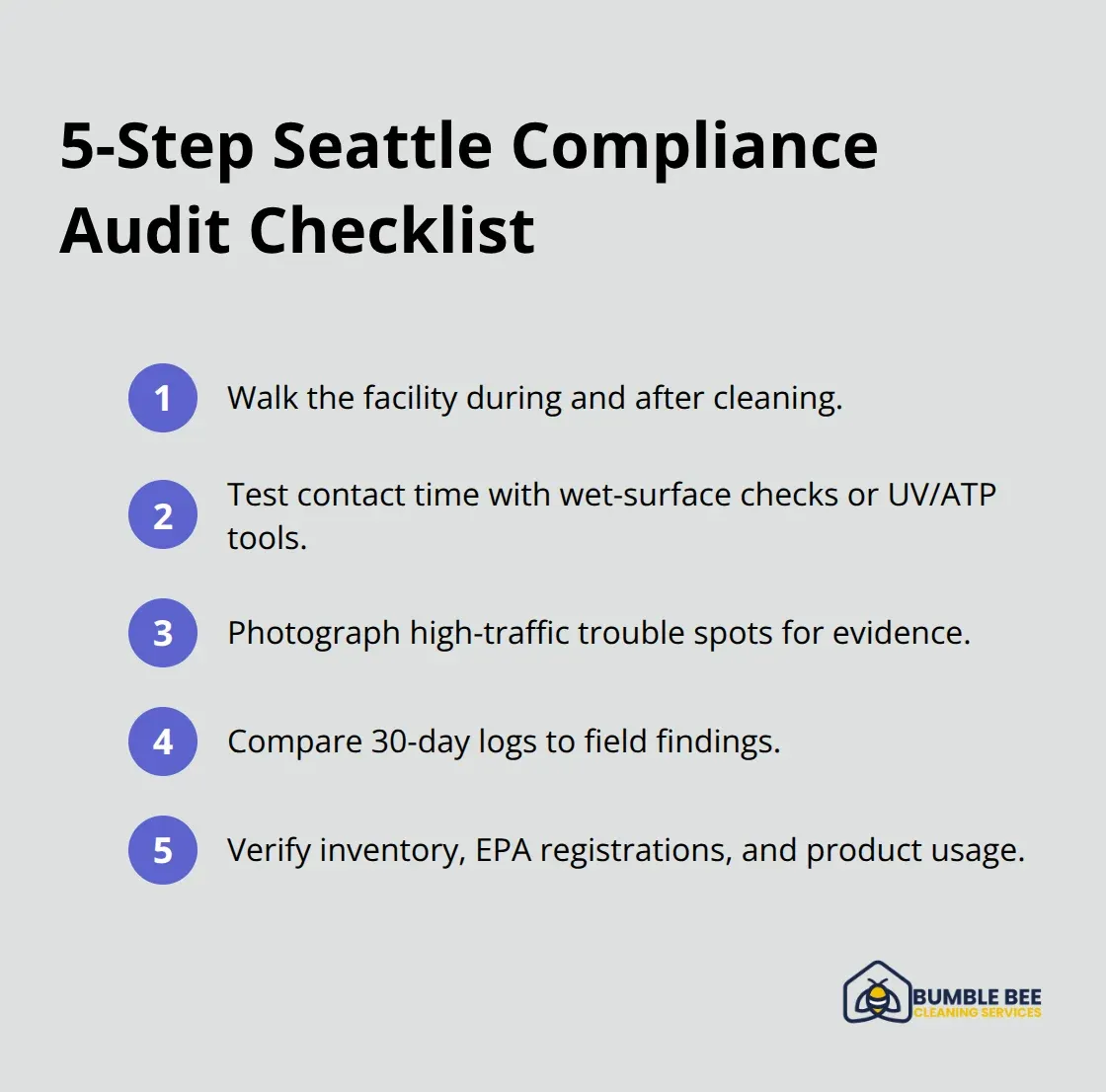
Start your compliance audit with a physical walkthrough of every area your cleaning team touches. Grab a clipboard, visit your facility during and after cleaning hours, and document what you actually see versus what your procedures claim happens. Check restrooms for moisture on surfaces 10 minutes after disinfection-if surfaces are already dry, contact time requirements were never met, meaning no disinfection occurred despite the effort. Inspect high-touch surfaces like door handles, light switches, conference room tables, and elevator buttons with a UV marker or ATP swab test, which measures organic residue and indicates whether disinfection actually worked. Most Seattle businesses discover their cleaners wipe surfaces without allowing proper contact time for EPA-registered disinfectants. Most EPA-registered hospital disinfectants require a minimum of 10 minutes of wet contact to kill pathogens. If your team wipes dry within 2 minutes, your facility fails disinfection standards regardless of which product they use.
Document What You Find in High-Traffic Areas
Photograph high-traffic areas and note where dirt accumulates fastest-these zones need higher cleaning frequency and stricter documentation than low-traffic spaces. Look specifically for carpet stains, grout discoloration, window film buildup, and restroom odors, all of which indicate protocol gaps your current system misses. These visual markers reveal where your cleaning program breaks down under real-world conditions.
Compare Your Records to Your Walkthrough Results
Next, pull your cleaning documentation for the past 30 days and compare it to what actually happened during your walkthrough. If your records show daily disinfection of conference rooms but your UV test reveals residue buildup, your documentation is fabricated or your team skipped tasks. ISSA standards require timestamped records tied to specific products and contact times, not vague entries like “cleaned at 6 PM.” Verify that your documentation system captures which disinfectant was used, when it was applied, how long it remained wet, and who performed the work. Digital systems with automatic timestamps and GPS-verified location data eliminate this vulnerability.
Verify Your Product Inventory Against Usage Claims
Check your product inventory against your documentation-if your logs claim you used 50 gallons of EPA-registered disinfectant monthly but your supplier records show 10 gallons purchased, someone is falsifying records. Washington State regulators now cross-reference product purchases with documented usage, so this discrepancy creates immediate liability. Examine your cleaning product labels and verify EPA registration numbers against the EPA database. Many off-shelf products marketed as disinfectants lack actual EPA registration for disinfection claims, meaning they sanitize at best but do not meet healthcare or food-service standards. If your facility handles food, healthcare, or serves vulnerable populations, you need products registered specifically for those applications, not generic commercial cleaners.
Schedule a Third-Party Audit if Gaps Emerge
Schedule a formal audit with an independent third party if your internal review reveals more than two significant gaps. Professional auditors identify vulnerabilities your team may overlook and provide documentation that satisfies regulatory expectations. This step transforms your audit from an internal exercise into a defensible compliance record that protects your business if inspectors arrive.
Final Thoughts
Commercial compliance standards in Seattle demand action, not promises. Your audit revealed where your operation stands against OSHA, Washington State, and industry expectations. The three critical takeaways remain straightforward: use EPA-approved disinfectants with documented contact time, maintain timestamped records that prove compliance happened, and verify that your product choices align with state regulations.
Staying compliant protects your business in measurable ways. Facilities meeting ISSA standards report fewer infection-related incidents, lower insurance claims, and stronger client retention. Regulatory inspections become routine confirmations rather than crisis moments, and your team gains confidence knowing they follow proven protocols. Seattle businesses increasingly demand proof that their cleaning partners meet industry standards, and documentation demonstrating ARCSI or ISSA alignment wins contracts that price-focused competitors cannot.
Your next step depends on what your audit uncovered. If gaps are minor, implement digital record-keeping immediately and audit your product inventory against EPA registration requirements. If significant gaps emerged, contact a professional third-party auditor to formalize your commercial compliance assessment and create a remediation plan. We at Bumble Bee Cleaning Services specialize in commercial cleaning that meets these exact standards, with ARCSI certification and documented protocols that satisfy Seattle regulatory expectations.
For more information about our cleaning services in Seattle and Atlanta, or to request a cleaning quote, call or text us at 425-786-1360 or email us at info@qbclean.com
