
Post-construction dust doesn’t just settle on surfaces-it circulates through your office air and affects employee health and productivity. Many Seattle business owners assume that upgrading air circulation alone will solve the problem, but ventilation tells only part of the story.
At Bumble Bee Cleaning Services, we’ve seen firsthand that professional cleanup combined with improved ventilation delivers results that neither approach achieves alone. This post explains why both matter and how to create a genuinely clean, healthy workspace.
What Post-Construction Dust Actually Does to Your Office Air
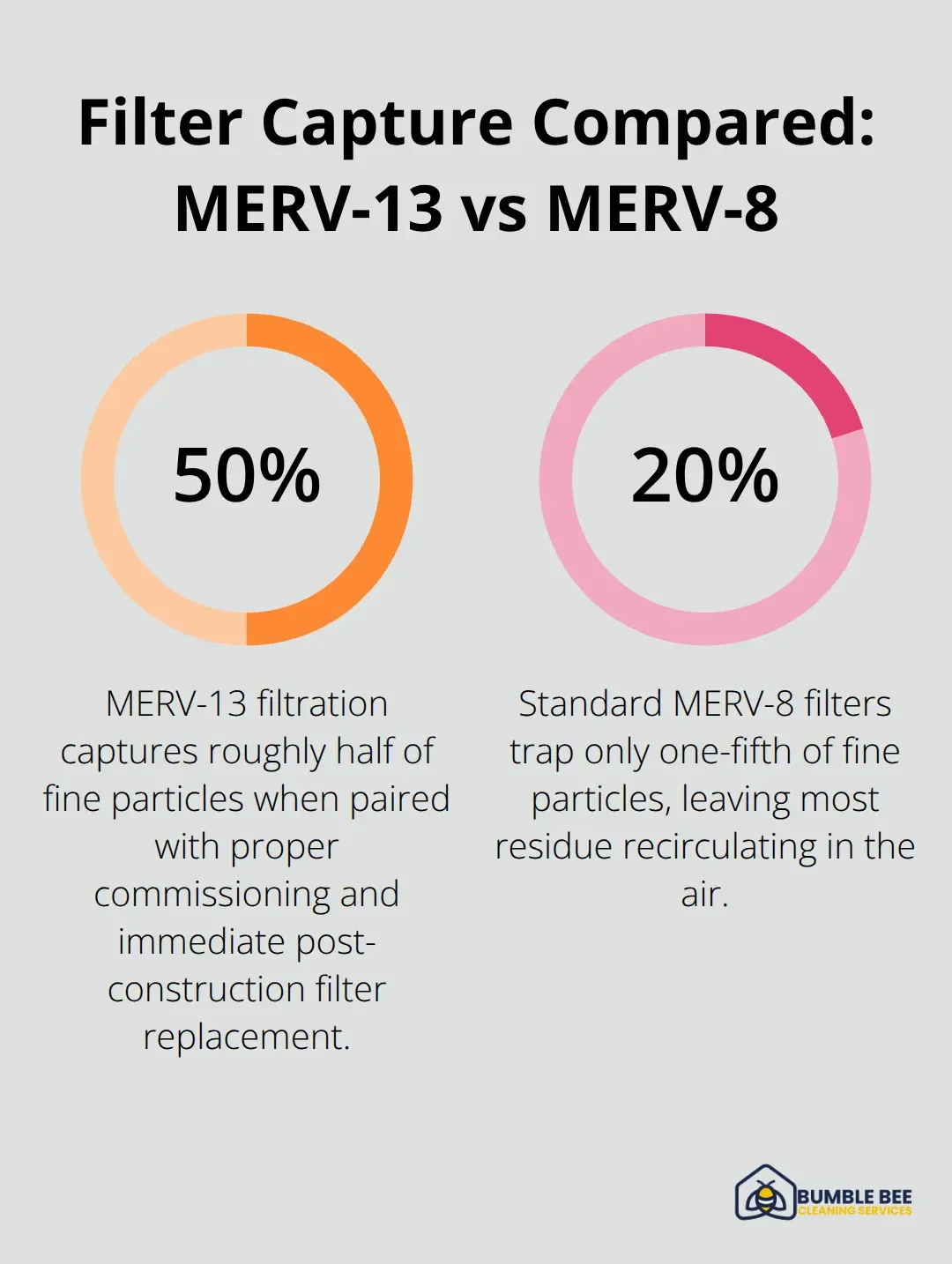
Post-construction dust contains silica, asbestos, lead, and volatile organic compounds from adhesives, sealants, and paints. These particles don’t simply disappear after cleanup ends-they circulate through your HVAC system, settle on surfaces, and remain suspended in the air long after visible debris is removed. According to ASHRAE 62.1 ventilation standards, without proper filtration and cleaning, these contaminants persist for weeks, degrading indoor air quality and affecting everyone in the building. Silica dust exposure causes silicosis, a serious respiratory disease; asbestos triggers mesothelioma and lung cancer; and lead particles pose particular danger around children and vulnerable staff. Volatile organic compounds from construction materials irritate the respiratory system and trigger headaches, fatigue, and breathing difficulties. A professional post-construction cleanup paired with MERV-13 filtration captures roughly 50 percent of fine particles, but only if the HVAC system receives proper commissioning and filters get replaced immediately after construction ends.
Why Ventilation Alone Falls Short
Ventilation without professional surface cleaning creates a false sense of security. Construction dust embeds itself in carpets, upholstery, ceiling tiles, and furniture-areas where air circulation alone cannot reach. Running your HVAC system harder simply redistributes settled dust back into the air, frustrating employees and prolonging exposure. Many Seattle offices skip the thorough surface cleaning phase and rely instead on increased air changes per hour, only to discover that dust complaints persist for months. The EPA and CDC both emphasize that source control-removing dust at its origin through professional cleaning-must come before relying on ventilation to maintain air quality. Professional cleaners use HEPA-filter vacuums that capture 99.97% of particles down to 0.3 microns and microfiber cloths to capture contaminants that standard vacuums leave behind, preventing re-circulation through your system. Without this step, upgrading your HVAC system becomes an expensive band-aid that masks the real problem rather than solving it.
Regulatory Expectations in Washington State
Washington’s Indoor Air Quality Program and the Seattle Energy Code (enforced by SDCI) require that commercial spaces meet baseline air quality standards before occupancy. Post-construction cleaning is not optional-it’s a compliance requirement. Failure to remove hazardous dust and materials exposes your business to health and safety violations, liability claims, and potential fines. The Washington Department of Health enforces these standards, and inspectors specifically check for construction debris in ductwork and on surfaces.
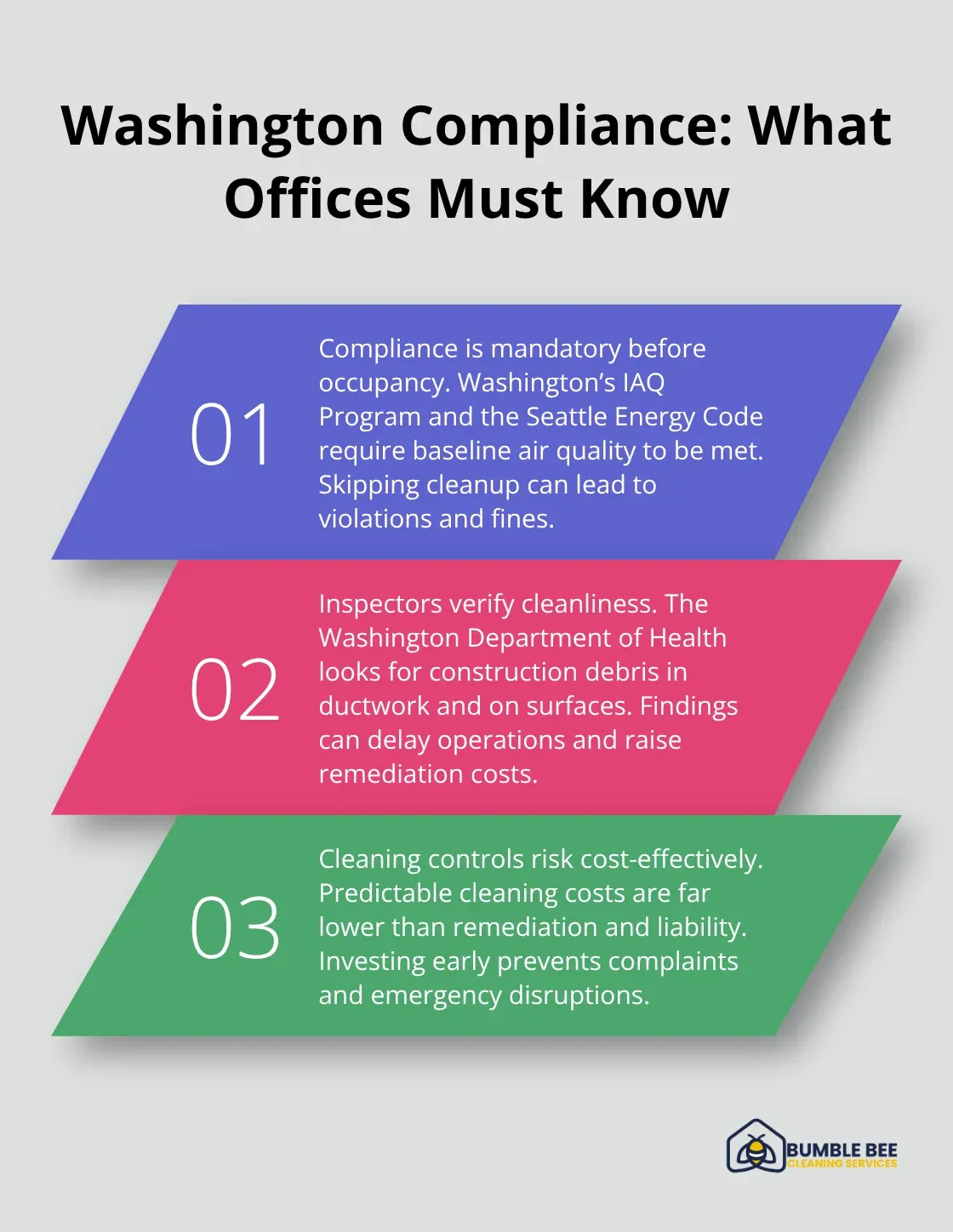
Standard post-construction cleaning typically costs $0.15 to $0.40 per square foot, while deep cleaning runs $0.50 to $0.90 per square foot. The cost of non-compliance-including remediation, legal fees, and lost productivity from sick employees-far exceeds the investment in professional cleanup. Seattle offices that skip professional post-construction cleaning often face occupant complaints about dust and odors within the first week, forcing emergency cleaning that disrupts operations and costs significantly more.
The Case for Combined Approach
Professional cleanup and ventilation improvements work together, not separately. Thorough surface cleaning removes the dust source, while enhanced ventilation maintains air quality going forward. This combination addresses both immediate contamination and long-term indoor air management. The next section explores how HVAC upgrades and filtration improvements support this strategy when paired with professional cleaning.
How HVAC Upgrades and Filtration Remove Construction Dust
Filter Efficiency and System Capacity
HVAC system performance directly determines whether construction dust stays airborne or gets captured. After professional surface cleaning removes embedded particles, your ventilation system must work harder to maintain air quality by filtering recirculated air and bringing in fresh outdoor air. HEPA filtration can remove 99.97% of particles sized 0.3 microns and smaller, a significant improvement over standard MERV-8 filters that trap only 20% of fine particles.
Upgrading filter efficiency increases static pressure on your system. Jumping from MERV-8 to HEPA raises static pressure by 0.05 to 0.15 inches of water column, so your HVAC equipment must handle the additional load before you make the switch. In Seattle’s heating-dominated climate, introducing 100 CFM of fresh outdoor air at 40 degrees increases heating demand by roughly 4,700 BTU per hour-a cost consideration when planning ventilation improvements.
Ventilation Standards and Air Exchange
ASHRAE 62.2 ventilation standards require 0.01 CFM per square foot plus 7.5 CFM per occupant for residential spaces, with commercial offices following ASHRAE 62.1 guidelines. Energy recovery ventilation systems recapture 70 to 85% of conditioned air energy, making HRV systems particularly effective in Seattle’s wet climate where ERVs can inadvertently add moisture during humid seasons.
Air exchange rates alone do not guarantee dust removal without proper source control. Seattle’s maritime climate contributes roughly 150 days per year of measurable precipitation, increasing moisture intrusion risk in construction zones and favoring controlled ventilation as building envelopes tighten under the Washington Energy Code.
Post-Construction System Preparation
After construction ends, replace all HVAC filters immediately, clean air handler coils, and remove debris from ducts and vents before running the system continuously. Ductwork cleaning follows NADCA Standard ACR-2021 protocols and prevents construction dust from dispersing throughout your office once the system activates.
Post-construction VOCs from engineered wood products and adhesives persist for six to twelve months, with the first weeks being critical for emissions reduction. Opening windows and doors during cleanup accelerates dust settlement and reduces occupant exposure, but mechanical ventilation with advanced filtration maintains ongoing air quality after initial cleanup concludes.
Commissioning Verifies Performance
Commissioning your ventilation system after construction verifies that airflow balancing meets design specifications and that ventilation rates reach all occupied zones. Without commissioning, your upgraded HVAC system may deliver inconsistent air quality across different office areas, leaving pockets of stale, contaminated air. Professional post-construction cleaning paired with properly commissioned ventilation creates the foundation for a genuinely healthy workspace where employees breathe cleaner air and productivity improves-but only when surface contamination receives attention first.
Why Ventilation Without Professional Cleaning Wastes Your Money
Ventilation systems move air, not dust. This fundamental truth separates offices that achieve real air quality improvements from those that spend thousands on HVAC upgrades only to discover dust complaints persist for months. When construction finishes, dust has already embedded itself into carpets, ceiling tiles, upholstery, and every horizontal surface in your building. Running your ventilation system harder simply re-suspends settled particles back into breathing zones, creating a cycle where employees experience dust irritation despite upgraded equipment. The EPA and CDC both emphasize that source control-removing dust through professional cleaning-must precede any reliance on ventilation alone. Without removing the contamination source first, you pay to circulate the problem rather than eliminate it.
The Cost Reality of HVAC-Only Solutions
Standard post-construction cleaning costs $0.15 to $0.40 per square foot; upgrading your entire HVAC system to HEPA-level filtration often exceeds $5,000 to $15,000 depending on office size. If you skip professional cleaning, that expensive system upgrade becomes a band-aid masking surface contamination that continues affecting air quality and employee health indefinitely. Your employees develop persistent coughing, wheezing, and fatigue during this period, reducing productivity and increasing absenteeism. The financial impact extends beyond equipment costs-lost work hours and potential liability claims from health complaints add up quickly.
Embedded Dust Resists Ventilation Alone
Construction dust doesn’t behave like outdoor air pollution that dilutes with ventilation. Post-construction silica, asbestos, and lead particles bond to fabric fibers, settle into carpet pile, and accumulate in HVAC ducts where air circulation cannot dislodge them without first removing the source. Professional cleaners use HEPA-filter vacuums that capture 99.97% of particles down to 0.3 microns-a capability standard ventilation systems cannot match. Dust hides underneath baseboards, inside ductwork before system activation, and within carpet fibers where standard vacuums leave 30 to 40% of fine dust behind.
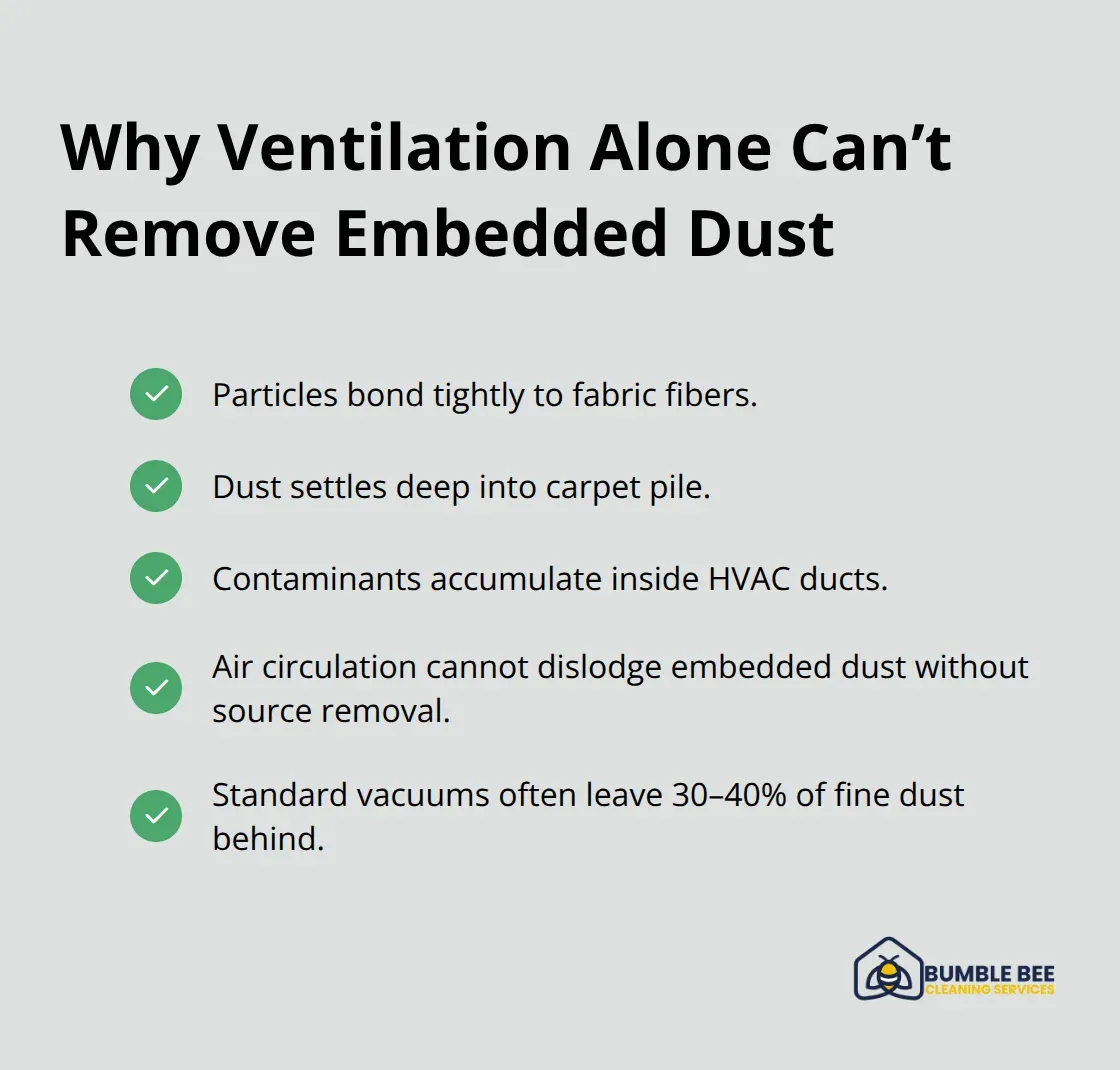
Relying on ventilation to handle this embedded contamination extends occupant exposure to hazardous particles for weeks or months longer than necessary.
Professional Cleaning Enables Ventilation to Work
Professional post-construction cleaning combined with enhanced ventilation delivers what neither approach achieves independently. Surface cleaning removes the dust source; ventilation then maintains air quality by filtering recirculated air and introducing fresh outdoor air at rates specified by ASHRAE 62.1 standards. This sequencing matters critically: clean surfaces first, then optimize ventilation. Many Seattle offices reverse this order, upgrading HVAC systems before scheduling professional cleanup, wasting capital and extending the contamination period. After professional cleaning removes embedded dust and debris from ductwork, MERV-13 filtration becomes genuinely effective at capturing remaining airborne particles rather than simply re-circulating construction residue. NADCA Standard ACR-2021 requires ductwork cleaning that removes construction debris before the system operates continuously, preventing dust from dispersing throughout your office once ventilation activates. Post-construction VOCs from adhesives and engineered wood products persist for six to twelve months, with enhanced ventilation and proper filtration reducing occupant exposure during this critical period. The combination approach costs less than upgrading HVAC systems alone, delivers measurable air quality improvements, and protects your investment in the renovation itself by preventing dust-related surface damage and HVAC contamination that drives long-term maintenance costs upward.
Final Thoughts
Professional post-construction cleanup must precede ventilation improvements in Seattle offices. Dust embedded in carpets, upholstery, and ductwork resists air circulation alone, leaving employees exposed to silica, asbestos, and lead particles for months. Upgrading your HVAC system before removing contamination wastes thousands of dollars and extends health risks unnecessarily.
We at Bumble Bee Cleaning Services combine professional cleanup with ventilation strategy to deliver results that neither approach achieves independently. Our team removes embedded dust using HEPA-filter vacuums that capture 99.97% of fine particles, while ductwork cleaning following NADCA standards prevents debris from dispersing once your system activates. After surfaces are clean, enhanced filtration and proper air exchange rates maintain air quality going forward, protecting your renovation investment and supporting employee productivity.
Schedule professional post-construction cleaning immediately after construction ends, then commission your HVAC system to verify proper airflow and filtration. Your employees will breathe cleaner air, productivity will improve, and you’ll avoid costly compliance issues with Washington State regulations. The investment in comprehensive cleanup pays dividends through better health outcomes and reduced long-term maintenance costs.
For more information about our cleaning services in Seattle and Atlanta, or to request a cleaning quote, call or text us at 425-786-1360 or email us at info@qbclean.com
