
Post-renovation projects in Seattle leave behind stubborn odors that standard cleaning can’t touch. Paint fumes, adhesives, and construction materials seep into walls, carpets, and ventilation systems where they linger for weeks.
We at Bumble Bee Cleaning Services have found that enzymatic treatments offer real odor neutralization where traditional methods fail. This guide shows you exactly how these treatments work and why they’re the solution Seattle property owners need.
Where Post-Renovation Odors Come From and Why Standard Cleaning Fails
Construction Materials Release Odors Deep Into Your Space
Post-renovation odors in Seattle homes and businesses originate from specific materials and construction processes, not just paint fumes. Adhesives used for flooring and wall treatments release volatile organic compounds that penetrate deep into subflooring, drywall, and carpet fibers. Grout, sealants, and primers contribute their own distinct smells that don’t dissipate quickly indoors. According to IICRC standards for professional inspection of flooring subfloors and substrates, moisture trapped beneath finished surfaces during construction becomes a breeding ground for mold and bacterial growth, intensifying odors weeks after the project ends.
Seattle’s Climate Traps Moisture and Odors Longer
Seattle’s humid climate makes post-renovation odors worse than in drier regions. Moisture lingers in materials longer, giving odor-causing compounds more time to embed themselves into your spaces. Trapped moisture activates the organic compounds in construction materials, making them release stronger smells over extended periods. The combination of humidity and construction residue creates conditions that standard cleaning cannot address.
Traditional Cleaning Methods Only Mask the Problem
Traditional cleaning methods fail because they target surface-level dirt, not the organic compounds causing the smell. Vacuuming, mopping, and standard deodorizers mask odors temporarily but leave the actual source untouched. The ANSI/IICRC S500 standard for professional water damage restoration and the S520 standard for mold remediation both emphasize that odors rooted in moisture and organic growth require specialized treatment approaches.
Odors Hide in Places You Can’t Reach
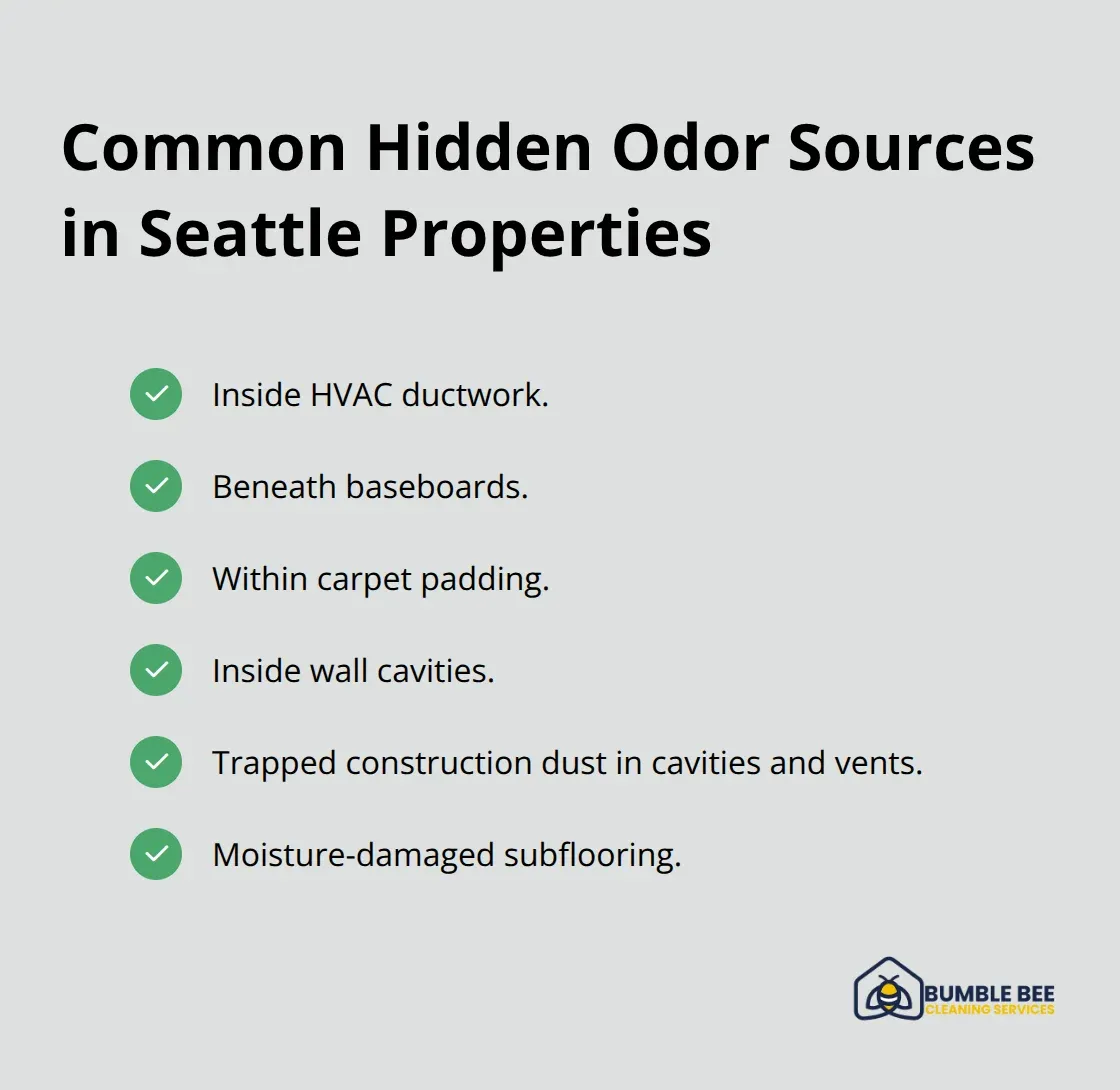
Odors hide in places most people never reach-inside HVAC ductwork, beneath baseboards, within carpet padding, and inside wall cavities where construction dust settled. A property owner might spend hundreds on air fresheners and surface cleaning, only to have the smell return within days because the root cause remains. Ventilation systems circulate these odors throughout your entire property, making the problem feel impossible to solve with conventional methods.
The Real Solution Targets Organic Compounds at the Source
The real solution targets the organic compounds themselves, breaking them down at the source rather than covering up the problem. This approach eliminates odors permanently instead of temporarily masking them. Understanding how enzymatic treatments accomplish this transformation reveals why they succeed where traditional methods fail.
How Enzymatic Treatments Break Down Odors at the Source
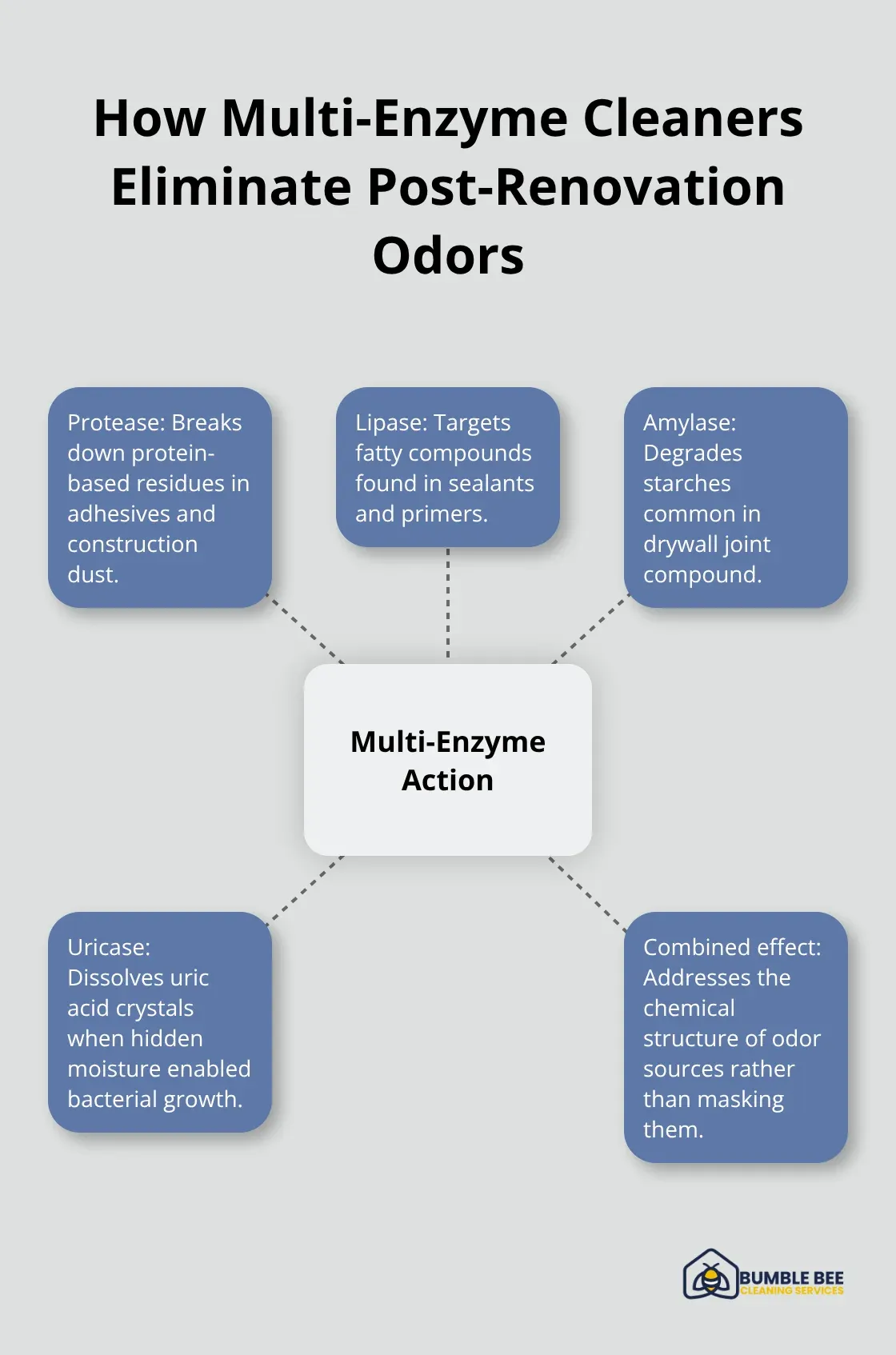
Enzymatic treatments work through a straightforward biological process that traditional cleaners cannot replicate. Enzymes are proteins that break down specific organic compounds into smaller, water-soluble pieces that no longer produce odors. The most effective post-renovation formulations contain multiple enzyme types: protease breaks down proteins in adhesives and construction residue, lipase tackles fatty compounds in sealants and primers, and amylase handles starch-based materials common in drywall joint compound. Uricase specifically targets uric acid crystals, which matter if moisture has allowed bacterial growth in hidden spaces. This multi-enzyme approach addresses the actual chemical structure of odor-causing substances rather than simply covering them up with fragrance.
According to IICRC standards for mold remediation and water damage restoration, this targeted breakdown of organic compounds at the source represents the most reliable method for permanent odor elimination in post-construction scenarios.
Temperature and Moisture Activate Enzymatic Performance
Enzymatic cleaners perform optimally with adequate moisture present, which makes Seattle’s climate both advantageous and challenging. The moisture that traps odors also activates enzymes, but excessive dampness can reduce their effectiveness if the environment becomes too wet. Application method matters significantly: spraying enzymatic treatments directly onto affected carpets, subflooring, and wall cavities allows extended contact time depending on odor severity, while professional carpet extractors provide deeper penetration into padding where construction residue embeds itself. Commercial enzyme cleaners maintain activity when stored sealed and cool, so purchasing quality products ensures reliable results. Always spot-test on hidden areas first, as enzymes can occasionally affect certain dye lots, though this remains rare with modern formulations.
Enzymatic Treatments Outperform Chemical Deodorizers Permanently
Chemical deodorizers and oxidizing agents mask odors or neutralize them temporarily through reactive processes that leave residue behind. Enzymes eliminate odors permanently because they consume the actual source material, leaving nothing to reactivate when humidity returns. This distinction matters in Seattle where moisture cycles continue year-round: a chemical solution applied in summer may fail completely once fall rains increase humidity, but enzymatic cleaners remain active as long as there is moisture and a food source. Professional enzymatic cleaning services emphasize eco-certified products that remain safe for families and pets, unlike harsh chemical alternatives that can off-gas their own problematic compounds. The investment in enzymatic treatment typically ranges from several hundred to a few thousand dollars depending on property size and odor severity, but this cost avoids repeated applications that chemical masking requires every few weeks. Understanding these performance differences reveals why enzymatic solutions deliver superior results, yet application timing and professional expertise determine whether your specific post-renovation odor actually disappears.
What Seattle Property Owners Actually Pay for Post-Renovation Odor Solutions
Enzymatic Treatments Cost Less Than Repeated Chemical Applications
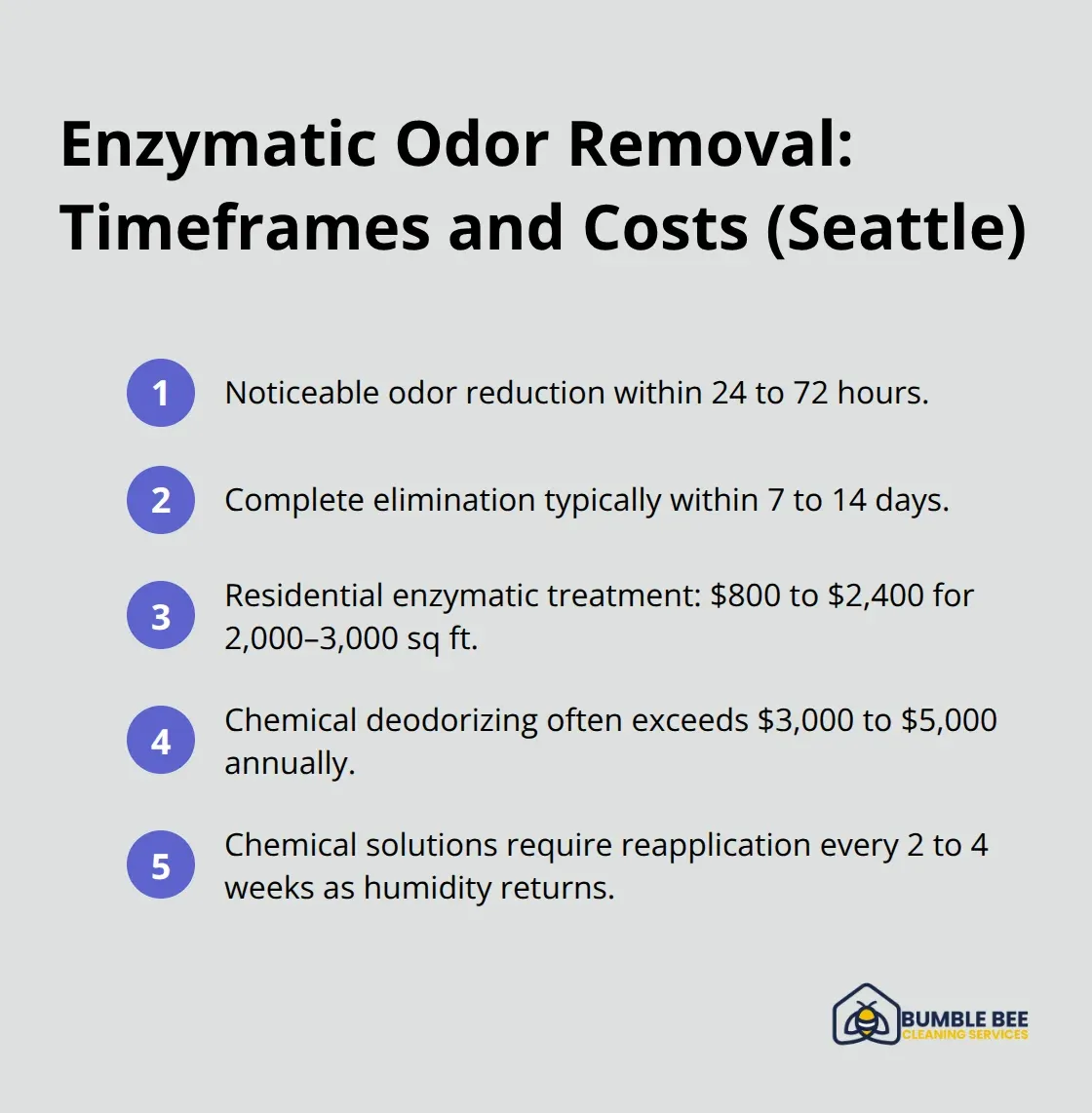
Enzymatic treatments deliver results in Seattle homes and businesses within measurable timeframes and at costs significantly lower than repeated chemical applications or professional remediation cycles. Most properties see noticeable odor reduction within 24 to 72 hours of enzymatic application, with complete elimination occurring within 7 to 14 days depending on odor severity and material penetration. A typical Seattle residential property of 2,000 to 3,000 square feet requires enzymatic treatment costs between $800 and $2,400, whereas repeated chemical deodorizing applications over the same period easily exceed $3,000 to $5,000 annually because those solutions require reapplication every 2 to 4 weeks as humidity returns.
Commercial properties face steeper costs with chemical masking approaches, often spending $5,000 to $15,000 yearly on temporary solutions that never address root causes. Property owners who invest in professional enzymatic treatment once avoid the endless cycle of temporary fixes, making the upfront cost substantially cheaper over 12 months. The ANSI/IICRC S520 standard covers procedures and precautions for performing mold remediation in residential, commercial and institutional buildings, acknowledging that enzyme-based approaches reduce long-term treatment costs by targeting organic compounds permanently rather than masking symptoms.
Enzymatic Treatments Work Faster Than Chemical Alternatives
Timeline matters for Seattle businesses especially, where post-renovation odors can delay reopening or damage customer perception within days. Enzymatic treatments begin working immediately upon application, with enzymes requiring only 15 minutes to several hours of contact time depending on product concentration and odor depth. Carpet extraction combined with enzymatic application accelerates results in residential spaces, typically delivering fresh air quality within one week.
Commercial kitchens and bathrooms where moisture amplifies odor compounds show results within 48 to 72 hours when treated with multi-enzyme formulations containing protease and lipase to address adhesives and sealant residues. Chemical oxidizing agents promise faster results on paper but often fail within weeks once Seattle’s seasonal humidity increases, forcing repeated expensive treatments that ultimately cost far more than enzymatic solutions.
Professional Application Eliminates Multiple Callbacks
Professional enzymatic cleaning services complete most Seattle projects within a single visit, whereas chemical approaches typically require multiple callbacks to maintain temporary odor suppression through construction season and beyond. Multi-visit chemical treatments disrupt business operations and residential routines repeatedly, adding hidden costs beyond the service fees themselves. Enzymatic treatments applied by professionals trained in IICRC standards provide permanent results that eliminate the need for follow-up appointments and seasonal reapplications that plague chemical masking strategies.
Final Thoughts
Enzymatic treatments represent the most effective approach for eliminating post-renovation odors in Seattle because they target the actual source of the problem rather than masking it temporarily. Unlike chemical deodorizers that require repeated applications every few weeks, enzymatic solutions break down organic compounds permanently, delivering odor neutralization that lasts. Your investment in enzymatic treatment costs significantly less over time than the endless cycle of chemical masking, and results appear within days rather than weeks.
If your post-renovation odors remain mild and confined to carpeted areas, quality commercial enzyme cleaners applied with proper dwell time may resolve the issue independently. However, if odors persist in multiple rooms, hide within ventilation systems, or involve moisture-damaged subflooring, professional treatment becomes necessary. Hidden moisture sources beneath finished surfaces often drive stubborn odors that DIY approaches cannot reach, making professional inspection and application the practical choice for most Seattle properties.
We at Bumble Bee Cleaning Services specialize in post-construction cleaning and understand exactly how renovation materials embed odors into your spaces. Our team applies multi-enzyme formulations specifically designed for construction residue, adhesives, and sealants while identifying hidden moisture sources that standard cleaners miss. Contact us for a consultation to assess your property and receive a flat-rate quote for enzymatic treatment tailored to your Seattle home or business.
For more information about our cleaning services in Seattle and Atlanta, or to request a cleaning quote, call or text us at 425-786-1360 or email us at info@qbclean.com
