
Seattle’s commercial spaces face unique air quality challenges, especially with our region’s moisture and dense office environments. HEPA filtration has become a game-changer for businesses serious about indoor air quality, but not all cleaning services use it effectively.
We at Bumble Bee Cleaning Services have seen firsthand how the right filtration technology transforms workplace health. This guide breaks down what HEPA filtration actually does, whether it’s worth the investment, and how to choose the right cleaning partner for your facility.
How HEPA Filtration Works in Commercial Cleaning
Understanding HEPA Filter Technology and Standards
HEPA stands for high efficiency particulate air, a standard defined by the U.S. Department of Energy that guarantees a filter removes at least 99.97% of dust, pollen, mold, bacteria, and other airborne particles at 0.3 microns, according to the EPA. The 0.3 micron size represents the most penetrating particle size for HEPA filters, meaning particles larger or smaller than this threshold trap with even higher efficiency. This matters in commercial cleaning because standard office vacuum cleaners and HVAC filters cannot achieve this level of capture. Most building HVAC systems use MERV-rated filters, which measure efficiency only for particles between 0.3 and 10 microns. A MERV 13 filter, considered mid-range, captures far fewer fine particles than true HEPA.
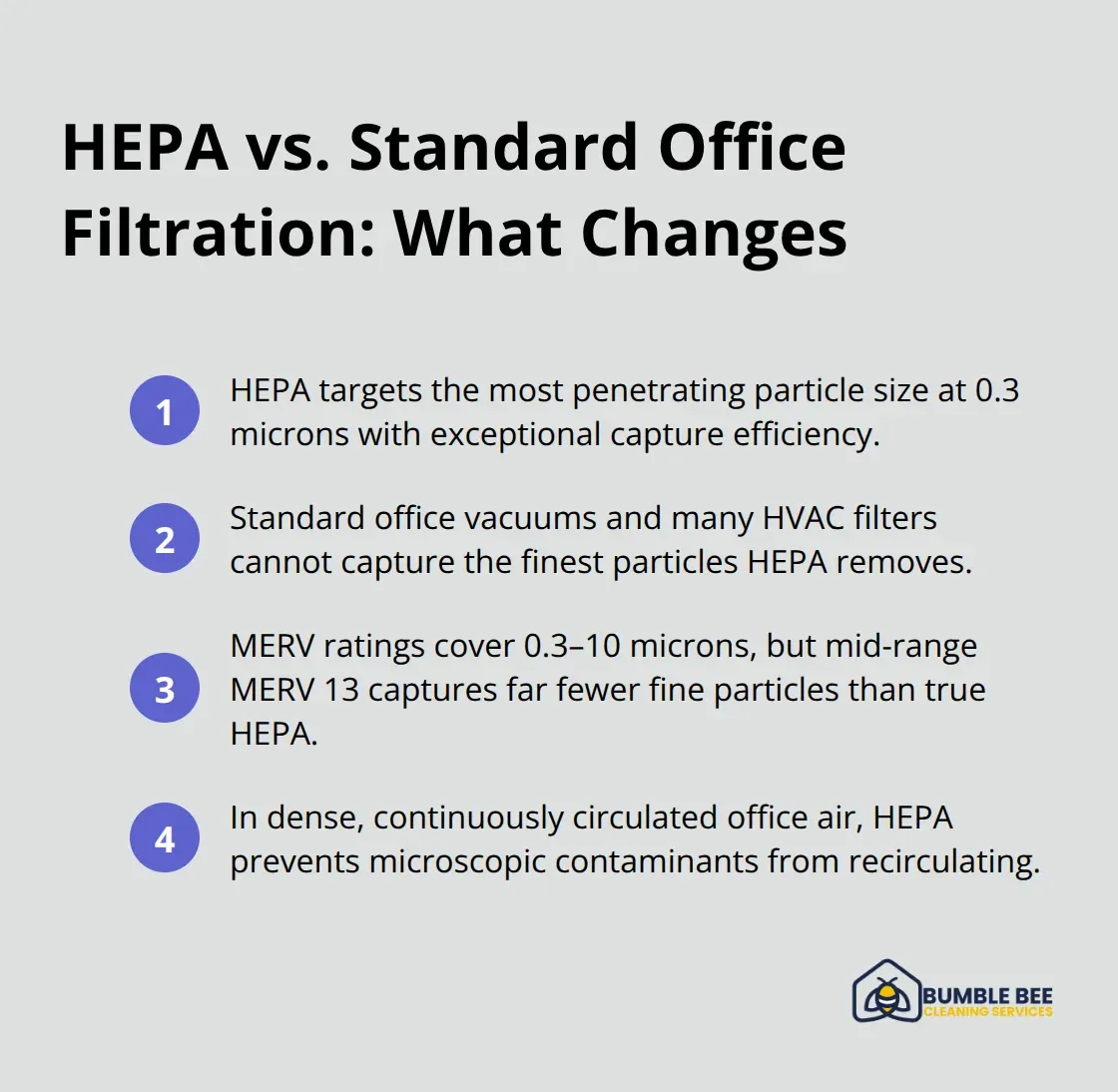
In Seattle’s dense office environments with continuous air circulation, the difference becomes significant: HEPA filtration stops microscopic contaminants that standard filters allow to recirculate.
How HEPA Vacuums Protect Your Workspace
HEPA vacuums certified by AHAM Verifide prevent fine dust from re-entering the air during cleaning, protecting both workers and occupants. Without true HEPA, a standard vacuum actually stirs up settled dust particles, defeating the purpose of cleaning in the first place. This distinction matters more than most business owners realize-the equipment your cleaning service uses directly impacts what remains in your air after they leave.
Seattle’s Unique Air Quality Challenges
Seattle’s Pacific Northwest climate creates conditions that amplify air quality problems. The region’s moisture supports mold growth and dust mite populations, both common indoor allergens. During wildfire season, outdoor PM2.5 levels spike dramatically, and without proper indoor filtration, that smoke penetrates commercial spaces even when windows stay closed. HEPA filtration can effectively reduce smoke concentrations indoors. For Seattle businesses, HEPA-equipped cleaning services address a practical defense against seasonal air quality threats rather than representing a luxury upgrade.
Who Benefits Most from HEPA Filtration
Office workers with allergies and respiratory conditions benefit measurably from HEPA filtration. The American Lung Association confirms that HEPA filtration reduces pollen exposure for allergy sufferers. A cleaning service that pairs HEPA vacuums with high-MERV furnace filters creates a two-layer defense that standard cleaning alone cannot match. This combination becomes particularly important as you consider what filtration approach actually protects your specific facility and workforce.
Impact of HEPA Filtration on Indoor Air Quality
How HEPA Filtration Removes Particles Standard Methods Miss
True HEPA filters capture 99.97% of particles at 0.3 microns, which means they stop dust, pollen, mold spores, and bacteria that conventional vacuums actually kick back into the air. Standard cleaning methods fail to address these microscopic contaminants because most office vacuums lack true HEPA certification. In Seattle office spaces where employees spend eight hours daily breathing recycled air, this difference produces measurable health outcomes. HEPA-equipped cleaning services remove what standard methods leave behind, creating a genuinely cleaner workspace rather than simply redistributing particles.
Benefits for Employees with Allergies and Respiratory Conditions
Employees with allergies experience fewer symptoms when their workplace uses HEPA-equipped cleaning services, not because of placebo but because fewer allergens circulate in the air they breathe. The American Lung Association confirms that HEPA filtration reduces pollen exposure for allergy sufferers, making it especially valuable during Seattle’s spring and fall seasons when outdoor pollen counts spike. Workers with asthma or COPD benefit even more, since airborne particles trigger respiratory flare-ups that HEPA filtration prevents from occurring in the first place. HEPA vacuums certified by AHAM Verifide stop fine dust from becoming airborne during cleaning, protecting both your staff and your building’s HVAC system from the cumulative damage that fine particles cause over months and years.
Seattle’s Moisture and Seasonal Air Quality Threats
Seattle’s moisture-heavy climate amplifies air quality problems that HEPA filtration addresses directly. The Pacific Northwest’s humidity supports mold growth and dust mite populations, both common indoor allergens that thrive in damp conditions, and HEPA filtration captures the spores and feces these organisms release into your air. Wildfire smoke presents another seasonal threat, particularly in late summer and early fall when PM2.5 levels outside can exceed safe limits for hours or days at a time. HEPA filtration reduces smoke concentrations indoors even when windows remain closed, giving your team a cleaner breathing environment when outdoor air quality deteriorates.
Layering HEPA Cleaning with Building Filtration Systems
Your HVAC system’s standard filters, typically MERV 8 or lower in most commercial buildings, cannot achieve the protection that HEPA filtration provides.
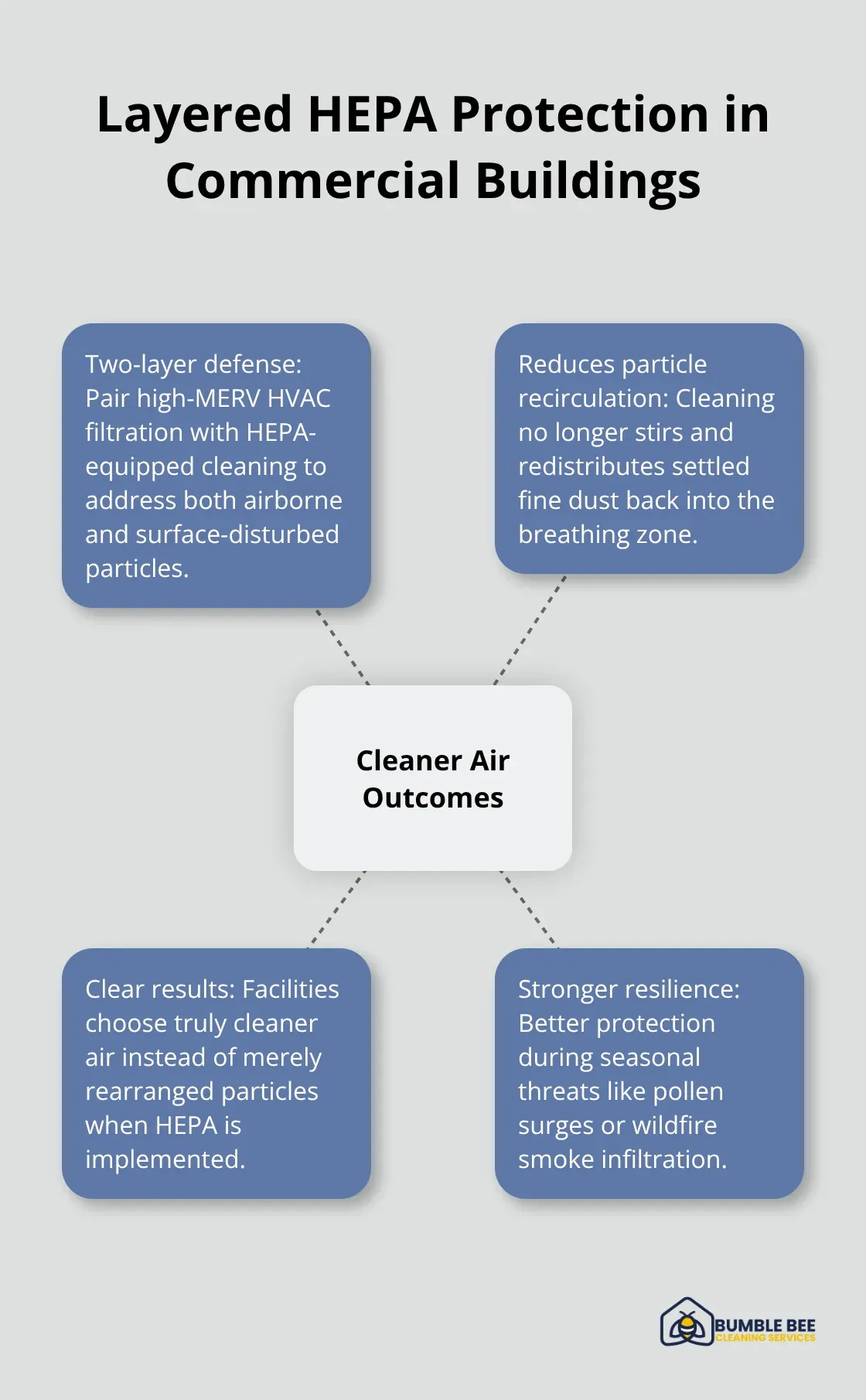
Upgrading to high-MERV filters in your building systems and pairing them with HEPA-equipped cleaning services creates a two-layer defense that addresses both the air circulating through your ducts and the dust settling on surfaces that cleaning disturbs. This combination prevents the recirculation problem where cleaning actually worsens indoor air quality by stirring up settled particles. Choosing a cleaning partner means choosing whether your facility’s air gets cleaner or just gets rearranged-and HEPA filtration makes that choice clear.
HEPA Adoption and Real Costs in Seattle’s Cleaning Market
Equipment Investment Separates Serious Operators from Budget Services
Most Seattle commercial cleaning services still rely on standard equipment rather than investing in true HEPA filtration systems. The reason is straightforward: HEPA-certified vacuums and portable air purifiers cost more upfront, and many cleaning companies avoid these expenses to maintain lower pricing. HEPA-certified vacuums run between $2,000 and $5,000 per unit, while portable HEPA air cleaners with adequate CADR ratings for office spaces range from $800 to $3,000 each. Smaller cleaning operations that service multiple buildings daily cannot justify this investment unless they charge premium rates or work with clients willing to fund better equipment.
What this means for you as a business owner is that requesting HEPA filtration often reveals which cleaning services prioritize actual results versus those cutting corners. When you contact a cleaning service about HEPA capabilities, ask specifically whether they use AHAM Verifide-certified equipment and whether their HVAC filter recommendations include MERV 13 or higher ratings.
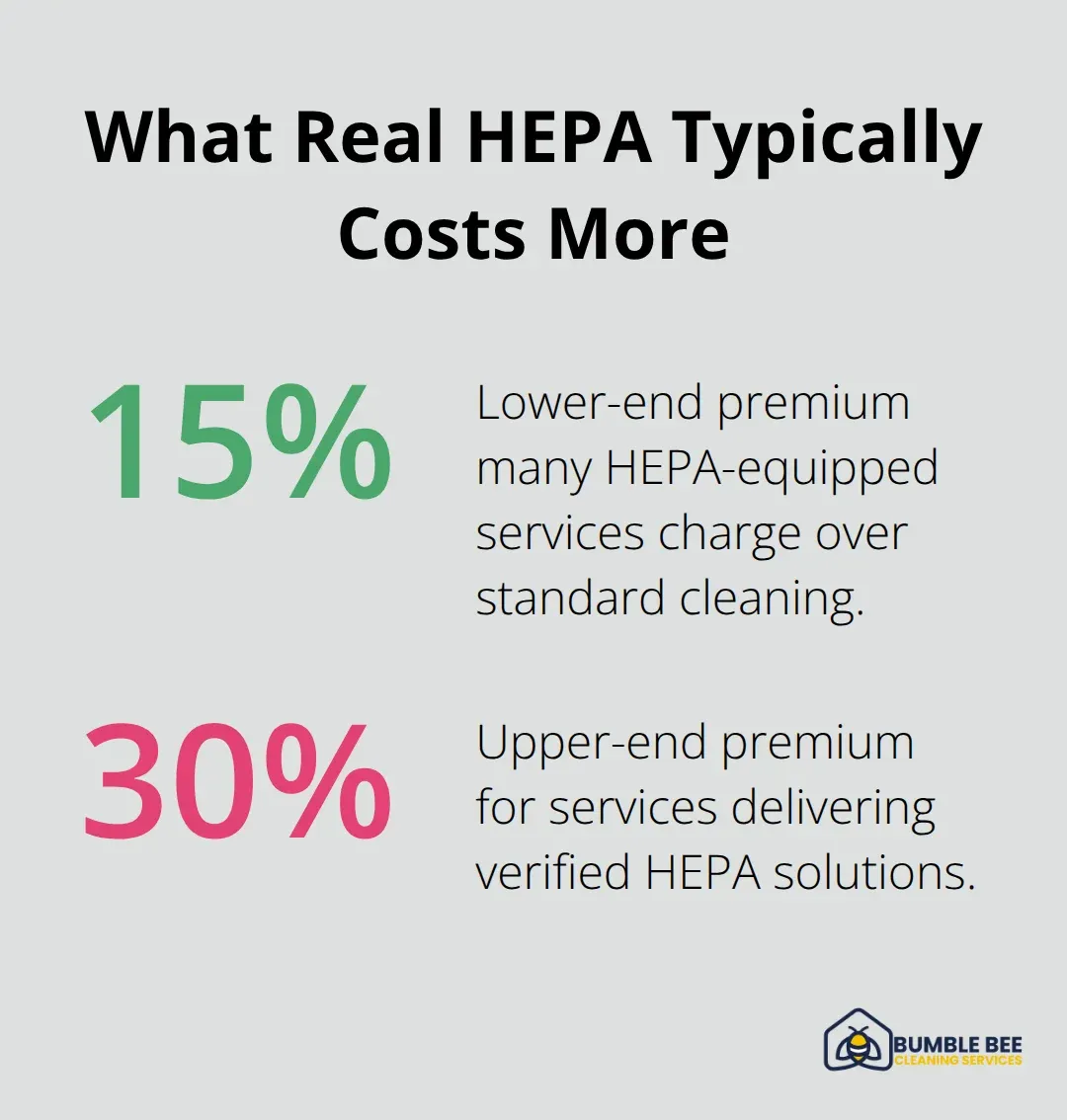
Services offering genuine HEPA solutions typically charge 15 to 30 percent more than standard cleaning, but that premium directly correlates with reduced allergens, fewer sick days among your staff, and longer HVAC system lifespan from reduced dust accumulation.
Three Factors That Separate True HEPA Services from Marketing Claims
Selecting a HEPA-equipped cleaning partner requires evaluating three specific factors beyond price alone. First, confirm they maintain a documented filter replacement schedule and can provide records showing when HEPA filters were last changed, since they lose effectiveness within 6 to 12 months depending on air quality conditions. Second, ask whether they pair HEPA vacuums with HVAC filter upgrades and portable air cleaners for high-traffic zones like lobbies and break rooms, since HEPA filtration works best as a layered approach rather than a single solution.
Third, request references from other Seattle commercial clients with similar facility sizes and occupancy levels, because effectiveness depends on matching equipment capacity to your specific space. Services claiming HEPA-type or HEPA-like filtration are not the same as true HEPA certification and should be avoided entirely. Your cleaning service should explain their equipment specifications in concrete terms: CADR ratings for air cleaners, MERV ratings for furnace filters, and certification standards for vacuums (AHAM Verifide certification proves legitimacy). This transparency separates operators genuinely committed to indoor air quality from those using HEPA terminology as a marketing tactic without backing it with certified equipment and trained staff.
Final Thoughts
HEPA filtration fundamentally transforms what commercial cleaning accomplishes in Seattle’s office environments. The 99.97% capture rate at 0.3 microns stops allergens, mold spores, and fine dust that standard cleaning methods actually push back into the air your team breathes. This represents measurable protection that reduces sick days, extends HVAC system life, and creates genuinely healthier workspaces rather than simply rearranging particles.
HEPA filtration matters most when your facility houses employees with allergies or respiratory conditions, when you operate in Seattle’s moisture-heavy climate where mold and dust mites thrive, or when wildfire smoke threatens outdoor air quality. High-occupancy spaces where air systems run continuously benefit significantly because HEPA-equipped cleaning prevents the particle accumulation that degrades both air quality and equipment performance over time. Seasonal pollen peaks also demand HEPA solutions, since standard cleaning fails to address the allergen load circulating through your building.
Contact a cleaning service that uses AHAM Verifide-certified equipment and maintains documented filter replacement schedules to implement HEPA solutions. We at Bumble Bee Cleaning Services work with commercial facilities throughout Seattle to deliver genuine HEPA protection rather than marketing claims. Reach out to discuss how HEPA filtration fits your specific space and budget.
For more information about our cleaning services in Seattle and Atlanta, or to request a cleaning quote, call or text us at 425-786-1360 or email us at info@qbclean.com
