
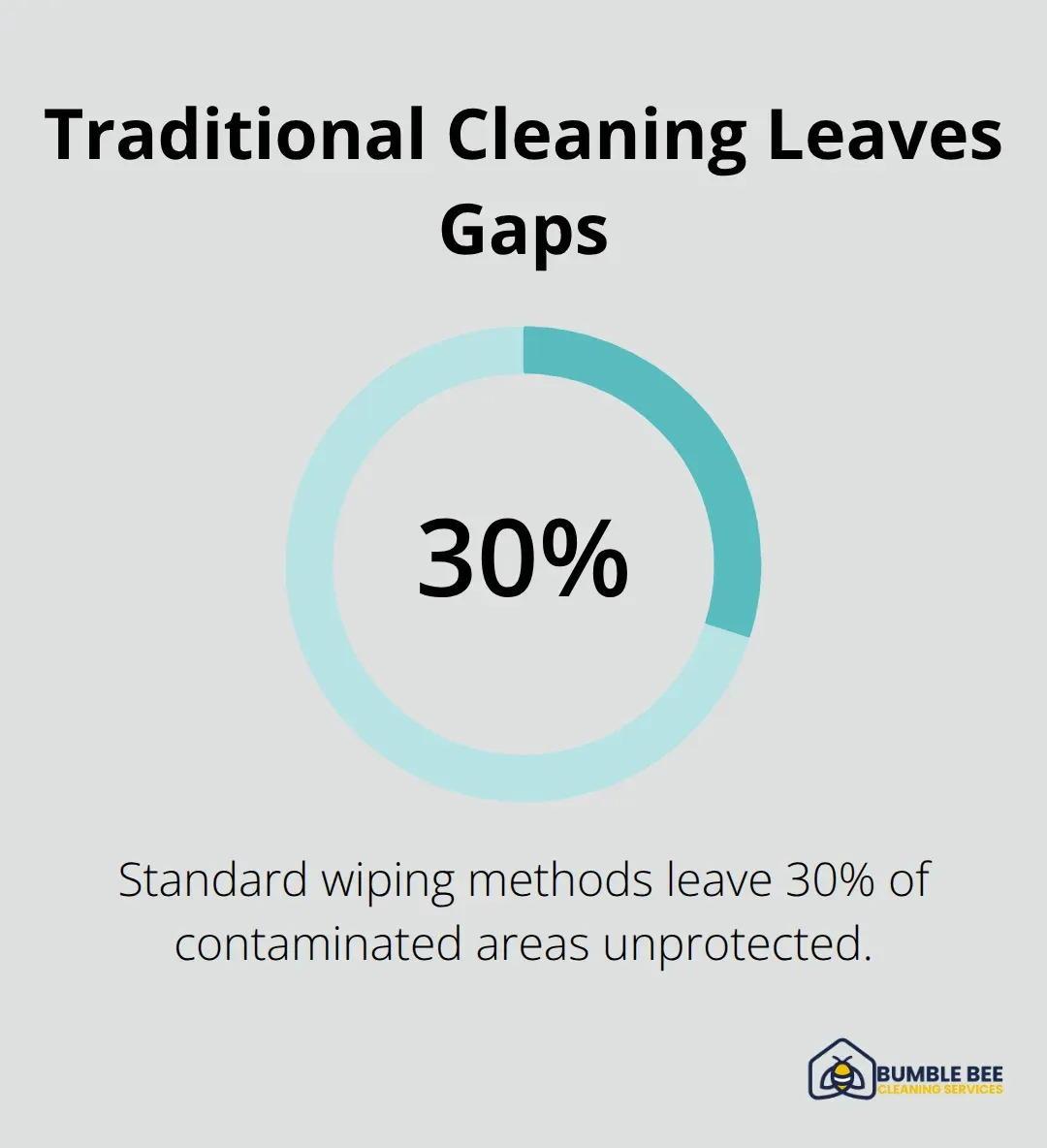
Pathogens spread fast in Seattle’s busy offices, warehouses, and retail spaces. Traditional cleaning methods miss up to 30% of contaminated surfaces, leaving your team at risk.
Electrostatic disinfection changes that. We at Bumble Bee Cleaning Services use this technology to coat every surface-visible and hidden-with a protective layer that kills viruses and bacteria on contact.
How Electrostatic Technology Reaches Every Surface
Electrostatic disinfection works through a straightforward mechanism that addresses a real problem with traditional cleaning. The technology charges disinfectant droplets as they leave the nozzle, creating a static attraction between the negatively charged particles and positively charged surfaces. This electrostatic induction pulls the disinfectant toward every surface-tops, undersides, corners, and crevices that manual wiping cannot reach. The droplets wrap around objects rather than simply landing on them, which explains why this method covers surfaces that traditional methods miss entirely.
Why Droplet Size Determines Real Coverage
Electrostatic spray droplets must meet EPA droplet size requirements to qualify as surface disinfection rather than fogging. This size specification determines how the disinfectant behaves once it leaves the device. Larger droplets cling to surfaces and maintain contact long enough for the germicide to kill pathogens, whereas smaller particles float away. The contact time-typically 10 minutes or longer depending on the EPA-registered product-must remain on the surface for effectiveness.
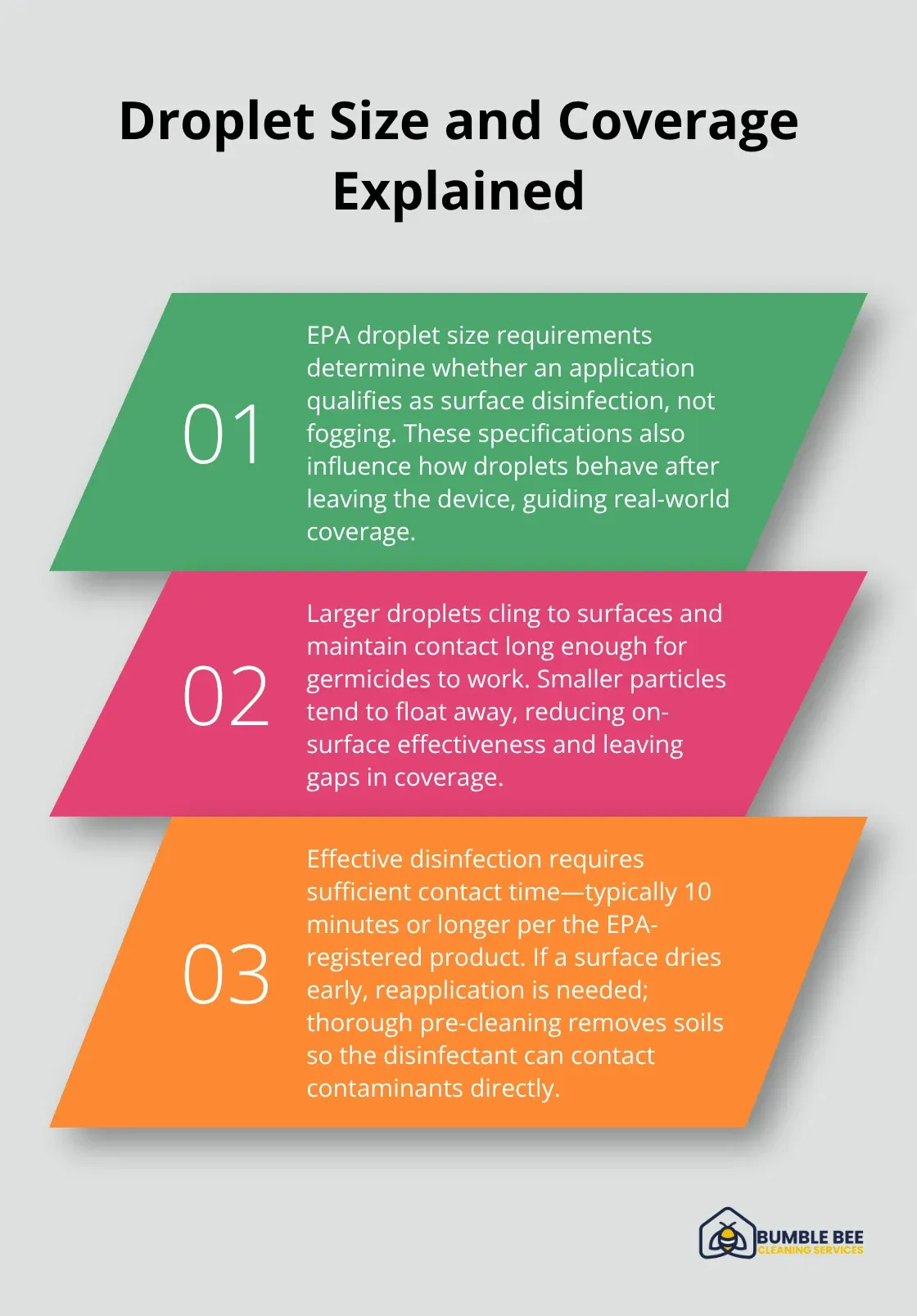
If a surface dries before that contact time is achieved, reapplication becomes necessary. Proper preparation matters because removing visible dirt first allows the disinfectant to make direct contact with contaminated areas rather than sitting on top of debris.
Effectiveness Against Real Pathogens
The EPA List N disinfectants used in electrostatic spray applications must demonstrate efficacy against specific organisms listed on their labels. Products approved for use against SARS-CoV-2 carry proven claims against bacteria like Staphylococcus aureus and Pseudomonas aeruginosa, plus viruses that represent the hardest-to-kill pathogens in commercial settings. Seattle businesses benefit from using List N products because these have undergone rigorous testing and carry verified claims about their germicidal power.
Chemical Efficiency and Staff Safety
The electrostatic method reduces chemical waste compared to traditional spraying because the charged droplets are attracted to surfaces rather than dispersing into the air. Less disinfectant is needed to achieve the same coverage, which matters for both cost and safety. Your staff breathes less chemical vapor, and the disinfectant concentrates where it actually kills germs rather than becoming airborne waste. This efficiency makes electrostatic disinfection a practical choice for facilities that operate continuously and cannot afford extended downtime between applications.
Understanding how electrostatic technology works sets the foundation for recognizing why Seattle businesses need this protection in their specific environments.
Why Your Seattle Business Faces Real Disease Transmission Risks
Seattle’s office buildings, warehouses, and retail spaces create the perfect conditions for pathogen spread. Environmental surfaces can harbor pathogens, particularly in enclosed spaces where employees spend eight or more hours daily. High-touch areas like door handles, conference tables, keyboards, and elevator buttons become contamination hotspots. Cold and flu viruses survive on hard surfaces for hours, and a single infected employee touching a shared object contaminates dozens of team members within days. Traditional cleaning methods fail here because standard wiping covers only visible surfaces. Your facility likely harbors pathogens in corners, under furniture, on ceiling vents, and inside air handling systems where traditional cleaning never reaches. The result: recurring illness cycles that reduce productivity, increase absenteeism, and damage your business reputation. Seattle’s growing workforce means higher occupancy density in shared spaces, which accelerates disease transmission rates compared to less populated areas.
Surface Contamination Persists Between Traditional Cleanings
Standard cleaning protocols typically occur once daily, usually after hours. This leaves your workplace unprotected for 16+ hours when employees touch contaminated surfaces. Healthcare facilities demonstrate this problem clearly: even with multiple daily cleanings, hospital-acquired infections remain a persistent challenge. Surfaces harbor pathogens and transmission occurs mainly through hand contact with contaminated surfaces. Electrostatic disinfection addresses this gap by coating every surface with a protective germicide layer that lasts longer than traditional applications. When integrated into your recurring cleaning routine, electrostatic spray ensures high-touch areas receive frequent disinfection without extending downtime. Seattle businesses operating in competitive markets cannot afford extended closures, making rapid disinfection methods essential. The IICRC S410 Standard emphasizes that infection prevention requires evaluating and maintaining surfaces consistently, not just occasional deep cleaning.
Health Code Compliance Demands Measurable Proof
Seattle and Washington State health departments increasingly require businesses to demonstrate cleaning effectiveness, not just document that cleaning occurred. Electrostatic disinfection provides objective verification through outcome monitoring devices that quantify disinfection results. Traditional cleaning produces only subjective impressions of cleanliness. When health inspectors visit your facility, you can show measured data proving that surfaces meet disinfection standards. This documentation protects your business legally if an outbreak occurs and demonstrates due diligence to customers and employees. Office workers, retail customers, and warehouse staff all expect businesses to take infection control seriously. Facilities that implement approved disinfectants through electrostatic methods comply with current disease prevention standards and signal to your community that you prioritize health. This competitive advantage matters in Seattle’s health-conscious market where customers actively choose businesses that demonstrate safety measures.
Why Implementation Timing Matters for Your Operation
The gap between traditional cleaning cycles creates a window where pathogens thrive unchecked. Electrostatic disinfection fills this window by working faster than manual methods and reaching surfaces that staff cannot access safely or efficiently. Your business can schedule electrostatic applications during operational hours (with proper occupant notification) or after closing, depending on your facility’s needs. The technology works on office equipment, warehouse surfaces, and retail displays without damaging sensitive electronics or merchandise. Integration with your existing cleaning schedule means you maintain current routines while adding a protective layer that traditional methods cannot provide. This layered approach (combining recurring cleaning with electrostatic disinfection) addresses both visible contamination and hidden pathogens that standard protocols miss. The next section explores how to choose the right disinfection schedule and implement this protection without disrupting your daily operations.
Implementation and Best Practices for Your Business
Determine Your Disinfection Frequency Based on Actual Conditions
Frequency matters more than most Seattle businesses realize. A single electrostatic application provides protection for a limited window, typically 24 to 48 hours depending on surface traffic and the specific EPA-registered disinfectant used. High-touch areas like door handles, conference tables, and payment terminals require more frequent treatment than low-traffic zones. Office environments with 50+ employees should schedule electrostatic disinfection at minimum twice weekly in common areas and daily in break rooms and restrooms where pathogen concentration peaks.
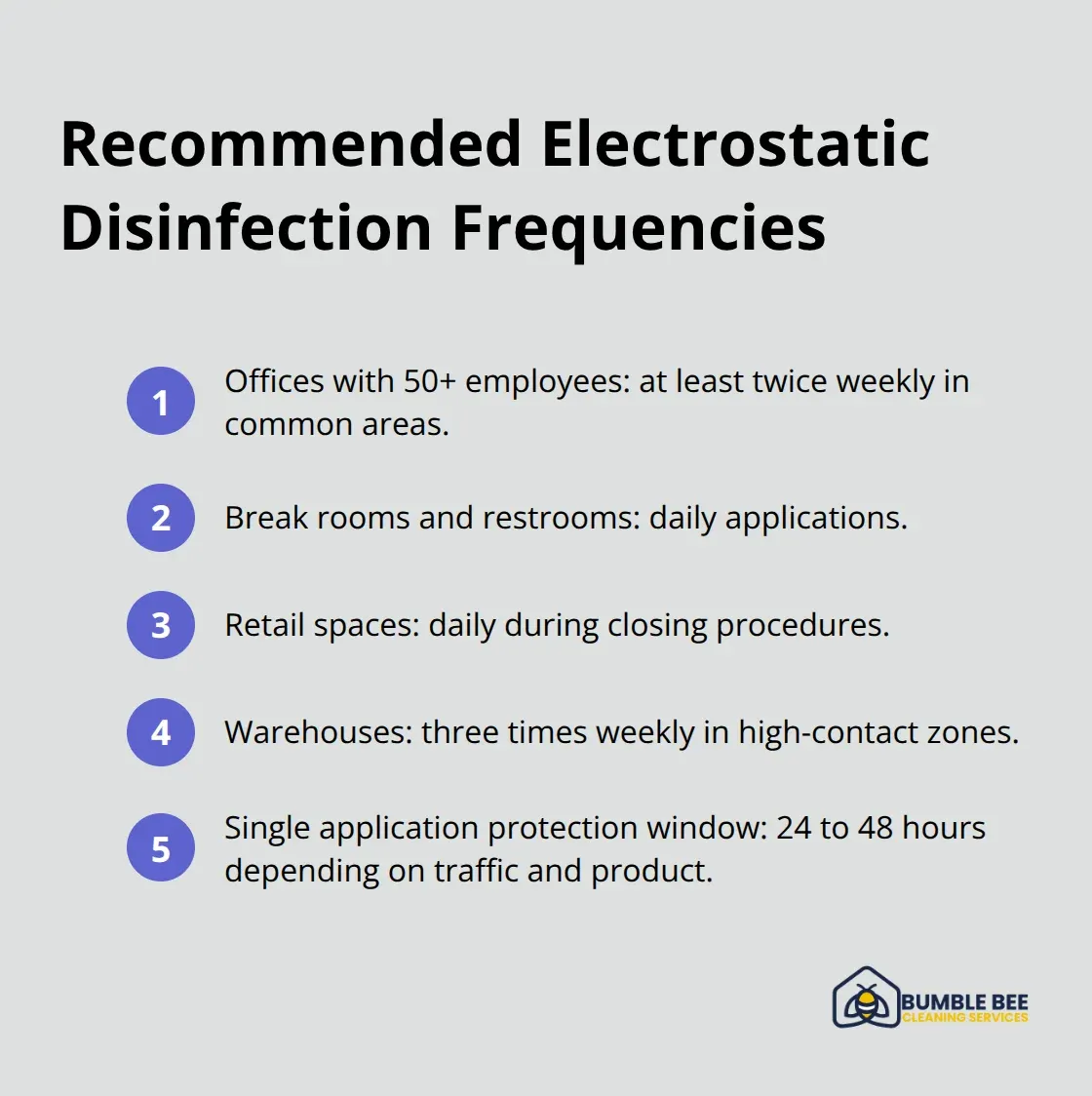
Retail spaces see customer turnover that recontaminates surfaces within hours, making daily applications during closing procedures essential for infection control. Warehouses with loading docks and shared equipment benefit from electrostatic spray three times weekly in high-contact zones. The IICRC S410 Standard emphasizes that infection prevention requires consistent evaluation and maintenance of surfaces, not sporadic deep cleaning treatments. Your business cannot rely on weekly applications and expect protection during the remaining six days.
Align electrostatic disinfection frequency with your actual occupancy patterns and surface contact rates rather than adopting generic schedules. Document your baseline contamination levels using outcome monitoring devices during the first two weeks of implementation, then adjust frequency based on measured results. This data-driven approach costs less than excessive applications and delivers measurable protection that satisfies health department requirements and customer expectations.
Sequence Electrostatic Disinfection After Traditional Cleaning
Integration into your existing cleaning routine requires sequential timing rather than replacement of current protocols. Standard detergent cleaning must happen first because visible dirt and organic matter block disinfectant contact with contaminated surfaces. CDC guidance on environmental infection control confirms that cleaning removes soils before disinfection, which enhances germicide effectiveness substantially.
Schedule electrostatic disinfection immediately after your recurring cleaning team completes traditional wiping and floor care, typically 30 to 60 minutes after they finish. This timing ensures surfaces are clean and dry, allowing the charged droplets to make direct contact with pathogens rather than sitting on residue. Electrostatic spray reaches undersides and corners that your regular cleaning team cannot access safely, so emphasize that this service complements rather than replaces recurring cleaning.
Train Staff and Coordinate Treatment Schedules
Your staff needs specific training on preparation procedures: removing or covering sensitive electronics, notifying occupants to vacate treated areas, and confirming that all high-touch surfaces are accessible. Designate one staff member as the disinfection coordinator who schedules applications, tracks treatment dates, and maintains documentation for health inspectors. This coordination prevents gaps in coverage and ensures your business demonstrates consistent infection control practices.
Many Seattle businesses waste money on electrostatic services scheduled randomly or without coordination with their cleaning routine, resulting in overlapped treatments some weeks and unprotected periods in others. Proper janitorial management eliminates this inefficiency and maximizes the protective benefit of each application.
Conclusion
Electrostatic disinfection fills a gap that traditional cleaning cannot address, protecting your Seattle business from pathogens that spread rapidly through high-touch surfaces. Standard wiping methods leave 30% of contaminated areas unprotected, but this technology charges disinfectant droplets to coat every surface-visible and hidden-with a germicide layer that kills viruses and bacteria on contact. This measurable protection satisfies health department compliance requirements and demonstrates to your employees and customers that you take infection control seriously.
Implementation requires integrating electrostatic disinfection into your existing cleaning routine with proper sequencing: traditional cleaning first removes visible dirt, then electrostatic spray reaches surfaces your staff cannot access. Frequency depends on your actual occupancy patterns and surface contact rates, not generic schedules-high-touch areas in offices require twice-weekly applications minimum, while retail spaces need daily treatment during closing procedures. Document your baseline contamination levels using outcome monitoring devices, then adjust frequency based on measured results rather than guessing at protection levels.
We at Bumble Bee Cleaning Services combine recurring cleaning with electrostatic disinfection to create a layered protection system that addresses both visible contamination and hidden pathogens. Contact us today to schedule a consultation and implement this technology as part of your comprehensive cleaning program.
For more information about our cleaning services in Seattle and Atlanta, or to request a cleaning quote, call or text us at 425-786-1360 or email us at info@qbclean.com
