
Manufacturing facilities in Seattle face unique cleaning challenges that go far beyond standard janitorial work. From post-construction debris to industrial degreasing and hazardous material removal, the stakes are high when production lines need to restart.
We at Bumble Bee Cleaning Services understand that improper cleanup can damage expensive equipment, trigger regulatory violations, and cost you thousands in downtime. That’s why specialized facility cleaning isn’t optional-it’s a business necessity.
Post-Construction Debris Removal in Seattle Manufacturing
What Debris and Hazards Emerge After Manufacturing Construction
Manufacturing construction in Seattle generates far more than drywall dust and sawdust. Concrete cutting produces silica particles that pose serious respiratory risks if workers do not contain them properly. Metal fabrication leaves behind ferrous dust, aluminum shavings, and grinding residue. Welding operations deposit slag, spatter, and zinc oxide fumes that require specialized ventilation and cleanup. Paint overspray, sealant residue, and solvent contamination accumulate on floors, equipment, and ductwork. These contaminants interfere with production equipment calibration, compromise product quality, and create genuine safety hazards for your workforce.
Equipment Damage and Production Delays Cost Real Money
Leaving construction debris on manufacturing floors damages expensive machinery. Equipment sensors and precision machinery malfunction when silica dust or metal particles settle into moving parts. Production lines fail during startup because contaminants trigger safety interlocks or damage optical sensors. One Seattle semiconductor manufacturer discovered that inadequate post-construction cleanup extended their restart timeline by three weeks, costing approximately $150,000 per day in lost production.
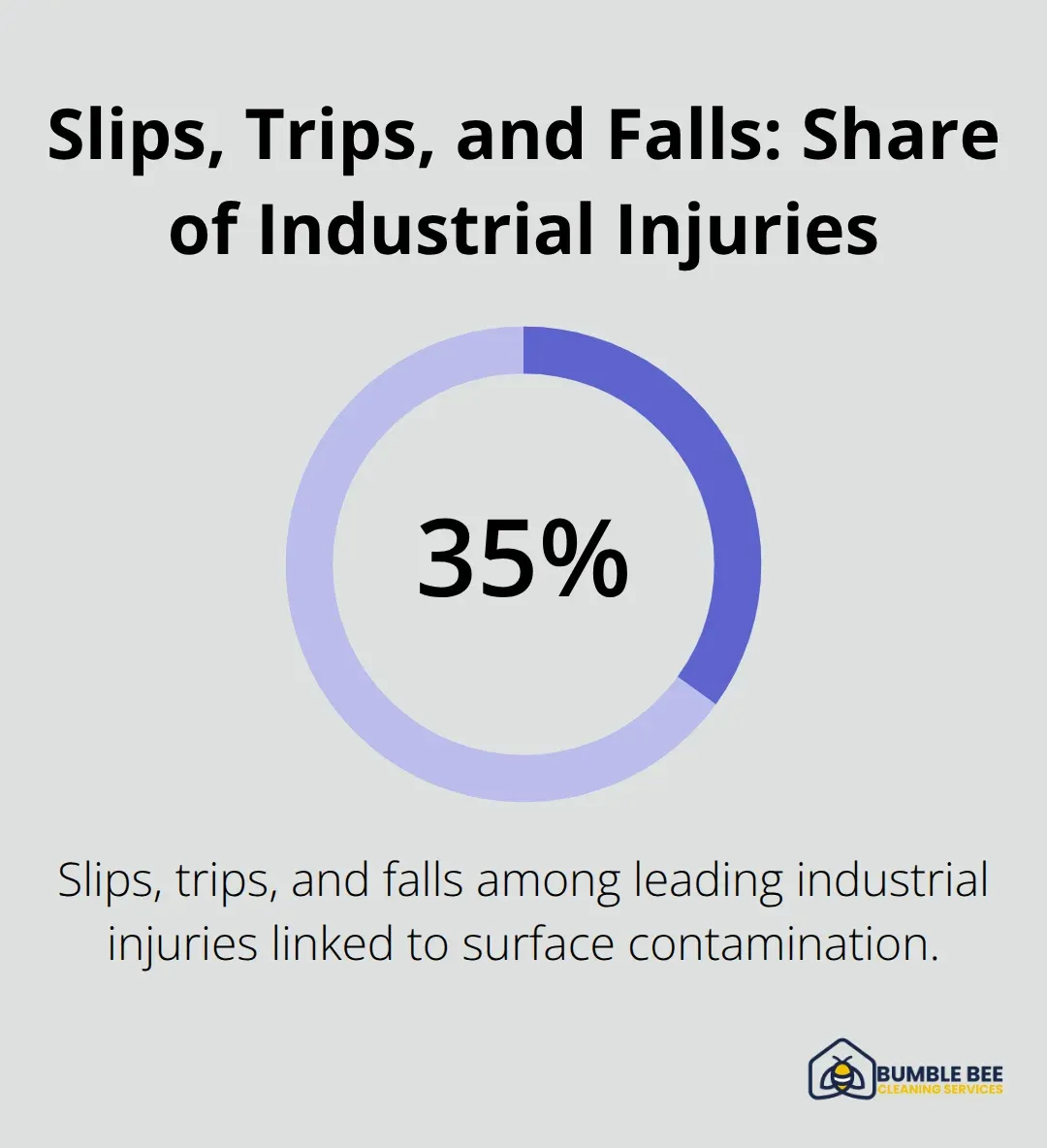
Walking-working surfaces must be regularly inspected and maintained to prevent hazardous conditions. Slips, trips, and falls account for roughly 35 percent of leading industrial injuries, and construction debris creates exactly these hazards. OSHA violations for surface contamination carry fines up to $15,625 per violation. Proper debris removal satisfies regulatory requirements with significant financial consequences for non-compliance.
Washington State Environmental Disposal Standards Demand Certified Handling
Construction debris from manufacturing facilities falls under Washington State’s waste classification system. Concrete with silica dust, metal shavings, and contaminated materials require disposal at approved facilities, not standard landfills. The Washington State Department of Ecology enforces hazardous waste regulations, and improper disposal triggers penalties ranging from $500 to $5,000 per violation according to Washington Municipal Code standards. Solvent-contaminated materials, spent welding rods, and paint waste demand certified hazardous waste handling.
Manufacturing facilities operating across multiple Washington counties face different local enforcement priorities. Seattle’s King County Public Health Department applies particularly stringent standards for facility cleanliness and contamination control compared to surrounding areas. Coordinating with licensed disposal vendors verifies that all construction debris meets state environmental standards before removal. Your facility maintains compliance documentation, protecting you from regulatory exposure.
The complexity of post-construction cleanup in manufacturing environments extends beyond debris removal-specialized equipment cleaning and industrial residue removal demand equally rigorous attention to prevent production delays and equipment failure.
How to Clean Manufacturing Equipment Without Damaging Precision Machinery
Production equipment in Seattle manufacturing facilities requires cleaning methods that remove industrial residue without compromising calibration or sensor accuracy. One wrong cleaning approach can cost you equipment replacement expenses that dwarf the cleanup itself. Hydroblasting at 10,000 to 25,000 psi removes heavy grease and mineral deposits from large floor surfaces and exterior equipment, but this pressure damages precision machinery through misalignment and optical sensor failure. Foam cleaning reaches into vents, grates, and drainage systems where expanding foam attaches to dirt and rinses away without liquid penetration into sensitive components. For small irregular parts and subassemblies, immersion cleaning in heated solutions dissolves stubborn deposits like hard water scale and welding residue without exposing nearby machinery to moisture or chemical spray. Laser cleaning eliminates solvent use entirely by using focused light to remove undesired materials with minimal surface damage, making it ideal for equipment sensitive to chemicals or water exposure.
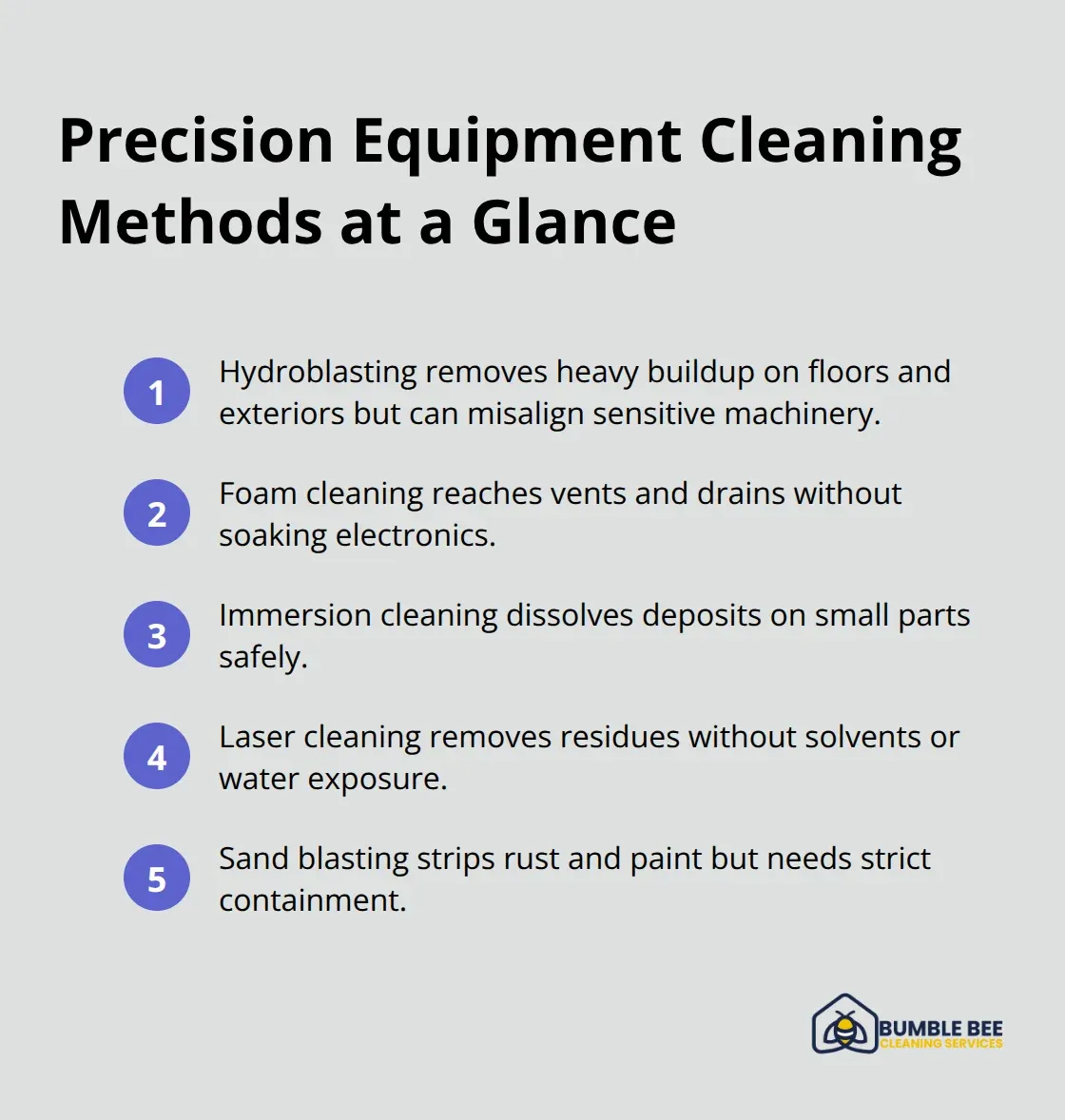
Sand blasting effectively removes rust, paint, and smoke stains but requires containment to prevent abrasive particles from contaminating adjacent production areas or settling into equipment crevices.
Matching Cleaning Methods to Your Equipment Type
The choice between these methods depends entirely on surface material, grime type, equipment accessibility, and your downtime tolerance. A facility producing beverage products cannot tolerate residual solvents near filling lines, so solvent-free laser cleaning becomes the only acceptable option. A metal fabrication shop can use hydroblasting on floors between production runs because the equipment sits in designated zones away from sensitive electronics. Improper method selection leaves contaminants behind that trigger quality control failures, equipment malfunctions, or worse, product recalls that damage your reputation and revenue.
Combustible Dust Demands Specialized Vacuum Equipment
Metal fabrication, grain handling, wood processing, plastics manufacturing, coal operations, and sugar facilities face a hazard that generic commercial cleaning completely ignores. Combustible dust accumulation poses extreme risk in metal and coal environments, high risk in grain, sugar, and wood operations, and moderate-to-high risk in plastics manufacturing. Even small dust accumulations ignite if dispersed into the air, which means sweeping with brooms or using compressed air to clear overhead surfaces actually creates the explosion hazard rather than preventing it. Intrinsically safe HEPA vacuums rated specifically for combustible-dust environments capture particles without generating static electricity or heat that could trigger ignition. High-level dusting of rafters, ductwork, and overhead structures controls airborne particulates that settle on equipment and create fire risk. A Seattle metal fabrication facility discovered combustible dust accumulation in ductwork during a routine inspection, revealing that their standard janitorial service had been sweeping production areas for months without understanding the danger. Regulatory compliance under OSHA combustible dust standards requires cleaning methods matched to your specific dust type and risk level, not generic approaches that create liability.
Verification Protocols Confirm Contamination Removal
After deep cleaning machinery and production lines, you need documented verification that surfaces meet your facility’s contamination standards before restart. A visual inspection that looks clean means nothing when microscopic particles remain in bearing housings, on optical sensors, or inside equipment enclosures. Some facilities use dry-pass verification procedures where technicians wipe cleaned surfaces with absorbent materials and examine them under specific lighting to confirm particle removal. Others require ATP testing on high-touch surfaces and equipment controls to verify microbial contamination levels before food production or sensitive pharmaceutical manufacturing resumes. Establishing written cleaning protocols tied to your specific equipment specifications and production requirements creates accountability and prevents repeated failures. Specialized cleaning vendors should provide detailed pre-cleaning assessments documenting existing contamination levels and post-cleaning verification results so you have evidence that work meets your standards.
The verification process reveals whether your facility can safely restart production or whether additional cleaning passes are necessary-a distinction that separates professional facility maintenance from standard janitorial work and directly impacts your bottom line.
Why Professional Cleanup Cuts Production Costs
Equipment Damage Costs Far More Than Cleanup Savings
Improper facility cleaning destroys expensive equipment faster than you realize. When your team or a generic janitorial service applies the wrong cleaning method to precision machinery, the financial damage extends far beyond the immediate cleanup failure. A Seattle beverage manufacturer learned this lesson when standard pressure washing damaged optical sensors on their filling line, requiring a $45,000 equipment replacement and forcing a five-day production halt. That downtime alone cost them approximately $75,000 in lost output, making the initial cleanup savings completely irrelevant.
Specialized industrial cleaning vendors understand equipment specifications and material compatibility, selecting methods that remove contaminants without creating new problems. Hydroblasting works on concrete floors between production runs, but applying that same pressure to sensitive electronics or precision calibration equipment triggers sensor misalignment and component failure. Foam cleaning reaches into drainage systems and ventilation without exposing nearby machinery to moisture or chemical spray. Immersion cleaning handles small parts without risk to adjacent production areas. The method selection directly determines whether your equipment operates at full capacity or requires expensive repairs that compound the original cleanup cost.
Downtime Between Cleaning Cycles Represents Your Largest Hidden Expense
Production downtime between cleaning cycles represents your largest hidden expense in manufacturing operations. OSHA’s Walking-Working Surfaces Standard requires clean, orderly floors to prevent the 35 percent of industrial injuries caused by slips, trips, and falls, which means you cannot skip cleaning between production runs. However, inefficient cleaning extends that downtime unnecessarily. A specialized vendor completing your facility cleanup in 12 hours versus 36 hours means your production lines restart three times faster, directly translating to recovered output and revenue.
Regulatory Violations Create Compounding Financial Exposure
Regulatory violations create another cost dimension that most manufacturers underestimate. Washington State enforces hazardous waste disposal requirements with penalties ranging from $500 to $5,000 per violation according to Washington Municipal Code standards, and improper post-construction debris handling triggers these fines consistently. OSHA citations for surface contamination violations reach $15,625 per violation when inspectors discover construction debris or combustible dust accumulation that generic cleaning failed to address.
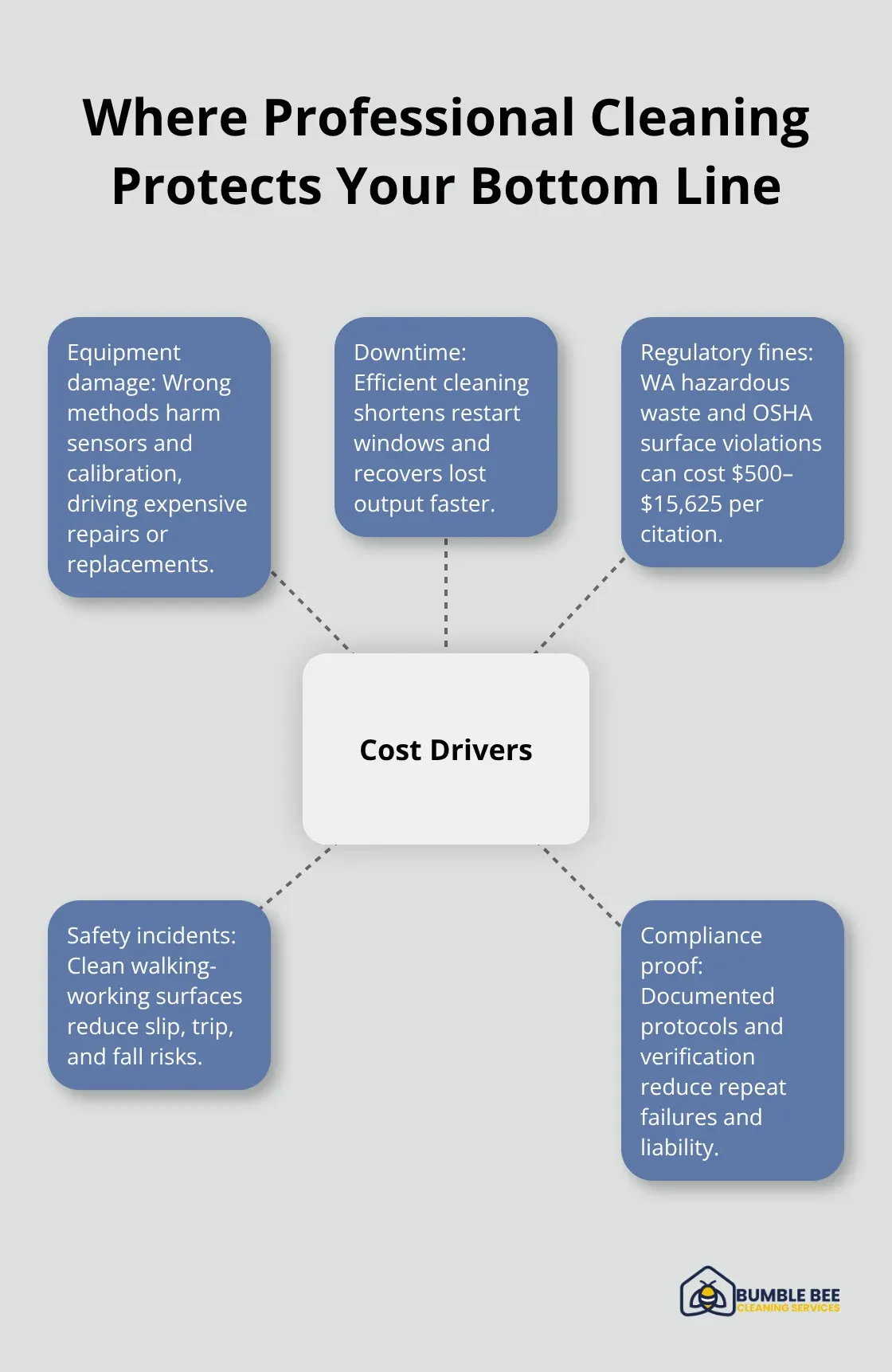
A single citation for inadequate combustible dust removal in a metal fabrication facility costs more than hiring a specialized vendor for six months of professional maintenance.
Specialized cleaning services protect your facility from these financial exposures by maintaining compliance with state environmental standards, OSHA surface requirements, and hazardous waste protocols that generic janitorial work ignores entirely.
Final Thoughts
Seattle manufacturing facilities operate in an environment where cleanup failures translate directly into equipment damage, regulatory penalties, and production losses that far exceed the cost of professional services. Specialized cleaning addresses the specific hazards your facility faces, whether that means post-construction debris removal meeting Washington State environmental standards, industrial degreasing of production equipment without sensor damage, or combustible dust control using intrinsically safe methods. Generic janitorial services lack the equipment, training, and understanding of manufacturing operations required to prevent these costly mistakes.
Equipment damage from improper cleaning methods, downtime between production cycles, and OSHA violations create compounding expenses that make specialized services the only economically rational choice. A facility that invests in professional maintenance avoids the $45,000 sensor replacement, the three-week production restart delay, and the $15,625 regulatory fine that result from cutting corners on cleanup. Professional facility maintenance also protects your workforce by preventing the slips, trips, and falls that account for 35 percent of industrial injuries, eliminating explosion hazards that generic sweeping actually creates, and confirming that contamination removal meets your production standards before equipment restarts.
We at Bumble Bee Cleaning Services bring specialized expertise to manufacturing facility cleanup, understanding the specific requirements that protect your equipment, your workforce, and your bottom line. Our team handles post-construction cleaning, deep cleaning of production areas, and industrial degreasing with the expertise your facility demands. Contact us to discuss how professional cleanup supports your manufacturing operations and regulatory compliance.
For more information about our cleaning services in Seattle and Atlanta, or to request a cleaning quote, call or text us at 425-786-1360 or email us at info@qbclean.com
