
Your office tiles look clean on the surface, but bacteria and grime hide deep in grout lines where standard mopping never reaches. We at Bumble Bee Cleaning Services know that tile grout cleaning requires professional equipment to remove what your daily routine misses.
Dirty office floors affect your team’s health and productivity more than most business owners realize. This guide shows you what’s really lurking in your tiles and how to fix it.
What’s Really Growing in Your Office Tile Grout
Your office tiles harbor far more than surface-level dirt. A UK swab study by Factory Direct Flooring found that bathroom floors averaged 933 CFU of bacteria before cleaning, with common culprits including Staphylococcus and Bacillus. These bacteria thrive in grout lines because the porous material absorbs moisture, spills, and organic matter that mopping leaves behind. Standard daily cleaning only addresses what sits on top of the tile surface, leaving grout lines untouched. Grout is highly porous and easily absorbs spills, creating a perfect breeding ground for bacteria and mold in office tile grout. In Seattle offices with high foot traffic, this buildup accelerates, especially in restrooms and break rooms where moisture and contamination are constant. The bacteria trapped in grout don’t stay confined-they release odors that permeate spaces and reduce comfort, while mold and mildew trigger allergies and respiratory issues in your team.
Why Mopping Fails Where It Matters Most
Your standard mopping routine removes visible grime but stops at grout lines. Vacuuming cuts bacteria by about 98% on hard floors like tile, and mopping with warm water and detergent reduces bacteria by about 97% on vinyl floors, according to Factory Direct Flooring research. However, these methods only work on the surface. The dirt, grease, and soap scum embedded deep in grout joints require pressure and specialized solutions that household equipment cannot deliver. Hidden dirt in office tile resides in grout lines and beneath surface grime, invisible during casual walk-throughs. Stubborn stains and discoloration resist removal without professional intervention, and neglecting maintenance makes cleaning exponentially more challenging later. Dirty grout and tile also make surfaces slippery, raising slip-and-fall risk in restrooms and break areas-a genuine liability for your business. Grime and moisture penetrate grout lines, leading to deterioration of underlying surfaces that may require costly repairs or tile replacement.
The Health Impact Your Team Experiences
Dirty tile and grout don’t just look bad; they actively harm your workforce. Bacteria, mold, and mildew trigger allergies and respiratory issues, with heightened risk for children and elderly visitors. Allergen accumulation from dust, pollen, and pet dander on tile surfaces requires regular professional cleaning to prevent buildup that compromises indoor air quality. Deep professional cleaning removes these allergens and the bacteria trapped in grout, directly improving the health and productivity of your office environment. The condition of your tile also influences perceived property value-dirty or damaged tile deters clients, customers, and potential lessees while reducing overall property appeal.
What Professional Equipment Actually Removes
Steam cleaning effectiveness bacteria removal tile grout 77% reduction proved most effective on tile, natural stone, and slate floors. This performance far exceeds what standard mopping achieves. Commercial-grade equipment applies high pressure and heat to grout lines, extracting dirt and bacteria that household tools leave behind. The process works because professional systems reach temperatures and pressures that penetrate porous grout, while standard mopping only skims the surface. Your team’s daily efforts, though important, cannot match the extraction power of truck-mounted or portable professional systems. This gap explains why offices with regular professional cleaning maintain healthier environments and longer-lasting tile installations.
How Professional Cleaning Really Works on Seattle Office Tiles
Commercial-Grade Equipment Transforms Grout Restoration
Truck-mounted or portable hot water extraction systems operate at pressures and temperatures that standard mopping cannot match, which is why the difference in results is dramatic. These systems heat water to temperatures that soften embedded grime while applying pressure that forces dirt and bacteria out of grout lines. The Factory Direct Flooring study showed that steam cleaning reduced bacteria on tile surfaces, far exceeding results from mopping with warm water and detergent. The extraction phase pulls contaminated water and loosened soil out of grout, preventing moisture from remaining trapped and creating new mold growth. This multi-step approach removes what your daily routine leaves behind.
The IICRC Standard Process That Protects Your Tiles
Professional technicians follow the IICRC S220 Tile and Grout Standard, a systematic process that guides every phase of restoration. The process starts with inspection to assess tile material and soil level, followed by pre-vacuum to remove loose dry soil. Pre-treatment with alkaline cleaners for grease and oils comes next, then rotary agitation breaks apart stubborn deposits in grout joints.
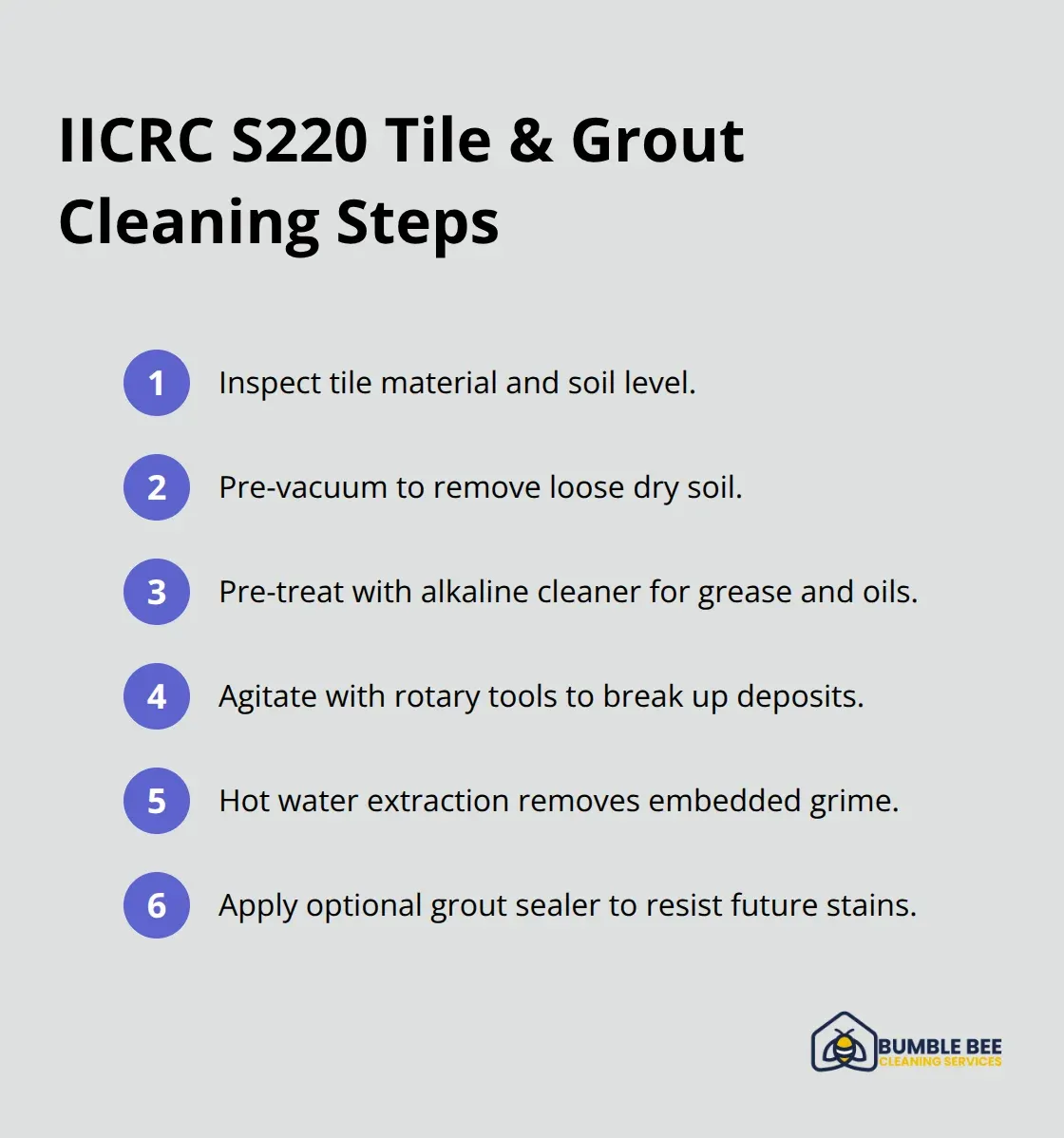
Hot water extraction pulls embedded grime from tile and grout, and optional grout sealing afterward protects against future staining. Each step serves a specific purpose-skipping any phase reduces effectiveness and risks damaging tile or grout. Professional teams trained in these standards achieve results that DIY methods simply cannot replicate.
Eco-Friendly Solutions Meet Seattle’s Environmental Standards
Eco-friendly products are now the standard in professional tile cleaning, not a compromise. King County bans phosphate-containing detergents to protect waterways, so professional cleaning companies use hydrogen peroxide-based cleaners, plant-based all-purpose solutions, and enzymatic cleaners that meet EPA Safer Choice standards. These products deliver the same cleaning power as harsh chemicals while reducing chemical exposure in occupied office spaces, which improves air quality and worker safety during and after cleaning.
Scheduling That Matches Your Office’s Traffic Patterns
For Seattle offices, scheduling professional deep cleaning every six to twelve months prevents grout deterioration and maintains health benefits. High-traffic areas like restrooms and break rooms require cleaning every three to six months because moisture and foot traffic accelerate dirt accumulation in these spaces. Between professional cleanings, your team should vacuum tile floors regularly and mop with pH-neutral cleaners to avoid grout erosion. Establishing a maintenance plan with periodic grout sealing after professional cleaning helps resist future staining and simplifies upkeep. This data-driven approach-combining professional deep cleaning on a schedule with consistent daily care-keeps office tile looking fresh while lowering long-term costs.
The health risks that hidden grout dirt creates extend beyond what appears on the surface, affecting everything from air quality to your team’s ability to work productively in clean spaces. Understanding what professional cleaning removes is only half the equation; knowing how to maintain those results between appointments determines whether your investment pays off long-term.
Keeping Your Tiles Clean Between Professional Service Calls
Daily Practices That Stop Dirt Before It Sets
Your daily routine matters far more than most office managers realize. Vacuuming tile floors cuts bacteria significantly, making it the single most effective daily practice you can implement. Vacuum at least three times weekly in high-traffic areas like hallways, restrooms, and break rooms where moisture and foot traffic accelerate dirt accumulation in grout. This removes loose soil before it gets ground into grout lines and hardens.
Mop with warm water and a pH-neutral cleaner at least twice weekly, which reduces bacteria on hard floors. Avoid acidic or alkaline cleaners that erode grout over time; pH-neutral formulas protect grout integrity while removing surface grime. Wipe up spills immediately rather than letting moisture sit on grout, since trapped moisture creates ideal conditions for mold and mildew growth.
Choosing Products That Protect Your Grout
Address stains promptly with professional-grade stain removers before they set permanently into porous grout. King County’s environmental standards restrict phosphate-containing detergents to protect waterways, so select eco-friendly cleaners that meet EPA Safer Choice standards. These products deliver genuine cleaning power without the chemical exposure that harms indoor air quality during and after application.
Use color-coded cloths to prevent cross-contamination between areas, work from high surfaces down to floors, and ensure tiles dry thoroughly after mopping to prevent moisture from settling in grout lines. Cracks in grout require prompt repair to stop water infiltration and further damage.
Scheduling Professional Cleaning to Prevent Deterioration
The gap between daily maintenance and professional deep cleaning determines your long-term tile condition and costs. Schedule professional deep cleaning every six to twelve months for standard office environments, but reduce this to every three to six months if your space experiences heavy foot traffic or high moisture exposure. Professional cleaning removes what your daily routine cannot reach, preventing grout deterioration that leads to costly tile replacement.
If mold or mildew returns quickly after cleaning, ventilation issues are likely driving recurrence; address moisture sources rather than treating symptoms repeatedly. Establish a maintenance plan that pairs your consistent daily care with scheduled professional cleaning, because this combination keeps office tile looking fresh while lowering long-term replacement and restoration costs significantly.
Final Thoughts
Clean office tiles directly impact how your team performs and how clients perceive your workspace. When grout stays free of bacteria and mold, your employees experience fewer respiratory issues and allergies, which translates to fewer sick days and higher productivity. A professional appearance matters too-visitors and potential clients form opinions within seconds, and tile grout cleaning results speak louder than any marketing claim.
Professional tile and grout cleaning prevents costly replacement by stopping the deterioration that happens when moisture and grime penetrate grout lines. Regular professional cleaning paired with your daily maintenance routine protects your property value while keeping your office looking fresh. This investment extends your tile’s lifespan and saves thousands in repair costs over time.
Contact Bumble Bee Cleaning Services today to set up a free site assessment and start protecting your office’s health and appearance. Our team uses eco-friendly products that meet King County’s environmental restrictions while delivering the deep cleaning power your tiles need. With flat-rate pricing and easy online booking, scheduling professional tile grout cleaning fits your budget and your schedule.
For more information about our cleaning services in Seattle and Atlanta, or to request a cleaning quote, call or text us at 425-786-1360 or email us at info@qbclean.com
