
Seattle’s commercial spaces face constant pressure to maintain safe, sanitary environments. UV sanitizing technology offers a powerful solution that goes beyond what traditional cleaning alone can achieve.
We at Bumble Bee Cleaning Services see UV systems transforming how businesses protect their facilities and occupants. This guide shows you exactly how this technology works and why it matters for your operation.
How UV Light Destroys Pathogens in Commercial Spaces
The Science Behind UV Disinfection
UV technology works by using specific wavelengths of ultraviolet light to damage the DNA and RNA of microorganisms, rendering them unable to reproduce or cause infection. The most effective wavelength for commercial disinfection is 254 nanometers, which penetrates the genetic material of bacteria, viruses, and fungi on contact. This approach differs fundamentally from chemical disinfectants that require contact time and can leave residues behind.
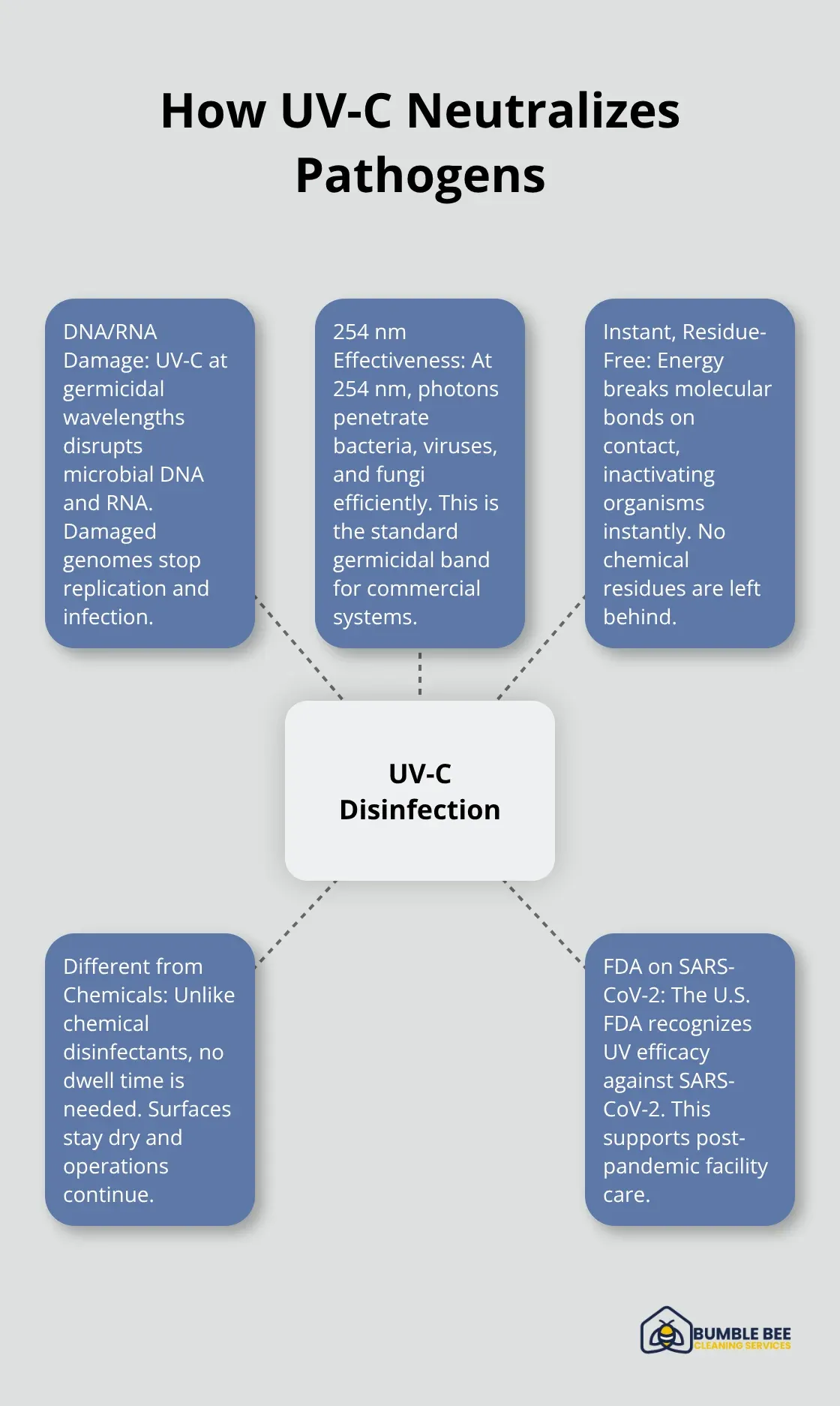
When UV-C light hits a pathogen, it breaks the molecular bonds that hold the organism together, killing it instantly without creating any toxic byproducts. The U.S. FDA has confirmed UV cleaning’s effectiveness in neutralizing SARS-CoV-2, making it particularly relevant for Seattle businesses managing post-pandemic facility care.
The Trade-Off with Newer UV Wavelengths
A newer 222 nanometer UV-C wavelength can operate in occupied spaces because it has limited skin penetration. However, research from NIST published in May 2024 found that this wavelength can generate ozone when it reacts with indoor air chemistry, particularly with fragrance compounds in restrooms. While 222 nm offers occupancy flexibility, it requires careful ventilation integration and real-time air quality monitoring to prevent secondary chemical pollutants like formaldehyde and volatile organic compounds from forming.
Commercial UV System Configurations
Commercial UV systems come in three main configurations: duct-mounted units that sanitize air as it flows through HVAC systems, surface-mounted devices for hard-to-reach areas like coils and registers, and portable units for targeted treatment of specific zones. The most effective approach combines mechanical cleaning with UV application, since UV light cannot penetrate dust or organic buildup-surfaces must be clean first for the light to reach pathogens.
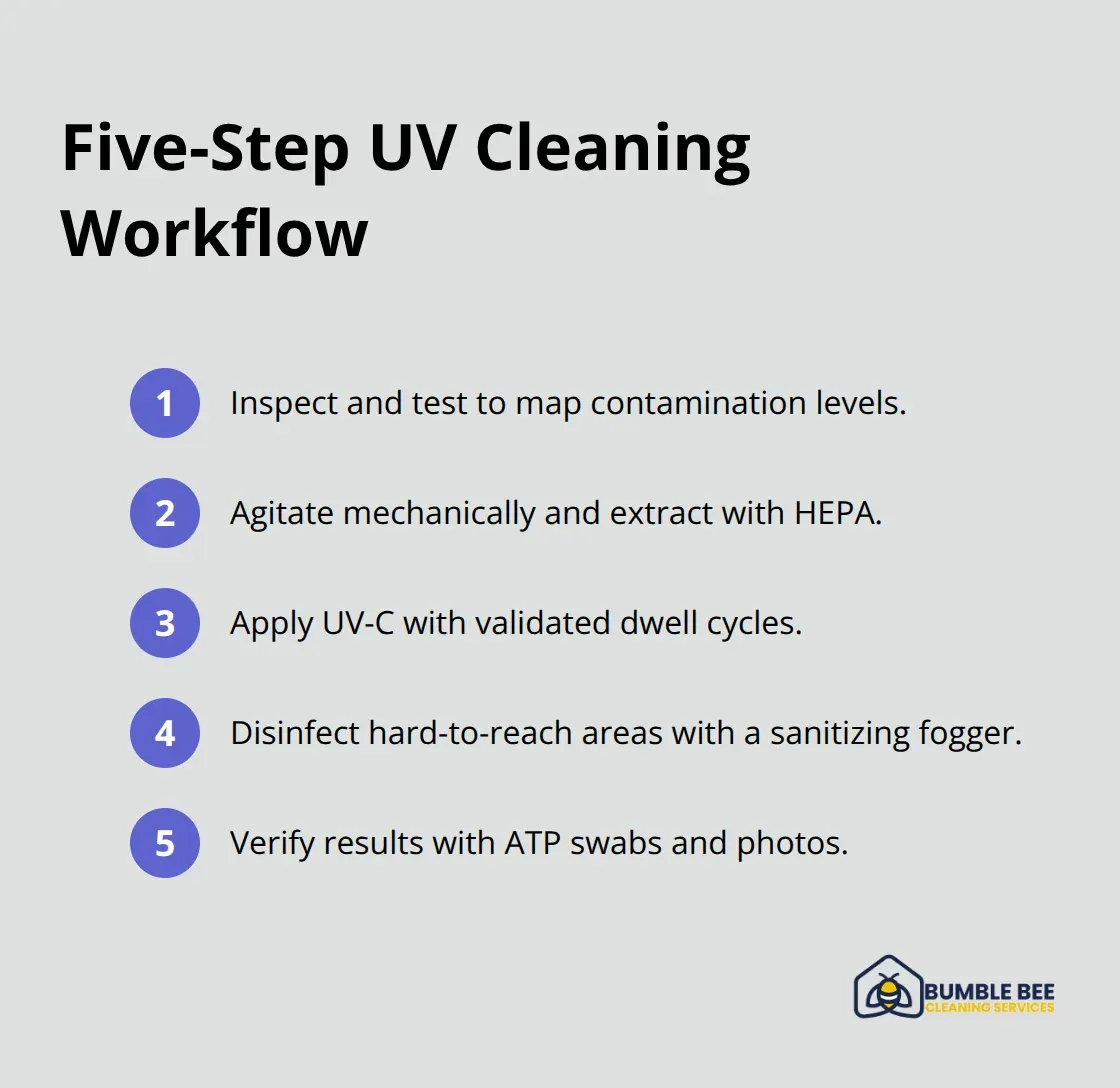
A five-step process works best: inspection and testing to identify contamination levels, mechanical agitation plus HEPA extraction to remove debris, UV-C application with proper dwell cycles, targeted disinfection using a sanitizing fogger for complete coverage, and verification using ATP swabs and photography to confirm effectiveness.
Measuring Treatment Effectiveness
Differential pressure measurement before and after treatment shows whether your ductwork is truly clean. Unlike traditional chemical cleaning, UV disinfection provides chemical-free sanitation, reducing exposure for staff and customers while microbes are inactivated on contact, enabling immediate reduction in contamination. Seattle’s humid climate and lingering odors make this approach particularly valuable-UV systems paired with proper ventilation can control odors and improve HVAC efficiency year-round without relying on harsh chemicals.
These technical advantages set the stage for understanding how UV technology delivers real benefits across different types of commercial operations in Seattle.
Why UV Technology Cuts Your Real Operating Costs
UV disinfection eliminates the need for constant chemical restocking and reduces labor hours spent on manual surface treatments. Chemical disinfectants require contact time-typically 10 minutes or longer depending on the product-meaning staff must spray surfaces and wait before moving to the next area. UV systems work instantly on contact, so pathogens die the moment light exposure occurs, cutting treatment time substantially. This speed advantage matters most in high-traffic environments like office lobbies, retail checkout areas, and healthcare waiting rooms where downtime costs money. Beyond speed, UV produces zero toxic byproducts, eliminating chemical exposure liability for your employees and customers. Over a five-year period, the return on investment from UV installation typically ranges from two to five years, after which the system continues delivering protection at minimal cost beyond lamp replacement every nine to twelve months.
Pathogen Control Without Chemical Residue
Hospitals and medical offices benefit most from UV’s chemical-free approach because healthcare-associated infections cost the U.S. healthcare system billions annually. UV sterilization supports rapid turnover in operating rooms, patient rooms, and shared restrooms through disinfection of surfaces without leaving chemical residues that can irritate respiratory systems or trigger allergic reactions in vulnerable populations. Retail environments and food service facilities also gain from this advantage because customers increasingly expect chemical-free sanitation practices. EPA-registered disinfectants work, but they require proper ventilation and leave surface residues that accumulate over time. UV systems paired with mechanical cleaning remove this concern entirely, making facilities safer for occupants with chemical sensitivities or respiratory conditions. In Seattle’s commercial spaces, where occupancy density varies throughout the day, UV allows rapid re-entry to treated areas without waiting for chemical off-gassing or ventilation cycles to complete.
Air Quality and Surface Protection in One System
UV duct sanitization addresses pathogen control in HVAC systems by killing bacteria, mold, and some viruses, working best on wet coil surfaces to prevent biofilm and odors. A contaminated duct system circulates pathogens, allergens, and odor-causing bacteria throughout your entire facility, affecting every occupant regardless of how often you clean individual rooms. Installing UV-C lamps inside supply and return ducts creates continuous sanitization as air flows through, preventing microbial regrowth between deep cleaning cycles. This approach particularly suits Seattle’s climate, where humidity and seasonal temperature fluctuations encourage mold and bacterial growth in ductwork. Verification through ATP swabs and post-treatment testing confirms whether your UV system actually works, giving you measurable proof rather than assumptions about sanitation effectiveness.
Measuring Real Results With Data
Differential pressure measurement before and after treatment shows whether your ductwork is truly clean and functioning at peak efficiency. Unlike traditional chemical cleaning, UV disinfection provides chemical-free sanitation, reducing exposure for staff and customers while microbes die on contact, enabling immediate reduction in contamination. Seattle’s humid climate and lingering odors make this approach particularly valuable-UV systems paired with proper ventilation control odors and improve HVAC efficiency year-round without relying on harsh chemicals. Post-treatment retesting and before-and-after photography document the transformation, giving you concrete evidence that your investment protects your facility and occupants.
These cost and performance advantages set the stage for understanding how UV technology delivers real benefits across different types of commercial operations in Seattle, from the moment air enters your ductwork to the surfaces your customers and employees touch daily.
Where UV Technology Makes the Biggest Impact
Office Buildings: Continuous Protection Without Workflow Disruption
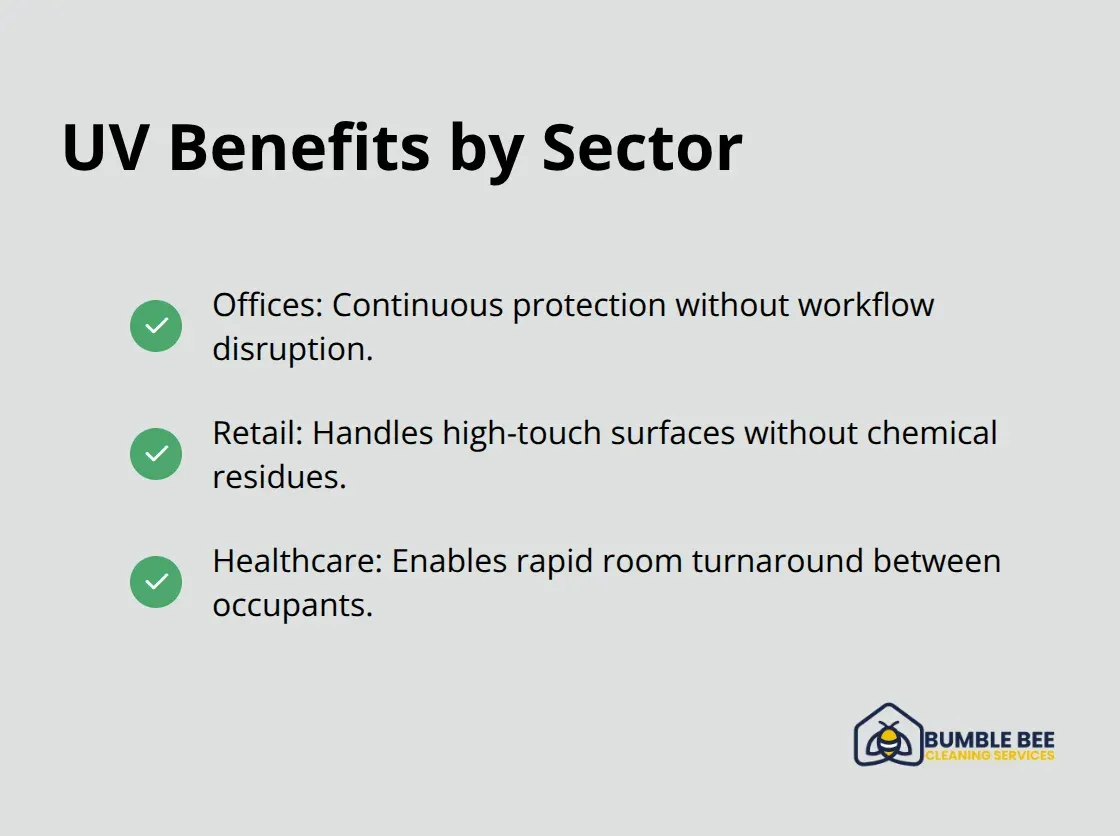
Office buildings across Seattle operate on tight schedules where downtime costs thousands per hour. UV systems installed in HVAC ducts and applied to high-touch surfaces like elevator buttons, conference room tables, and restroom fixtures eliminate pathogens during normal business hours without disrupting workflows. The instant disinfection capability matters here because offices cannot shut down for chemical off-gassing cycles. Installing UV-C lamps in supply and return ducts provides continuous sanitization as air circulates, preventing the buildup of bacteria and mold that trigger sick building complaints and reduce employee productivity. A contaminated duct system affects every floor simultaneously, making centralized UV treatment far more efficient than spot-treating individual offices.
Retail Environments: Managing High-Contact Surfaces
Retail environments face even higher contamination pressure because checkout counters, fitting rooms, and door handles see constant customer contact throughout operating hours. UV disinfection paired with electrostatic spraying covers irregular surfaces that manual wiping misses, particularly in fashion retail where customers touch hundreds of items daily. The chemical-free approach also matters for retail because customers increasingly research whether businesses use harsh disinfectants, and UV systems allow retailers to advertise safer sanitation practices without residual chemical concerns.
Healthcare Facilities: Rapid Turnaround Between Occupants
Healthcare facilities represent the highest-value application for UV technology because healthcare-associated infections extend hospital stays and increase operational costs while reducing profit margins. Operating rooms, patient recovery areas, and shared restrooms require rapid turnaround between occupants, and UV systems enable immediate re-entry without waiting for chemical disinfectants to dry or off-gas. Medical offices and urgent care clinics particularly benefit because they operate on compressed schedules with minimal gaps between appointments, and UV provides instant pathogen control without occupancy restrictions.
Implementation Across All Three Sectors
A five-step process works best across all three sectors: inspection to identify contamination hotspots, mechanical cleaning to remove organic matter that blocks UV light, UV-C application with proper dwell time, verification through ATP swabs to confirm effectiveness, and scheduled lamp replacement every nine to twelve months to maintain protection. Differential pressure measurement before and after treatment documents whether ductwork truly improved, providing concrete evidence rather than assumptions. Seattle’s humid climate accelerates mold and bacterial growth in all three environment types, making preventive UV plans particularly valuable for reducing repeat deep cleanings and extending HVAC system life.
Final Thoughts
UV sanitizing technology fundamentally transforms how Seattle commercial spaces protect occupants and maintain operational efficiency. Instant pathogen elimination without chemical residue, reduced labor costs through faster treatment cycles, and measurable results through ATP verification and differential pressure testing set UV systems apart from traditional disinfectants that require contact time and leave surface buildup. Mechanical cleaning removes organic matter that blocks UV light, making the two approaches complementary rather than competitive, so deep cleaning handles visible debris while UV sanitizing addresses pathogens that survive standard wiping and chemical treatment.
Seattle’s humid climate accelerates microbial growth in ductwork and on surfaces, making preventive UV plans particularly valuable for reducing repeat deep cleanings and extending HVAC system life. Preventive maintenance with scheduled lamp replacement every nine to twelve months sustains protection at minimal ongoing cost, typically delivering return on investment within two to five years. This layered approach works across offices, retail environments, and healthcare facilities because it addresses contamination at multiple points in your facility’s daily operation.
We at Bumble Bee Cleaning Services combine UV sanitizing with deep cleaning, recurring maintenance, and post-construction services to create comprehensive protection for your commercial space. Contact us to schedule a site visit and develop a customized cleaning plan that integrates UV technology with your existing operations, giving your Seattle facility the protection it deserves.
For more information about our cleaning services in Seattle and Atlanta, or to request a cleaning quote, call or text us at 425-786-1360 or email us at info@qbclean.com
