
Your Bellevue home deserves more than just a weekly vacuum and dust. Deep cleaning goes beyond surface tidiness-it tackles the buildup that regular cleaning misses, protecting both your family’s health and your home’s value.
We at Bumble Bee Cleaning Services know that figuring out the right deep clean frequency guide for your household isn’t one-size-fits-all. Family size, pets, and how much foot traffic your home sees all play a role in how often you should deep clean.
How Often Should You Deep Clean Your Bellevue Home
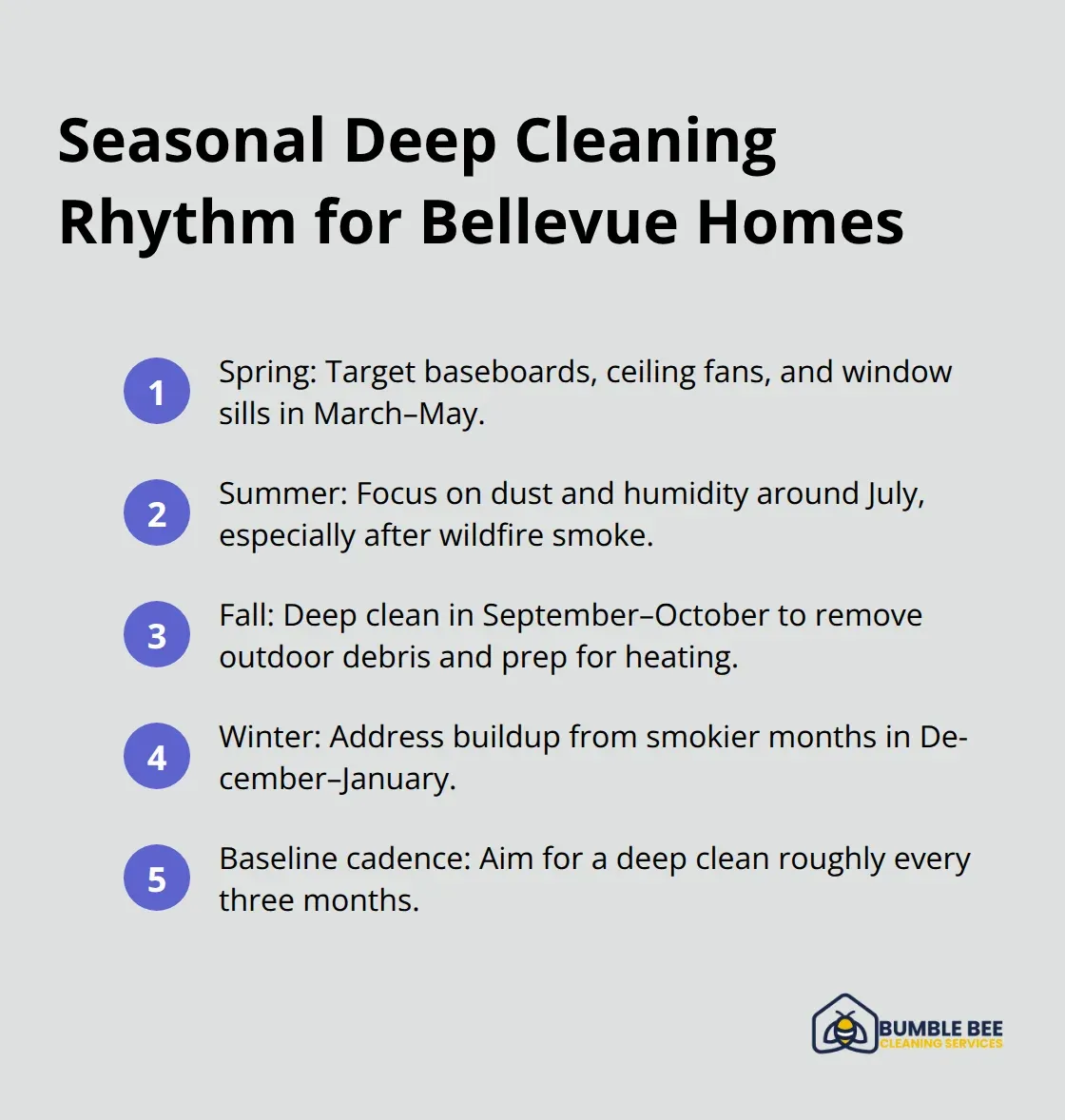
Bellevue’s four-season climate demands that you shift your deep cleaning schedule with the weather. Spring brings pollen that settles on every surface, making March through May the ideal time to tackle baseboards, ceiling fans, and window sills where allergens accumulate. Summer dust and humidity require attention around July, especially if wildfire smoke has degraded air quality in the region during previous years. Fall in September and October calls for another deep clean to remove outdoor debris and prepare for winter heating, which dries out indoor air and concentrates dust. Winter deep cleaning in December or January matters less for seasonal triggers but more for the buildup that accumulated during the smokier months. This quarterly rhythm, roughly every three months, keeps your home fresh without overdoing it.
Pets and Children Change Your Timeline
If your family includes pets or young children, you’ll want to add an extra deep clean between seasons, moving to a bimonthly schedule every six to eight weeks. A household of four with two dogs needs deep cleaning every six weeks, while a couple with no pets can stretch to quarterly visits. Homes with long-haired pets in Bellevue commonly report needing deep cleaning every five to six weeks because pet dander and fur settle into baseboards and under furniture where regular vacuuming cannot reach.
High-Traffic Zones Accumulate Dirt Faster
High-traffic zones like entryways, kitchen floors, and hallways accumulate dirt faster because shoes, paws, and daily movement grind debris into carpets and grout. If your family logs 40-plus hours per week inside the home working or schooling remotely, dust and allergens build up more quickly on surfaces you touch constantly.
Finding Your Home’s Rhythm
Start with quarterly deep cleaning and track whether you notice visible dust on baseboards or stale air quality between sessions. If you do, move to bimonthly service. The cost difference is real-quarterly deep cleaning runs roughly $488 per visit according to Angi’s data, so bimonthly would add significant annual expense. For families with pets or multiple children, that extra investment in the sixth or eighth week prevents the need for more intensive remediation later and keeps your home genuinely fresh rather than just appearing clean on the surface. Once you identify your home’s rhythm, you can spot the specific areas that demand the most attention.
Signs Your Home Needs a Deep Clean
Dust and Allergen Buildup Tell the Story
Your eyes catch the first warning signs. Dust collecting on baseboards, window sills, and ceiling fan blades signals that surface cleaning alone no longer cuts it, especially in Bellevue where spring pollen and summer wildfire smoke leave visible residue on every horizontal surface. Run your finger across a baseboard and you’ll see gray or tan buildup-that’s your signal that a deep clean has become necessary. Bellevue’s four-season climate intensifies this problem, with each season depositing its own layer of particles that regular vacuuming misses.
Odors Reveal What You Cannot See
A stale or musty smell lingering in your home despite regular vacuuming means allergens and dust have settled into carpet fibers, upholstery, and air vents where standard weekly cleaning cannot reach. Bellevue’s humidity during certain seasons traps odors in fabrics and makes rooms feel stuffy even when windows stay open. These smells indicate that dirt has penetrated deeper than surface-level attention addresses. If you detect stale air between your scheduled deep cleaning sessions, your home’s rhythm needs adjustment.
Carpets and Upholstery Show Physical Wear
Visible wear, discoloration, or matted fibers on carpets and upholstery indicate that deep cleaning has been delayed too long. Pet hair embedded in carpet pile or dark spots on light-colored upholstery are concrete signs that surface vacuuming has not addressed deeper accumulation. These physical changes happen gradually, but they accelerate when deep cleaning intervals stretch too far apart.
Track Specific Markers Instead of Following a Calendar
The practical step is to monitor these specific indicators in your home rather than relying on dates alone. Note when you first spot dust on baseboards or detect stale air, then measure how many weeks have passed since your last deep clean. If visible dust appears within four weeks of a deep clean, your home needs service every four to six weeks instead of quarterly. If odors emerge or carpet matting becomes noticeable, dirt and allergens have penetrated deeper than regular cleaning handles.
According to Angi’s research, deep cleaning costs around $488 per visit on average, so adjusting your frequency based on actual warning signs ensures you invest in cleaning when your home genuinely needs it rather than following a generic schedule. Homes in Bellevue with pets or higher foot traffic show these signs sooner, so monthly inspections of baseboards, carpets, and air quality help you stay ahead of buildup. This approach transforms deep cleaning from guesswork into a responsive strategy tied to what your home actually demonstrates. Once you identify these markers, you can pinpoint the specific areas that demand the most attention.
Deep Cleaning Areas Bellevue Families Often Overlook
Hidden Zones Trap Allergens and Dust
Most Bellevue families focus their deep cleaning efforts on visible surfaces, leaving behind the areas where dirt actually accumulates most densely. Behind refrigerators, under kitchen cabinets, and beneath dining tables, dust and pet dander settle into thick layers that regular weekly vacuuming never reaches. These hidden zones become allergen traps, especially problematic during Bellevue’s spring pollen season when particles settle into every crevice. The space behind your refrigerator collects lint, dust, and pet hair that compress into a felt-like mat over time. Under sofas and beds, carpet fibers mat down from foot traffic while dust mites and their droppings accumulate in the compressed pile, creating conditions that trigger allergies and respiratory irritation.
When you move furniture to inspect these areas, you often find a visible line where clean carpet meets the darkened, matted section that has been hidden for months. This is not just an aesthetic problem-it directly affects your home’s air quality and your family’s health. Deep cleaning these zones every six to eight weeks prevents allergen buildup and keeps the dust from resettling on surfaces you touch daily. If your household includes pets or multiple children, these hidden areas demand attention every four to six weeks because foot traffic and pet movement accelerate the accumulation cycle.
Baseboards and Crown Molding Collect Grimy Film
Baseboards, crown molding, and the tops of door frames collect a fine gray layer that becomes obvious only when you look up with bright light behind you. Baseboards along kitchen and bathroom walls absorb moisture and dust, creating a grimy film that cloth-based weekly cleaning cannot remove effectively. These surfaces trap particles that circulate through your home and settle on items you use regularly. Professional deep cleaning targets these neglected areas because crews use equipment and techniques to access spaces your household routine misses.
Ceiling Fans and Light Fixtures Redistribute Allergens
Dust accumulates on ceiling fan blades, and that dust circulates through your home’s air every time the fan runs, redistributing allergens across rooms. Light fixtures and ceiling corners accumulate cobwebs and dust that harbor dust mites and allergens, contributing to the stale air quality you notice between deep cleaning sessions. For Bellevue families trying to maintain genuinely fresh air rather than just the appearance of cleanliness, targeting these high-reach areas during deep cleaning every six to eight weeks prevents the dust from becoming so embedded that it requires aggressive scrubbing or specialized equipment to remove.
According to Angi’s research, deep cleaning costs around $488 per visit on average, but this investment specifically covers these neglected areas. Professional crews access spaces and use techniques that standard household routines miss entirely.
Final Thoughts
Your deep clean frequency guide depends on what your Bellevue home actually shows you, not a calendar date. Start with quarterly deep cleaning every three months, then adjust based on visible dust, odors, or carpet wear. Families with pets or children should plan for bimonthly service every six to eight weeks because dirt accumulates faster in high-traffic households.
Regular deep cleaning protects your family’s health by removing allergen traps hidden behind furniture and inside carpet fibers where dust mites thrive. Bellevue’s seasonal changes mean spring pollen, summer smoke, and winter heating all deposit particles that standard weekly cleaning cannot address. Deep cleaning targets these accumulated allergens, reducing respiratory irritation and improving air quality throughout your home.
Professional deep cleaning saves you from spending entire weekends scrubbing baseboards, moving furniture, and accessing high-reach areas like ceiling fans. We at Bumble Bee Cleaning Services handle these neglected zones with equipment and techniques your household routine cannot replicate, completing work in hours rather than days (and we use eco-friendly products safe for children and pets). Contact Bumble Bee Cleaning Services to schedule your first deep clean and stop guessing about when your home needs attention.
For more information about our cleaning services in Seattle and Atlanta, or to request a cleaning quote, call or text us at 425-786-1360 or email us at info@qbclean.com
