
Facility maintenance isn’t a luxury-it’s a business investment that directly impacts your bottom line. We at Bumble Bee Cleaning Services see Seattle businesses waste thousands annually on preventable repairs and equipment failures.
The good news is straightforward: a structured maintenance plan catches problems early, extends equipment life, and reduces emergency costs. This post shows you exactly where to focus your efforts for maximum savings.
How Much Money Do You Actually Lose Without Maintenance
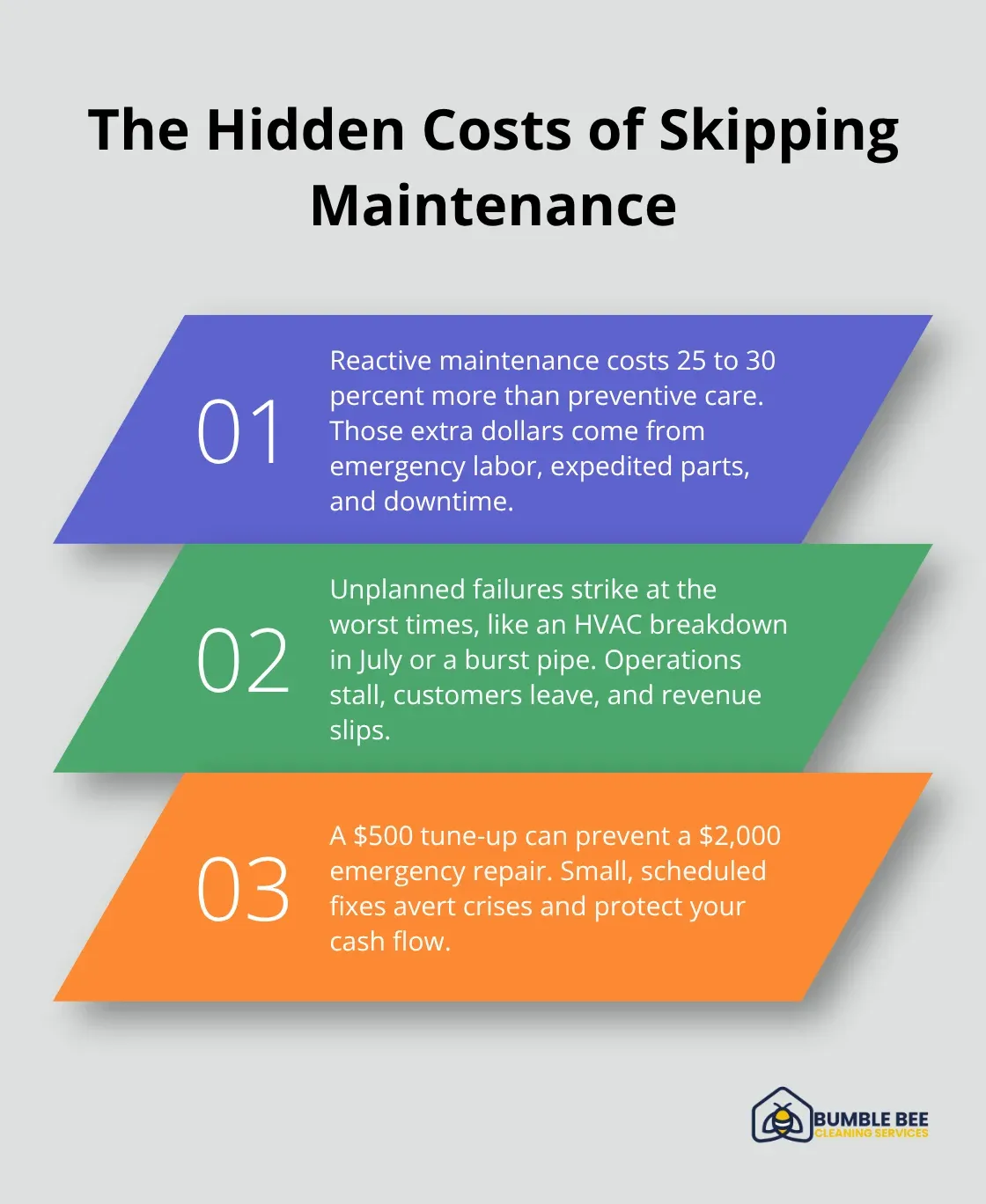
Reactive maintenance costs 25 to 30 percent more than preventive care, according to industry benchmarks. Every dollar you skip on regular upkeep translates into emergency labor charges, expedited parts, and unplanned downtime that halts operations. A broken HVAC system in July doesn’t wait for budget approval, and neither does a burst pipe in your office building. Seattle businesses operating without a maintenance plan pay a penalty every time something fails. The math is brutal: a $500 tune-up prevents a $2,000 emergency repair, yet most facility managers treat maintenance as optional until crisis hits.
Equipment Lives Longer With Regular Care
Well-maintained HVAC systems last about 15 years compared to 10 years for neglected units, giving you five additional years of service before replacement costs mount. Regular maintenance extends asset lifespan, meaning your flooring, plumbing, electrical systems, and climate control equipment all stay productive longer. A monthly filter change and quarterly refrigerant check on your HVAC system costs far less than replacing the entire unit early. Preventive maintenance also delivers about 400 percent return on investment through energy savings and extended asset life combined. Instead of replacing equipment in five years, a structured plan lets you stretch replacements to eight or ten years, freeing capital for other business priorities.
Energy Bills Drop When Systems Run Right
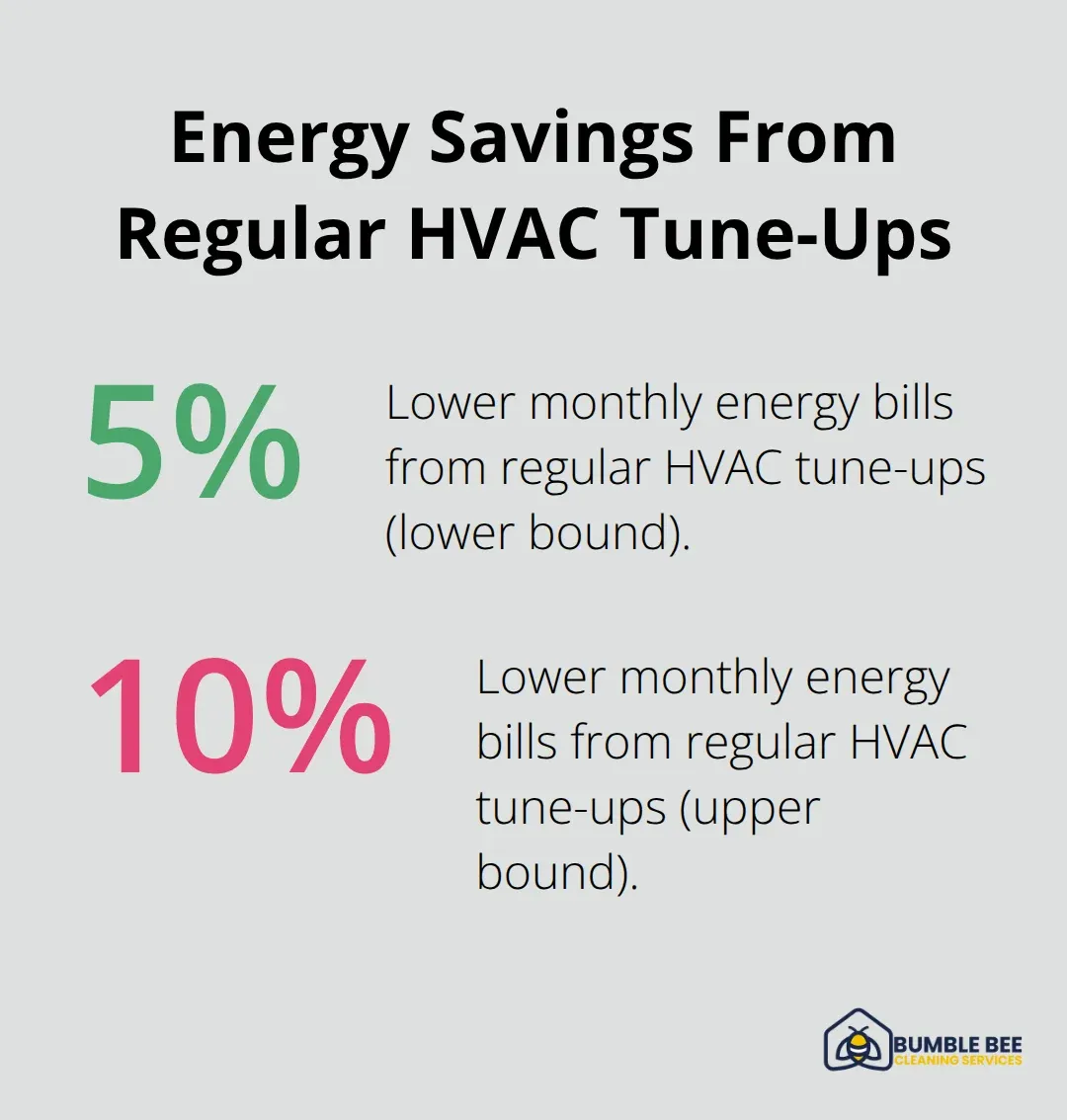
Regular HVAC tune-ups cut monthly energy bills by 5 to 10 percent because clean coils, proper airflow, and balanced thermostats let systems operate at near-original efficiency. Your commercial heating and cooling accounts for one of the largest energy drains in any Seattle facility, so even modest improvements compound into serious annual savings.
A tune-up includes cleaning coils, tightening electrical connections, and checking refrigerant levels, all of which restore the system’s ability to reach desired temperatures faster and maintain consistent performance. Lubricated components reduce wear and the risk of overheating, which also cuts energy waste. Well-maintained systems reach target temperatures faster and cycle less frequently, lowering your utility invoices month after month without any reduction in comfort or productivity.
Why Most Seattle Businesses Miss These Savings
Facility managers often view maintenance as a line item to cut rather than an investment that pays dividends. The upfront cost of tune-ups feels painful until you compare it against emergency repair bills and equipment replacement expenses. Many businesses operate in crisis mode, responding to failures instead of preventing them-a costly habit that compounds year after year. Once you shift to a proactive approach, the financial picture changes dramatically. The next section walks you through the specific areas where your Seattle business can capture the biggest savings with a focused maintenance strategy.
Where Your Seattle Business Saves the Most Money
HVAC Systems Drive the Biggest Savings
HVAC systems dominate facility budgets because they run year-round in Seattle’s climate. A commercial HVAC tune-up costs between $200 and $500 but prevents emergency repairs that run $2,000 to $5,000 when compressors fail or refrigerant leaks occur during peak heating or cooling seasons. The math shifts dramatically when you factor in downtime: a broken system in summer forces customers out, halts productivity, and damages inventory in temperature-sensitive businesses.
Regular maintenance includes cleaning evaporator and condenser coils, inspecting electrical connections, checking refrigerant levels, and lubricating moving parts. These actions restore efficiency lost to dust accumulation and wear, directly cutting your monthly energy spend by 5 to 10 percent. For a 5,000-square-foot Seattle office using standard commercial HVAC, that translates to $300 to $600 in annual energy savings alone. The payback period on a $300 tune-up happens within months, yet most facility managers defer HVAC maintenance until failure forces their hand.
Water Systems Prevent Catastrophic Damage
Water systems present a different but equally costly risk: a single burst pipe floods carpeting, drywall, and equipment within hours. Preventive inspections catch corroded sections, loose connections, and pressure imbalances before rupture occurs. Plumbing maintenance costs roughly $150 to $300 annually for a small commercial building but prevents water damage claims exceeding $10,000 in restoration alone.
Flooring and Surfaces Extend Asset Life
Flooring and surface protection follow the same principle. Regular floor cleaning and sealing extends the life of carpet, tile, and wood by years, deferring replacement costs that run $5 to $15 per square foot. A 2,000-square-foot office spending $2,000 on professional floor maintenance every two years avoids a $20,000 replacement project that would otherwise arrive in year five or six.
Prioritize Based on Building Age and Risk
Seattle businesses operating in older buildings face accelerated wear because aging systems run less efficiently and fail more frequently. Preventive maintenance becomes non-negotiable in structures built before 2000, where HVAC equipment may already be near the 15-year lifespan threshold. A facility manager should prioritize HVAC first because it consumes 40 to 50 percent of commercial energy budgets, followed by plumbing to prevent catastrophic water damage, then flooring to preserve aesthetics and safety.
The specific maintenance frequency depends on building age, occupancy density, and usage intensity: a busy medical office needs more frequent cleaning and system checks than a light-use administrative space. This integrated approach costs less than hiring separate vendors and ensures nothing slips through gaps between service providers. The Seattle business owner who coordinates maintenance across HVAC, plumbing, and surfaces captures savings of 15 to 25 percent annually compared to reactive spending, with the largest gains appearing in year two and beyond as equipment operates longer and energy consumption drops.
Now that you understand where the money goes, the next section shows you how to build a maintenance schedule that fits your budget and prevents these costly failures from happening in the first place.
Build a Maintenance Schedule That Fits Your Budget
The biggest mistake Seattle facility managers make is treating maintenance as something to schedule whenever money appears in the budget. This reactive approach guarantees you’ll pay the 25 to 30 percent premium for emergency repairs and rushed service calls. Instead, map out your maintenance calendar around equipment age and building usage patterns, then stick to it regardless of cash flow fluctuations.
Audit Your Facility’s Critical Systems First
Start with a complete inventory of your building’s major systems. HVAC installed in 2015 needs more frequent attention than a unit from 2022, and a busy medical office demands different maintenance intervals than a quiet administrative space. Document when each major system was installed, review the manufacturer’s recommended service schedule, and cross-reference those dates with your actual building operations.
A 5,000-square-foot Seattle office using HVAC continuously requires quarterly tune-ups, while a lightly occupied space might need only two annual inspections. The key is establishing a calendar that prevents failures, not one that responds to them after they occur.
Partner With Qualified Local Service Providers
Commit to working with qualified local service providers rather than juggling multiple vendors for HVAC, plumbing, flooring care, and janitorial services separately. A single coordinator who understands your building’s specific needs costs less than managing fragmented contracts and prevents critical gaps where problems slip through unnoticed.
When evaluating providers, request references from Seattle businesses similar to yours in size and industry. Ask about their preventive maintenance approach and response time for emergencies, and verify they hold appropriate licenses and insurance. For commercial cleaning services, look for companies that offer comprehensive solutions with certified expertise and proven track records in your area.
Track Maintenance Expenses and Calculate ROI
Document every maintenance expense in a simple spreadsheet: date, service performed, cost, and which system was serviced. This creates a documented history that reveals patterns, justifies budget requests to ownership, and quantifies your actual savings when equipment lasts longer and energy bills drop.
After year one, calculate your ROI by comparing maintenance spending against what you would have spent on emergency repairs, equipment replacement, and energy overages without the plan. Most Seattle businesses discover they spent $3,000 to $5,000 on scheduled maintenance but avoided $8,000 to $15,000 in reactive costs, yielding a 200 to 400 percent return. This documentation becomes your strongest tool for securing ongoing budget approval and expanding your maintenance program across additional facility areas.
Final Thoughts
Regular facility maintenance transforms how Seattle businesses manage costs, and the financial case proves itself within months. Preventive care costs 25 to 30 percent less than emergency repairs, equipment lasts five years longer with proper upkeep, and energy bills drop 5 to 10 percent when systems run efficiently. A Seattle business investing $3,000 to $5,000 annually in scheduled maintenance avoids $8,000 to $15,000 in reactive costs, delivering 200 to 400 percent return on investment.
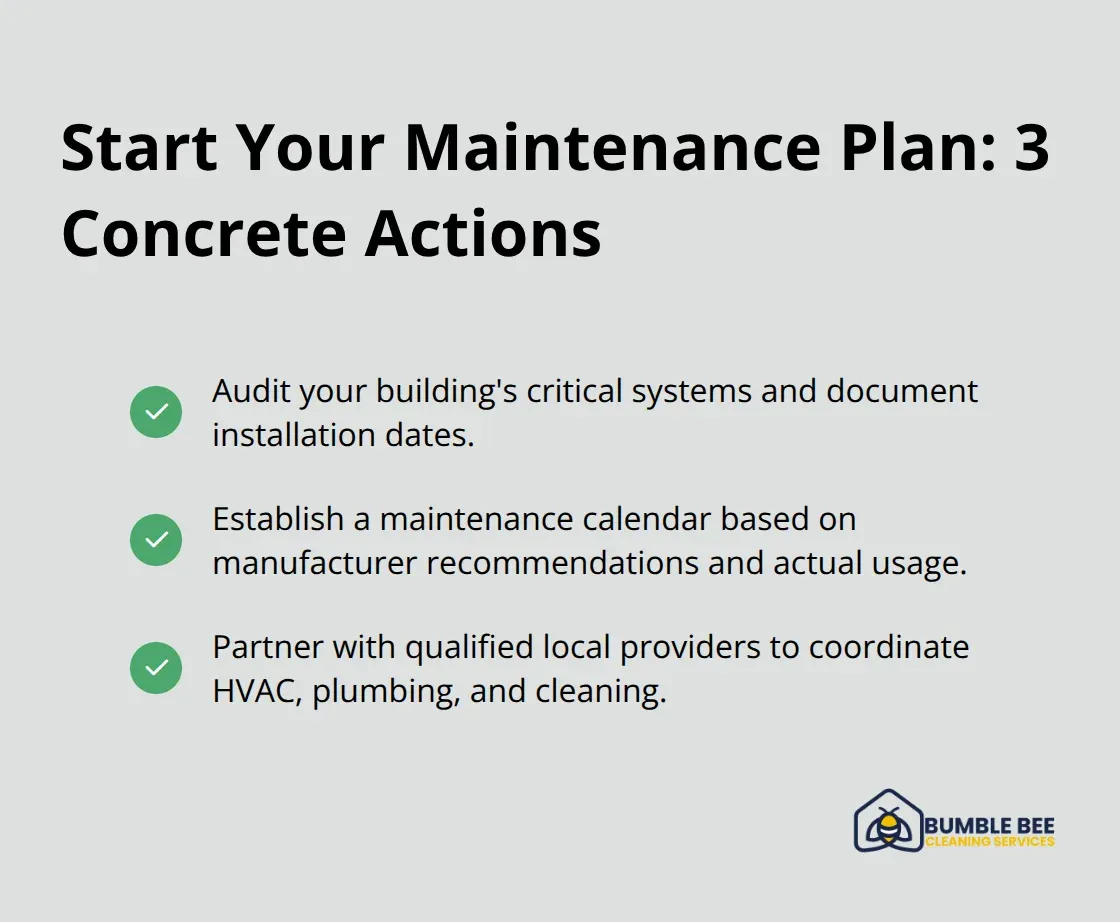
Start your maintenance plan with three concrete actions: audit your building’s critical systems and document installation dates, establish a calendar based on manufacturer recommendations and actual usage patterns, and partner with qualified local providers who coordinate across HVAC, plumbing, and cleaning services. Your HVAC system reaches the 15-year mark instead of failing at ten, your plumbing stays intact instead of flooding your space, and your flooring lasts twice as long before replacement becomes necessary.
These compounding benefits free capital for growth instead of draining it into crisis management.
We at Bumble Bee Cleaning Services understand that facility maintenance extends beyond HVAC and plumbing-it includes the cleaning and surface protection that preserve your building’s condition and occupant health. Our team specializes in recurring commercial cleaning, deep cleaning, and post-construction cleaning with eco-friendly products and a 100 percent quality guarantee. Contact Bumble Bee Cleaning Services to integrate professional cleaning into your maintenance strategy and capture the full spectrum of cost savings your Seattle business deserves.
For more information about our cleaning services in Seattle and Atlanta, or to request a cleaning quote, call or text us at 425-786-1360 or email us at info@qbclean.com
