
Many Seattle business owners assume their cleaning routines meet commercial standards. The reality is that janitorial compliance gaps often go unnoticed until an inspection reveals problems.
At Bumble Bee Cleaning Services, we’ve seen firsthand how businesses miss critical requirements around health codes, OSHA regulations, and industry certifications. This post walks you through what standards actually apply to your business and where you’re likely falling short.
What Standards Actually Apply to Your Seattle Business
Washington State and OSHA Requirements
Washington State and OSHA regulations form the foundation of commercial cleaning compliance, but many Seattle business owners misunderstand which rules apply to their specific operation. Washington State Health Department requirements vary significantly by industry-a medical office faces stricter disinfection mandates than a retail storefront, yet both must meet baseline sanitation standards. OSHA’s updated disinfection guidelines require higher frequency of cleaning and disinfection, especially on high-touch surfaces, with common areas treated at least daily.
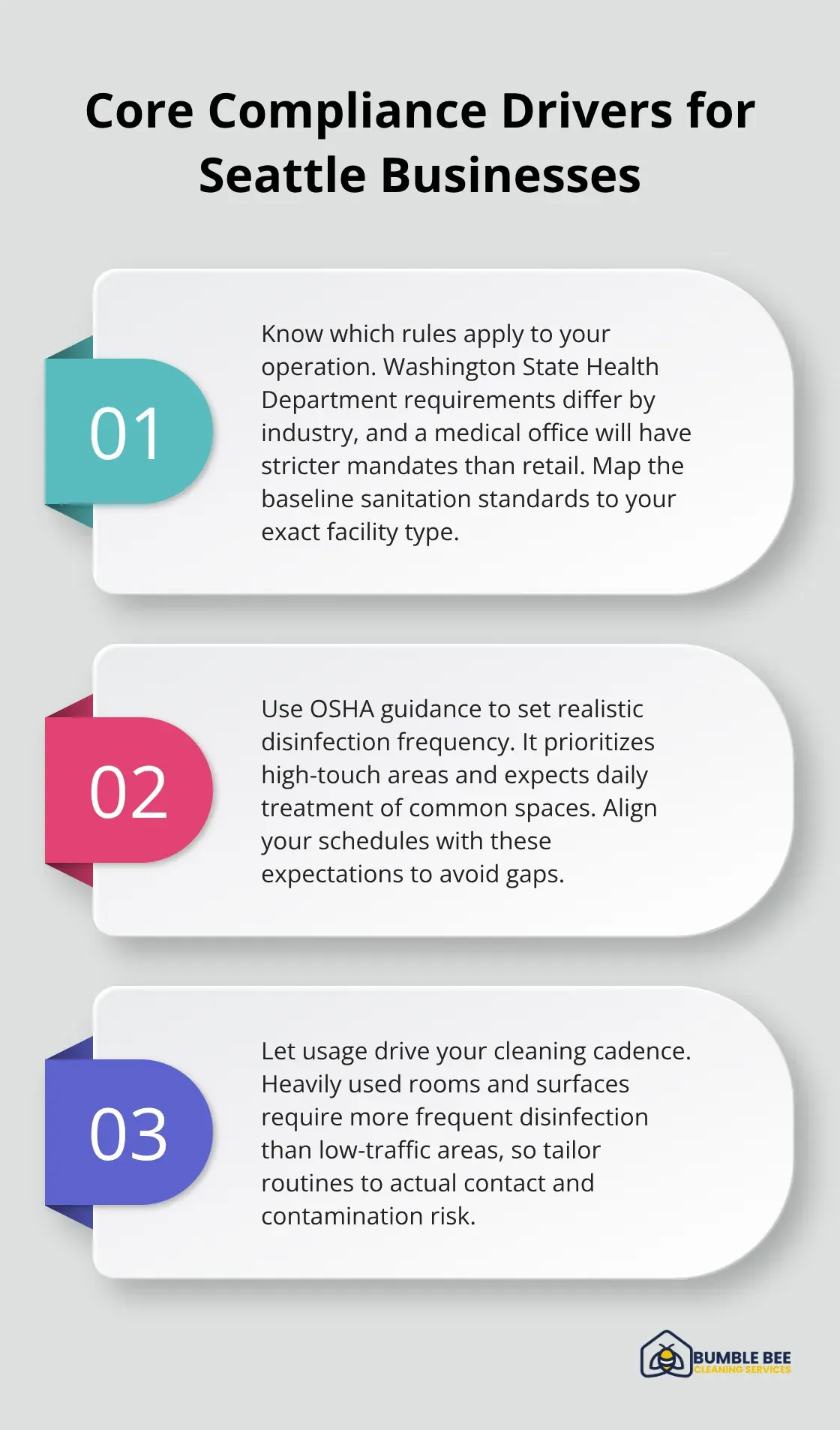
High-risk industries including healthcare, food processing, and hospitality face more stringent, industry-specific disinfection protocols. OSHA doesn’t prescribe one-size-fits-all cleaning schedules; instead, disinfection frequency should be guided by how often surfaces are used and the potential for contamination. This means a tech company’s conference room needs different treatment than a medical clinic’s waiting area.
Selecting the Right Disinfectants
EPA-approved disinfectants proven effective against COVID-19 and other pathogens must be used, and you must follow the manufacturer’s instructions for concentration, contact time, and application method to ensure effectiveness. Many Seattle businesses fail here by using household cleaners or applying disinfectants incorrectly, rendering them ineffective. Ventilation is critical during disinfection; use mechanical ventilation to circulate fresh air and reduce residual chemical exposure.
Many Seattle facilities overlook indoor air quality monitoring during disinfection processes, which can actually harm employee health. Employees have the Right to Know about chemical hazards; ensure access to safety information and clear reporting channels.
The ISSA Clean Standard Framework
Industry certifications provide a measurable framework that transcends vague compliance language. The ISSA Clean Standard for Institutional & Commercial Facilities uses a Clean, Measure, Monitor framework combining ATP testing with audits to objectively assess cleaning effectiveness. This standard defines acceptable ATP ranges and identifies high-touch areas, helping you benchmark your cleaning program against national standards.
Rather than guessing whether your office is clean enough, ATP testing gives you quantifiable data. The standard doesn’t prescribe specific products or procedures; it’s non-prescriptive and flexible, integrating with other frameworks like CIMS and CIMS-Green Building. Practical tools include audit forms and customizable templates for recordkeeping.
Documentation and Compliance Records
Documentation matters tremendously during inspections-maintain thorough records of disinfection activities, training, and ATP test results to demonstrate your commitment to compliance and protect your business legally. Common implementation challenges include resource constraints, keeping protocols updated, and staff training turnover. Many Seattle businesses face these obstacles and benefit from outsourcing to professional cleaners who maintain these standards consistently.
The question isn’t whether your business can meet these standards alone-it’s whether you have the systems and expertise to sustain them. Understanding what applies to your operation is the first step; identifying where you actually fall short requires a closer look at your daily practices.
Where Seattle Businesses Lose Ground on Cleaning Standards
High-Touch Surfaces Demand Targeted Disinfection
Most Seattle business owners focus on visible cleanliness-swept floors and wiped desks-while overlooking the surfaces that actually spread contamination. Germs survive on hard surfaces for up to 48 hours according to CDC data, which means your daily wiping routine misses critical points. High-touch surfaces like door handles, light switches, keyboards, phones, and elevator buttons require disinfection multiple times per day, not just once. These surfaces demand targeted attention rather than routine cleaning.
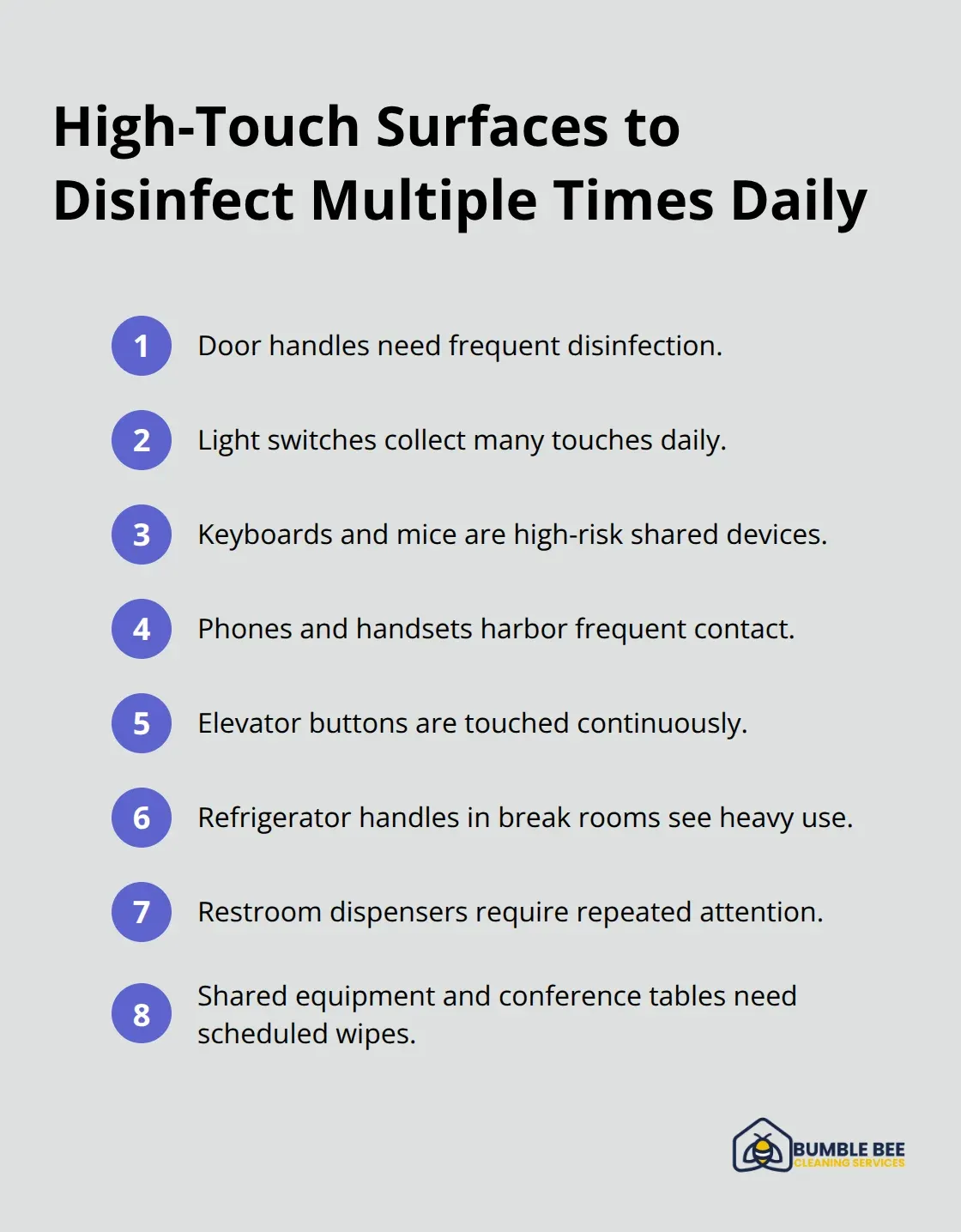
The gap exists because high-touch contamination points aren’t always obvious. Conference room tables, refrigerator handles, restroom dispensers, and shared equipment get touched by dozens of people daily but rarely receive the hospital-grade disinfectant treatment they need. Your staff might clean these areas with general-purpose cleaner, which removes visible dirt but leaves pathogens intact. The solution requires identifying every high-touch zone in your facility, then establishing a documented schedule that disinfects these points multiple times daily using EPA-approved products applied for the correct contact time.
Restroom and Break Room Sanitation Failures
Restrooms and break rooms represent another major compliance failure point. These spaces concentrate biological contamination and create slip hazards that expose your business to liability claims. Restroom floors need daily mopping with appropriate products to prevent falls, yet many Seattle facilities mop only weekly or use water alone without disinfectant. Break rooms accumulate food residue, spills, and cross-contamination in refrigerators and on countertops where employees prepare meals-areas that demand daily sanitization but often receive only surface-level attention.
Floor Care and Slip Prevention
Floor care extends beyond restrooms; high-traffic areas like lobbies and hallways develop grime buildup that reduces traction and signals poor maintenance to clients and employees alike. Princeton University research links clutter and poor maintenance to reduced focus and cognitive overload, meaning your floor conditions directly affect employee productivity. Hard floors require sweeping or vacuuming before mopping to prevent dirt from spreading, then mopping with disinfectant appropriate to the surface type. Carpet areas need regular vacuuming with HEPA-rated equipment to capture fine particles and improve indoor air quality.
Creating Accountability Through Documentation
Conduct a facility walk-through identifying every restroom, break room, and high-traffic floor area, then assign specific daily disinfection tasks with documented completion times. Without this structure, these spaces become compliance weak points that inspectors immediately flag. Documentation creates accountability and provides evidence that your business takes standards seriously. The next step involves measuring whether your current practices actually meet industry benchmarks-a process that reveals exactly where your operation stands against national standards.
Auditing Your Cleaning Practices Against Real Standards
Start with ISSA Audit Forms and Facility Walkthroughs
The ISSA Clean Standard audit forms provide ready-made checklists specifically designed for commercial facilities. These forms identify high-touch surfaces, restroom requirements, and floor care standards that match what inspectors actually look for. Download the template, walk through your facility with a clipboard, and honestly mark which areas receive daily disinfection, weekly deep cleaning, and monthly maintenance. This isn’t about guessing your compliance level-it’s about documenting exactly what happens each day.
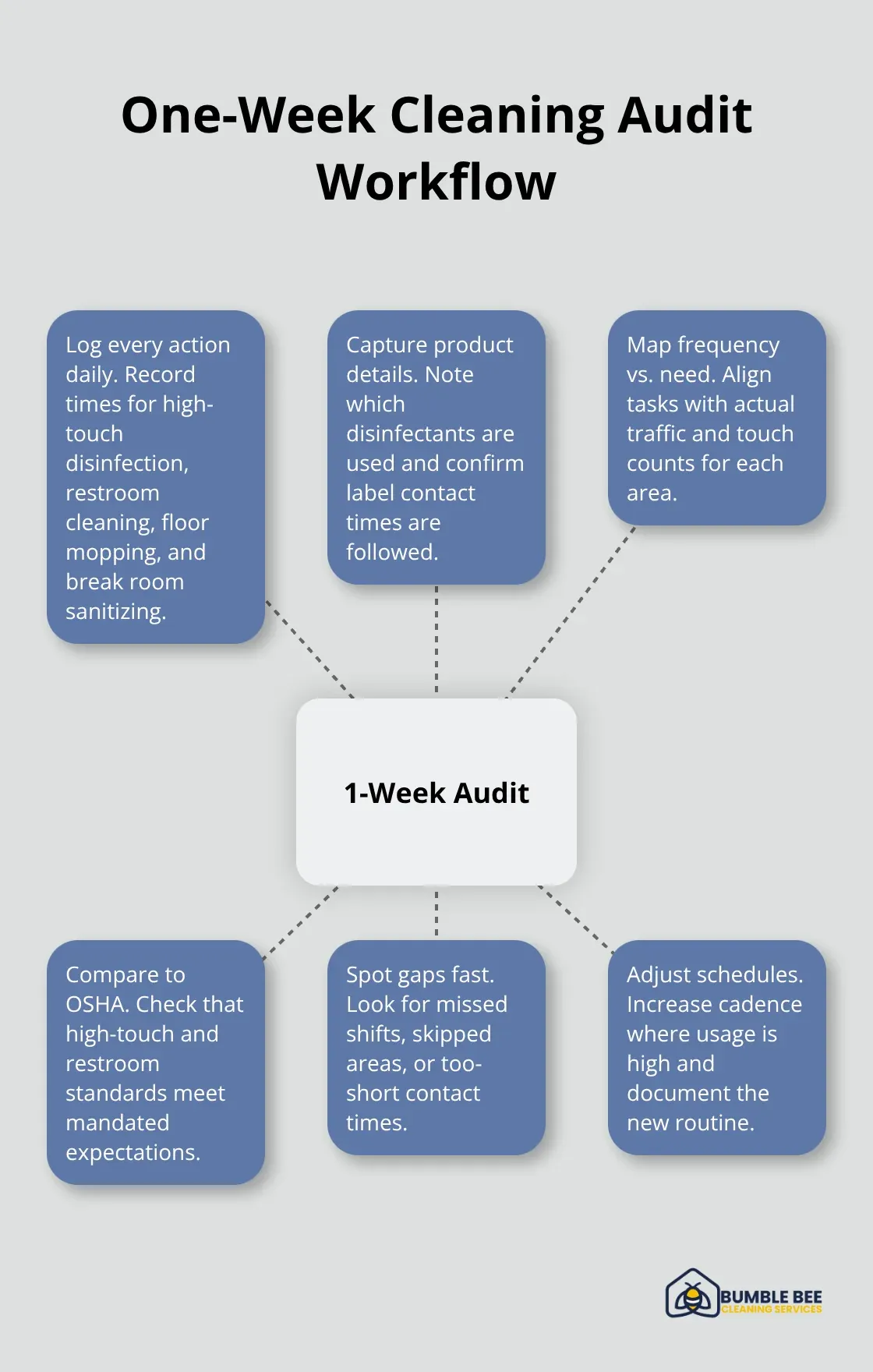
Note the specific disinfectants your staff uses, the contact time they apply them for, and whether they follow manufacturer instructions. Most Seattle businesses discover their staff uses generic surface cleaners instead of EPA-approved disinfectants, applies products for 30 seconds when the label requires 10 minutes, or skips restrooms entirely on certain days. Write down these failures without judgment; the goal is identifying what needs to change.
Track Actual Cleaning Activities for One Week
Establish a frequency audit by tracking actual cleaning activities for one full week. Have your staff record when they disinfect high-touch surfaces, mop floors, clean restrooms, and sanitize break rooms. Compare this against OSHA requirements, which mandate high-touch surface disinfection and restroom sanitation. The gap often reveals itself immediately-your team might clean restrooms once per day when your facility’s traffic patterns demand twice-daily service, or they might wipe door handles once in the morning and never again.
Calculate Traffic Patterns and Adjust Frequency
Calculate how many people touch each high-touch surface daily and adjust your disinfection frequency accordingly. A medical office entrance receives far more traffic than a back office hallway, so it needs more frequent attention. Document these findings in a spreadsheet showing current frequency versus required frequency for each area. This creates a visual map of your compliance gaps and tells you exactly where to focus improvements.
Share Results with Your Team
Share these results with your team so they understand why the new standards matter-compliance becomes real when staff sees the data showing they’ve been missing critical disinfection points. Your team members need to grasp that high-touch surfaces in restrooms, break rooms, and common areas (door handles, light switches, refrigerator handles) demand multiple daily treatments with EPA-approved disinfectants applied for the correct contact time. When staff understands the science behind these requirements, they execute protocols more consistently and catch gaps before inspectors do.
Final Thoughts
Meeting commercial cleaning standards protects your Seattle business from regulatory fines, liability claims, and the hidden costs of employee illness and turnover. The CDC estimates workplace illnesses and absenteeism cost U.S. employers over $225 billion annually, roughly $1,685 per employee. A single janitorial compliance gap discovered during an inspection can trigger penalties and damage your reputation far more than investing in proper cleaning standards upfront.
Your next step depends on your current situation. If your audit revealed minor gaps, assign specific staff members to execute the documented disinfection schedule you created and track completion daily. If your team lacks the expertise or capacity to sustain these standards consistently, outsourcing to a professional cleaning service eliminates the burden of training, scheduling, and compliance documentation while guaranteeing results.
We at Bumble Bee Cleaning Services deliver commercial cleaning solutions that meet and exceed these standards across Seattle. Contact Bumble Bee Cleaning Services to design a customized program that fits your budget and keeps your business compliant year-round.
For more information about our cleaning services in Seattle and Atlanta, or to request a cleaning quote, call or text us at 425-786-1360 or email us at info@qbclean.com
